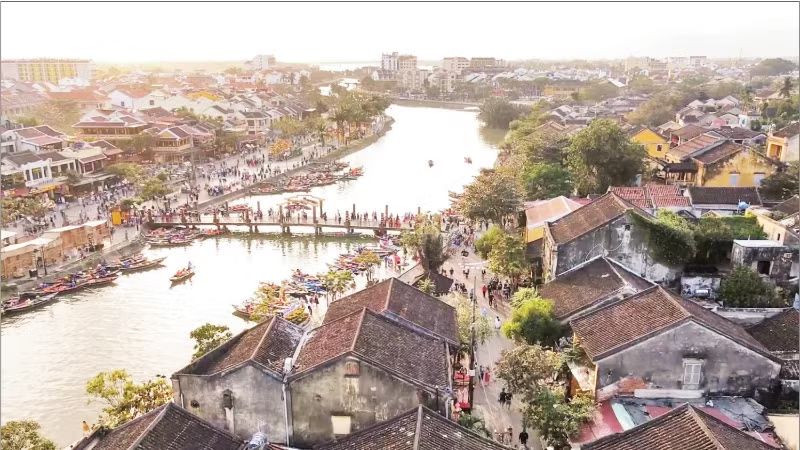
An aerial view of Hoi An's old town.
The value of the Hoi An Ancient Town World Heritage Site is not limited to the old town's residential areas but extends to surrounding areas such as Tra Que vegetable village, Thanh Ha pottery village, Kim Bong carpentry village, and the Cu Lao Cham World Biosphere Reserve… After the implementation of a two-tiered local government model, many previously standardized regulations for the entire town are no longer suitable, leading to overlapping management, preservation, and development of the heritage.
Overlapping management of historical sites
According to statistics from the Hoi An World Cultural Heritage Conservation Center, the old Hoi An has 1,439 relics, encompassing various types such as archaeological sites, architectural and artistic sites, revolutionary historical sites, and scenic spots. Specifically, Zone I of the Hoi An Old Town currently has a total of 1,194 relics, including: 37 relics in the Special Group; 95 relics in Group I; 220 relics in Group II; 339 relics in Group III; and the remainder in Group IV, which includes both jointly owned and privately owned relics.
Following the administrative reorganization, the city of Hoi An, in the former Quang Nam province, was divided into the following wards: Hoi An, Hoi An Dong, Hoi An Tay, and the island commune of Tan Hiep. Based on the demarcation of administrative boundaries, the system of historical sites, while unchanged, was divided into different management areas. Hoi An ward, established by reorganizing the Minh An, Cam Pho, Son Phong, Cam Nam, and Cam Kim wards of the former Hoi An city, currently covers an area of 10.81 km², has a population of over 37,000 people, and plays a central role in the Hoi An heritage urban space, thus possessing the largest number of historical sites.
The value of the Hoi An Ancient Town World Cultural Heritage site is not limited to the rows of houses in the old town but extends to surrounding areas such as Tra Que vegetable village, Thanh Ha pottery village, Kim Bong carpentry village, and the Cu Lao Cham World Biosphere Reserve…
According to Nguyen Duc Binh, Secretary of the Hoi An Ward Party Committee, the major difficulty currently is the overlap and conflict of functions, tasks, authority, and responsibilities between the Hoi An World Cultural Heritage Conservation Center and the Hoi An Ward People's Committee. The Center performs specialized tasks related to heritage conservation and management, while the Ward People's Committee is responsible for comprehensive state management within the ward. The lack of a sufficiently strong and clear coordination mechanism sometimes leads to fragmented, slow, and confused handling of tasks.
“Some issues fall under the administrative management of the ward but are heavily impacted by specialized regulations on conservation; other issues fall under the conservation field but arise directly in the lives of residents, businesses, and urban order, so people first report them to the ward government. If these issues are not resolved, responsibility will be divided, violations will not be dealt with promptly, and people will not know which agency has the authority,” Comrade Nguyen Duc Binh stated.
Furthermore, Hoi An Old Town is unique as a "living heritage." The people who live, work, and conduct business in these ancient houses have created the "soul" of the place. However, many households still live within the state-managed historical sites. Relocating and resettling these households faces many difficulties due to the lack of a proper mechanism.
For example, the family of Mr. Hua Van Loc, born in 1960, lives in Nghia Tu historical site, also known as the Temple of the Departed Souls, located at 76/9A Tran Phu Street, An Dinh Ward, within the Level I protected area of Hoi An Old Town. Mr. Loc said that since 1975, generations of his family have lived in Nghia Tu historical site to take care of ancestral worship. Because this is a state-managed historical site, his family has not been granted a land ownership certificate.
"Currently, the historical site is in serious disrepair and is very prone to collapse. Due to my financial situation and health issues, my family hopes to receive support in finding a new place to settle down and stabilize our lives," Mr. Loc shared.
The Party Secretary of Hoi An ward, Nguyen Duc Binh, added: “Since the two-level local government came into operation, Hoi An ward has also reviewed and planned resettlement arrangements to relocate households from state-managed historical sites to ensure better living conditions as well as the restoration, preservation, management, and protection of the sites. However, this issue is beyond the authority of the local government. Moreover, Hoi An is a central ward, so the land available for resettlement is insufficient. Therefore, the local government requests the Central Government and Da Nang city to study a special mechanism for the management, preservation, and development of the world heritage urban area that is suitable for the new model.”
A comprehensive study is needed.
Prior to the merger, Hoi An city consistently led in tourism brand value within the former Quang Nam province and had won numerous international awards. However, the current management landscape presents many challenges for the operation and preservation of the core heritage area and surrounding regions.
Hoi An is a heritage city, but its value is not concentrated solely within the old town area; it extends to the entire ecological, cultural, and marine environment.
Nguyen Hung, Secretary of the Party Committee of Hoi An Dong Ward
According to Nguyen Hung, Secretary of the Party Committee of Hoi An Dong ward, Hoi An is a heritage city, but its value is not concentrated only in the old town area but is spread throughout the entire ecological, cultural, and marine space.
Sharing the same view, Comrade Nguyen Duc Binh suggested that it is necessary to strengthen regional linkages in Hoi An based on the concept of "one space - many products - many destinations - one common brand". Hoi An ward plays the role of the heritage core; Hoi An Dong ward develops the coastal area and resort services; Hoi An Tay ward develops urban services, traditional crafts, and ecological agriculture; and Tan Hiep island commune develops marine and island ecotourism and preserves Cu Lao Cham. Based on this, the city will form interconnected tourism routes.
Recently, at a working session on economic development orientation and implementation of the general planning for the communes and wards of Hoi An, Hoi An Dong, Hoi An Tay, and Tan Hiep, Vice Chairman of the Da Nang City People's Committee Le Quang Nam requested that the localities develop the heritage city of Hoi An in harmony with its inherent characteristic landscape; and anticipate the impacts of climate change, living needs, tourist density, etc.
The city has instructed local authorities to urgently develop and complete the master plan, and based on that, to create detailed zoning plans. The master plan must ensure overall coherence, connectivity, and the formation of a multi-core, multi-layered, multi-tiered, and multi-centered urban area to maximize the advantages of the entire heritage region.
LE ANH QUAN and DO VAN
Source: https://nhandan.vn/can-co-che-dac-thu-cho-do-thi-co-hoi-an-post963928.html







![[Photo] General Secretary and President To Lam receives Amazon's Senior Vice President David Zapolsky](https://vphoto.vietnam.vn/thumb/1200x675/vietnam/resource/IMAGE/2026/05/22/1779466547770_a1-bnd-3513-6601-jpg.webp)
















































































Comment (0)