

Only within such a broad perspective can preservation efforts transcend the limitations of simply preserving bricks and stones, becoming a journey to restore the spatial memory of an entire dynasty.
The Vāstu Puruṣa Maṇḍala diagram and the agro-urban “giant” Indrapura
The Dong Duong Buddhist monastery – a crucial religious center of the Indrapura dynasty – once functioned as a sacred "superstructure," not only shaping religious life but also affirming the geopolitical position of the Champa kingdom in the region.
In 875, King Indravarman II established the Indrapura center of power in the Amaravati region, marking a major turning point in Champa history: the close integration of divine and royal power. Unlike the dispersed structure of the My Son valley, the Dong Duong Buddhist monastery was planned from the outset as a large Mahayana-Tantric Buddhist monastery with a unified and synchronized "superstructure".
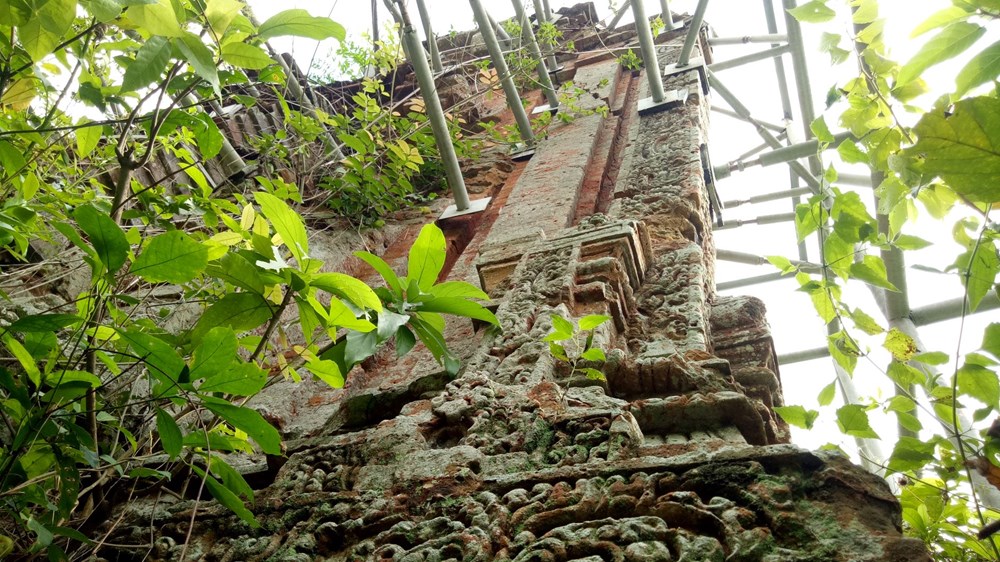
Through the veneration of the Bodhisattva Lakṣmīndra Lokeśvara, the king deified his power, transforming the entire architectural space into a symbol of sacred authority and salvific ideals. The artistic value of Đồng Dương lies not only in its brick construction techniques but also in its distinctive system of gray-blue sandstone sculptures, creating a rare visual depth and mystical aura. It is from this that the famous "Đồng Dương Style" in Champa art, rich in expression and full of inner strength, was formed.
From the perspective of Vāstu Śāstra, a Hindu and Buddhist architectural ideology, Đồng Dương demonstrates a very unique spatial organization. The traditional mandala is extended along a West-East axis for over 1,300m, transforming the space from a static contemplative model into a dynamic "mandala," serving the ceremonial movements of the royal family and clergy.
Each layer of walls, each architectural level, serves as a threshold for spiritual transformation, guiding people from the mundane world gradually towards the center of enlightenment.
On a broader scale, Dong Duong is not just a single monastery but the center of a low-density "agri-urban" structure, closely integrated with the hydrological and agricultural systems. In Professor Roland Fletcher's view, this is a kind of "anomalous giant"—an urban model spread across a large area but operating in harmony with the natural environment.
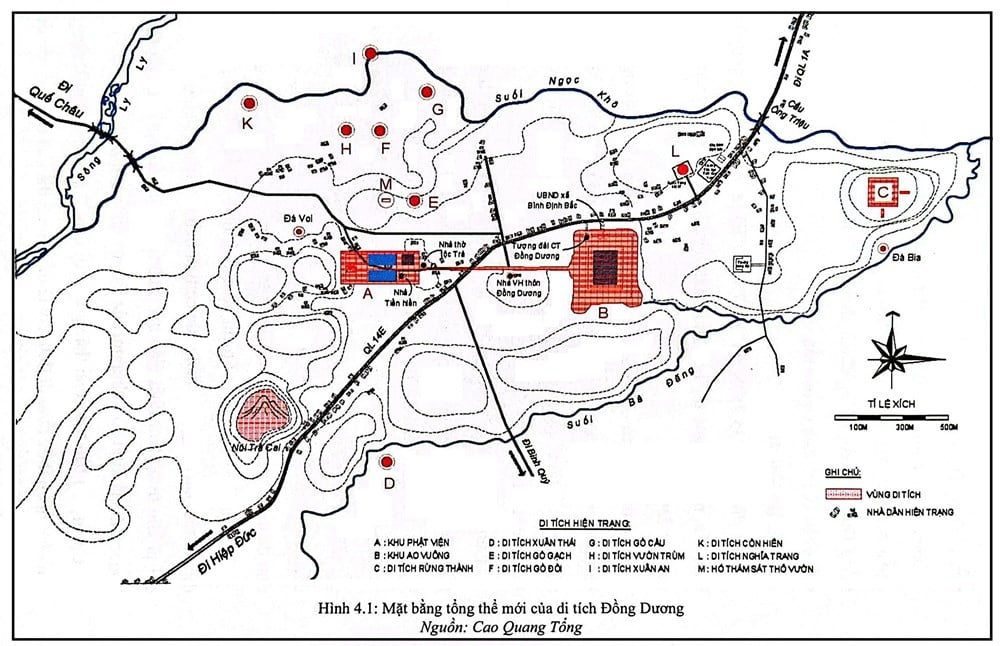
Field surveys and aerial photographic comparisons reveal that around the core of Dong Duong there are numerous satellite points such as Go Gach, Con Hien, Go Cau, Go Doi, along with the Baray square pond system and auxiliary temples.
All of this is closely linked to the network of rice paddies, suggesting that Dong Duong was once a center for coordinating resources and territory for the Indrapura dynasty. If this buffer zone continues to be neglected, the ecosystem and hydrological foundation of the site will face damage that is difficult to recover from.
The paradox of 5.3 hectares and biological "hydraulic wedges" is destroying heritage sites.
Despite once being a major center of a kingdom, Dong Duong today is confined to a protected area of only about 5.3 hectares. This "fencing-based" approach has inadvertently fragmented the heritage space, isolating the Tower of Light from its entire historical context and disrupting its original ceremonial network.
When detached from its original frame of reference, heritage gradually loses its cultural depth and becomes vulnerable to the expanding pressures of modern life. More worryingly, the greatest harmful agents today come not only from humans but also from the surrounding biological environment.
The acacia forests covering the area are acting as natural "hydraulic wedges." The deep root systems of this industrial tree species continuously erode the soil layers, disrupting the structure of Cham bricks and ancient sandstone peatstones lying underground.
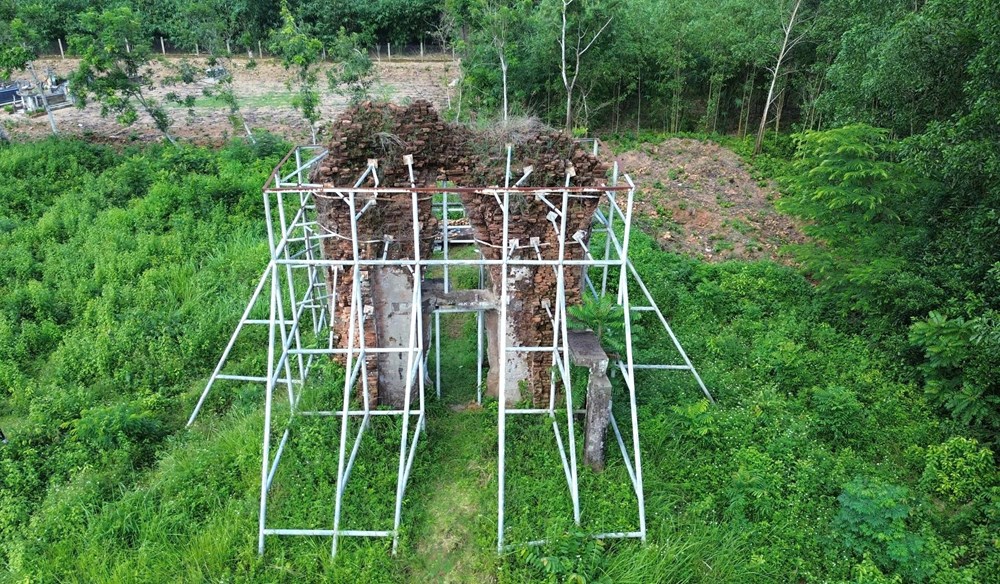
Meanwhile, the Tower of Light – one of the few remaining relics on the surface – is suffering from multiple forms of deterioration simultaneously: foundation subsidence, efflorescence of the bricks, and increasing structural fragmentation. All of this puts the structure at risk of serious deterioration.

Establishing a "technological shield" and the vision for the National Archaeological Park.
To save Dong Duong, it is necessary to quickly shift to a modern conservation model that combines high technology and contemporary archaeological principles.
First and foremost is the anti-anastylosis philosophy – prioritizing the preservation of monuments in situ rather than hypothetical reconstructions. This approach focuses on stabilizing the status quo with mild and controlled solutions, avoiding the creation of scientifically unfounded reconstructions.
Alongside this is the application of remote sensing technologies such as LiDAR and InSAR. LiDAR allows scanning through vegetation to reconstruct terrain and identify traces of buried structures. InSAR can monitor extremely small deformations of structures, helping to provide early warning of the risk of subsidence or structural instability.
At the materials level, nano-lime technology is also essential. Nanoparticles have the ability to penetrate deep into ancient bricks, recrystallizing into calcium carbonate, strengthening the structure while preserving the natural "breathing" ability of the ancient material.
Most importantly, the way heritage space is managed needs to change. Dong Duong needs to be defined as a complete "archaeological territory," aiming towards the model of a National Archaeological Park.
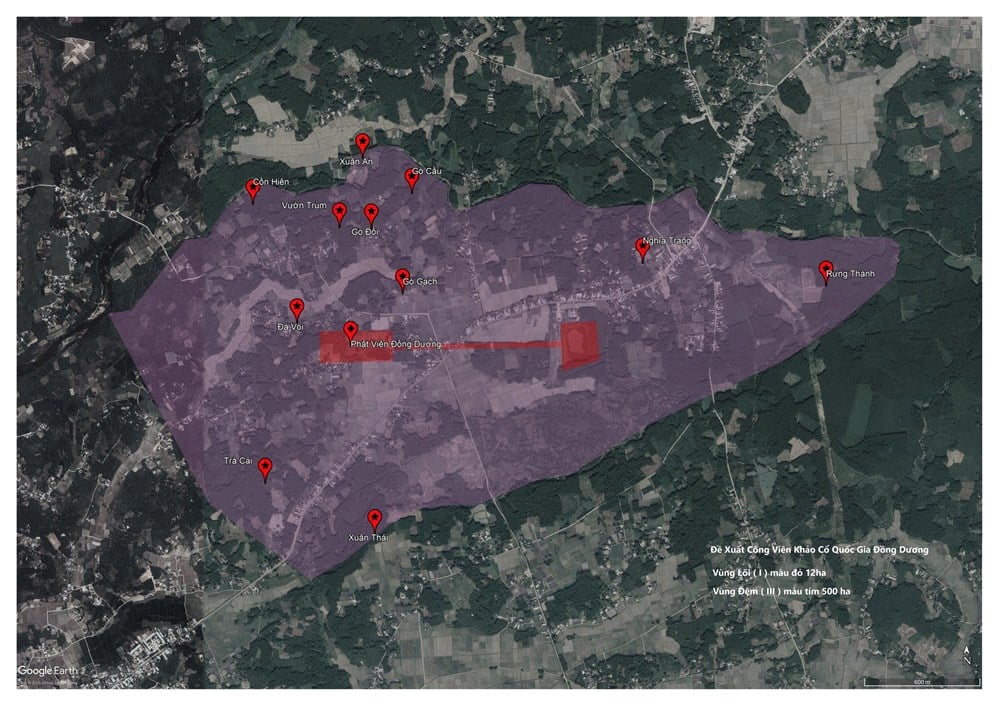
According to this plan, the space needs to be organized into three main zones. Within these, the core zone, covering approximately 12 hectares, will be under absolute protection, focusing on restoring the 1,300-meter-long "Sacred Path," expanding the space towards Baray Square Pond, and removing encroaching elements such as acacia forests.
The satellite corridor area is where preventive archaeology is applied to protect archaeological mounds such as Xuan An, Go Cau, Vuon Trum, Go Doi, Go Gach, Con Hien, and Da Voi from the threat of agricultural and construction activities that could destroy the cultural layers.
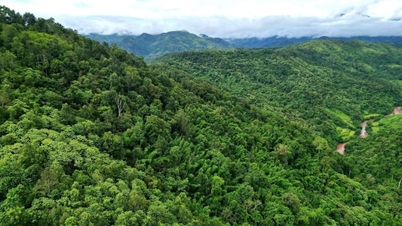
A large-scale ecological buffer zone of 500 hectares, based on natural elements such as the Ly Ly River, Tra Cai Mountain, and the Ngoc Kho and Ba Dang stream systems around the area, aims to maintain the ancient topography, hydrology, and drainage capacity.
This is a crucial shift: from viewing heritage as a single landmark to recognizing it as a "functioning landscape" capable of self-adaptation and recovery.
The revival of Dong Duong is inseparable from the larger cultural triangle of Champa in the Amaravati region: My Son – Tra Kieu – Dong Duong. If My Son was a spiritual sanctuary and Tra Kieu a secular center, then Dong Duong played a special role as a royal Buddhist center – a place where political power and religious life intersected.
Therefore, the revival of Dong Duong should not be merely a physical restoration project, but should become a broad socio-cultural program. The key element is the local community. When people become active participants in protecting, interpreting, and operating the heritage space, they will create a more sustainable "social shield" than any administrative measure.
From a cultural experience perspective, the restoration of the "Sacred Path" will open up the possibility of recreating ancient rituals such as circumambulating (pradakṣiṇa) around sandstone stupas and altars. When these rituals are revived, Dong Duong will no longer be a "static site," but a vibrant living space where the memory of Champa civilization continues to be present in contemporary life.


An epic poem on stone about the life of Buddha.
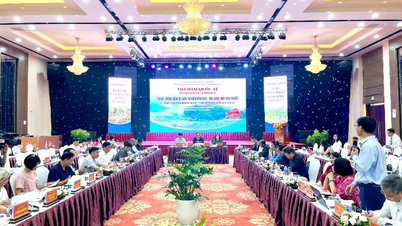
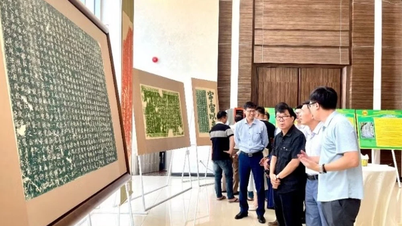
In order to systematize, supplement, and update scientific documents, and at the same time comprehensively assess the cultural heritage value of Dong Duong Buddhist Monastery and propose directions for preserving and promoting the value of the relic in the current context, on May 15th, the Da Nang City People's Committee, in coordination with the Executive Council of the Vietnam Buddhist Sangha; the Ministry of Culture, Sports and Tourism; the Ministry of Ethnic Minorities and Religions; and the Vietnam Academy of Social Sciences, organized the scientific conference "Research on the Preservation and Promotion of the Cultural Heritage Value of Dong Duong Buddhist Monastery".
The seminar focused on clarifying and deepening discussions on several key issues. Firstly, regarding the history of the formation and development of Champa Buddhism in general and the Dong Duong Buddhist monastery in particular, especially assessing the role and influence of the monastery on the ideology, political, social, cultural, and religious life of the Champa Kingdom.
Secondly, to deepen the historical and contemporary values of the Dong Duong Buddhist Monastery, especially its ideological, spiritual, ethical, architectural, sculptural, and aesthetic values through its architectural works, statues, and reliefs, in order to affirm the value of "Champa art" in general and "Dong Duong style" and "Dong Duong art" in particular.
Thirdly, implementing policies and solutions to preserve and effectively promote the cultural heritage of Dong Duong Buddhist Monastery in the current context contributes to socio-economic development, especially in the fields of moral and spiritual education, tourism, and academic research, etc.
Specifically, the focus is on proposing appropriate and feasible recommendations and solutions for the government and specialized agencies in carrying out the task of preserving and promoting the cultural heritage value of the Dong Duong Buddhist Monastery, a special national historical site.
In particular, identifying the overall planning space and orientation, applying scientific and technological solutions, and building a digital database are crucial for the restoration and recreation of the Dong Duong Buddhist monastery, in order to preserve and promote this unique cultural heritage in the digital environment.
Source: https://baovanhoa.vn/van-hoa/tu-tu-duy-hang-rao-den-chien-luoc-hoi-sinh-lanh-tho-thieng-230552.html

































![[Video] Sunset at Lap An Lagoon – Where the sun sets over the fishing nets](https://vphoto.vietnam.vn/thumb/1200x675/vietnam/resource/IMAGE/2026/05/31/1780192137701_beach-landscape-sea-water-nature-grass-745871-pxhere-com.jpeg)



























Comment (0)