

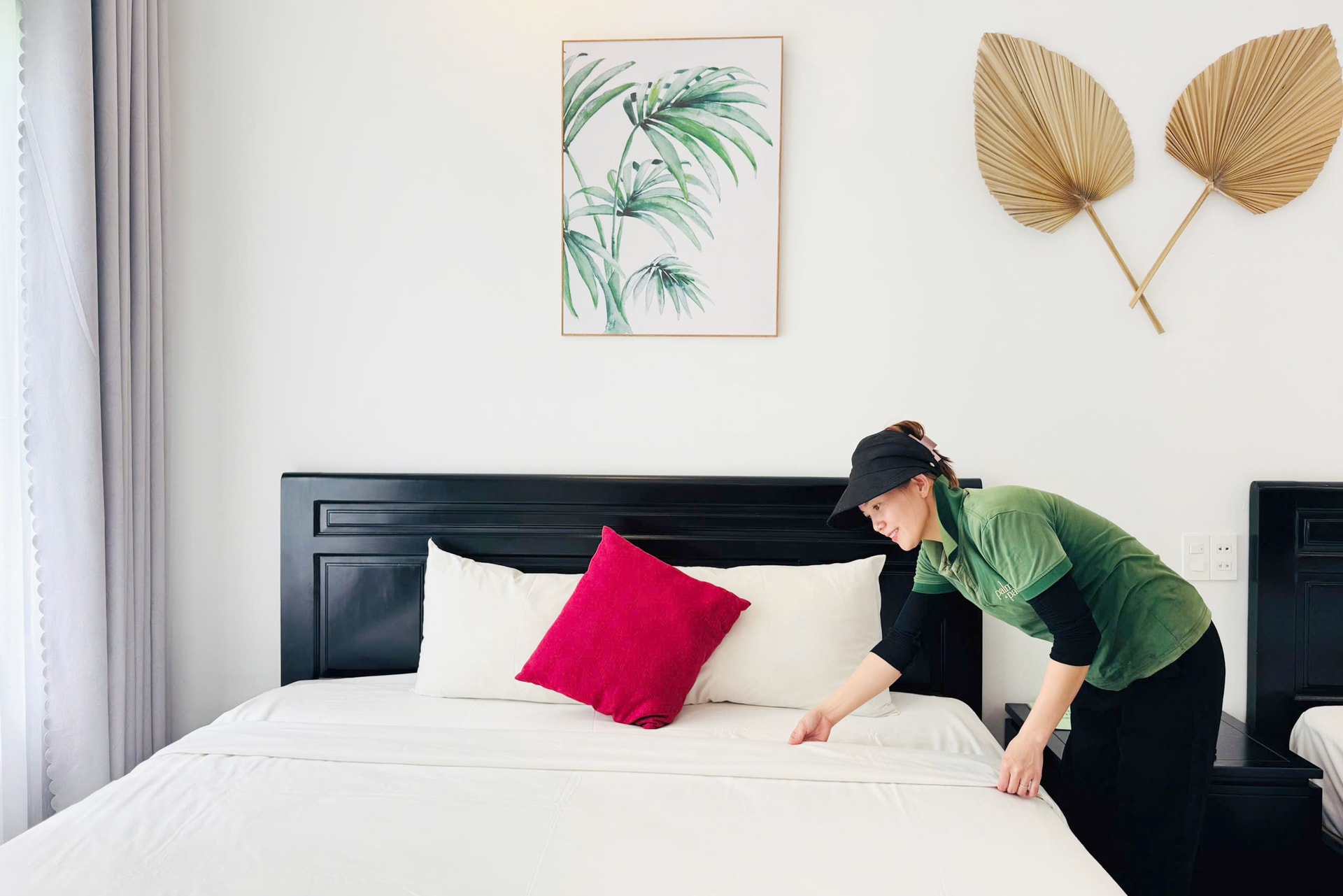
The tourism industry doesn't stop during office hours; as long as there are customers, there's work. The vibrancy of the city brings income and opportunities, but behind it all are late nights, delayed meals, and the worry of young children waiting for their mothers... These are the silent pressures that many women in the service industry have to bear.
A life without a fixed schedule.
Ms. Ho Thi An (born in 1992) has been working as a housekeeper since 2022, after a period of unemployment due to the pandemic. Before that, she worked as a factory worker, earning a steady income but not enough to support her family with two young children. When tourism gradually recovered, she applied for a job at a villa near her home that caters to foreign guests. From managing 4 rooms in her early days as an apprentice, she now manages 10 rooms per shift.
The official working hours are from 7:30 AM to 4:00 PM. In reality, it depends entirely on the guest schedule. On days when guests check out after 12:30 PM, the cleaning work is concentrated in the afternoon, taking about 30 minutes per single room and nearly an hour for a double room. She changes the linens, cleans, checks the items, and pays attention to every small detail to be ready for the next guests.
“Some days, customers check out late, so I work non-stop until late evening. By the time I get home, it’s pitch dark, and I don’t have time to pick up my children. I’m exhausted, but I still have to prepare meals and check their homework. My two children are young, one in second grade and the other in kindergarten, so I requested to work the day shift. Many other women have to work the night shift, which is much harder. A stable income helps ease the financial burden on my family, but during holidays and Tet (Lunar New Year), the pressure increases significantly; there are many customers, but the housework remains the same,” said Ms. An.
At another point in the service chain, Ms. Dao Thi Ngoc Thanh (born in 1987), owner of Myhome Hoi An restaurant in Tra Que vegetable village, operates at a similar pace. Running a service business means that weekends, summer holidays, and Tet (Lunar New Year) are peak times. Her house is a short distance from the restaurant, and she usually returns home after 11 PM each evening after cleaning up.
"It's nice when there are many customers because it brings in revenue, but it also brings pressure on costs, staff, and ingredients. There are days when my children are off school, but I'm busier than usual. Sometimes I get home when my children are already asleep, and the feeling of not having enough time for my family just lingers," Ms. Thanh shared.
According to tourism industry statistics, women account for more than half of the total workforce in the accommodation, restaurant, and travel sectors. In tourist cities, this percentage is even higher. They contribute to maintaining the rhythm of hotels, restaurants, and tours, but behind the scenes, meals, homework, and household chores still await them. This irregular lifestyle has become commonplace, demanding both physical and mental endurance.
The supporting ecosystem still has gaps.
With jobs operating on a shift-based and seasonal basis, the public service system primarily operates during regular business hours. Most public kindergens close in the late afternoon, with few offering evening or weekend childcare. For workers like Ms. An, childcare often depends on grandparents or relatives. "My family's support allows me to go to work with peace of mind. Without someone to help, I probably wouldn't be able to stay in this profession long-term," Ms. An admitted.

The pressure on women working in the tourism industry isn't just about time constraints. Ms. Ho Thi Phuong Thao (born in 1993), a tour guide at Ba Na Hills tourist area, said that her job gives her many experiences and a sense of pride in introducing local culture and people to tourists. However, on weekends and holidays, when friends gather, she often follows the tour group from early morning until late at night.
“My husband and I are both tour guides, so having children is always a difficult decision. If we had a child, I would need to take a few years off to care for her. When I return, the market would have changed, the customers would be different, the products would be different, and I would have to learn everything from scratch. Thinking about that makes me feel pressured. Sometimes I wonder if I'm capable of balancing my job as a tour guide and being a mother,” Thao said.
The mental health of female workers in the service industry is rarely addressed directly. They need to maintain a professional image and a positive attitude towards customers, while simultaneously worrying about income, family, and their future. The decision to have children is therefore linked to multiple layers of thought, such as career disruption, reduced income, and the possibility of returning to the labor market.
Based on this reality, many opinions suggest that businesses need to be more flexible in scheduling shifts, prioritize female workers with young children, organize regular health check-ups, and create an environment for open discussion about work pressure. Local authorities could study the model of after-hours childcare in areas with a concentration of accommodation facilities, restaurants, and tourist areas, while also considering policies to support workers on night shifts. In each family, sharing household chores from husbands and relatives is an important factor in helping women reduce their burden.
Tourism continues to expand the development space for service-oriented cities. For this growth to be sustainable, we need to look directly at the lives of the women who are contributing to keeping the industry running, so that they can work with peace of mind and return home feeling supported, instead of having to shoulder two heavy responsibilities alone.
Source: https://baodanang.vn/ganh-nang-kep-cua-phu-nu-3326987.html



































































































Comment (0)