

Located on Dat Do Mountain – a low mountain nestled amidst the fields of An Dao village, Tinh Long commune – the shrine dedicated to the God of Agriculture consists of two shrines, known by locals as the Ông shrine and the Bà shrine. The Ông shrine is smaller than the Bà shrine. In front of each shrine is a screen carved with the image of a seated tiger. This is a decorative motif found in ancient structures.
One of the two ancient shrines at the Thần Nông shrine site, in An Đạo village, Tịnh Long commune ( Quảng Ngãi city). |
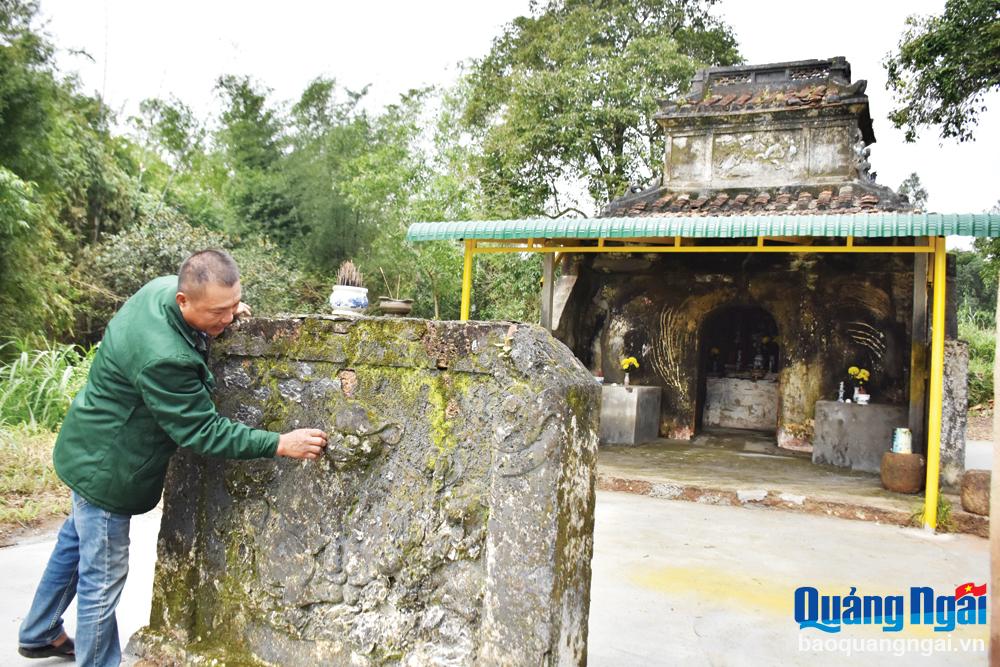
According to local people, the shrine dedicated to the God of Agriculture was built at least 200 years ago to worship a couple who contributed to the development and cultivation of farmland in the former Gia Dao village (now An Dao hamlet). During the war against the Americans, the shrine was partially destroyed by bombs. However, the people quickly restored the shrine and continued to worship and offer incense.
To express their gratitude and appreciation to those who contributed to the expansion of agricultural land, the people of An Dao village regularly hold a ceremony to worship the God of Agriculture at the temple on the 25th day of the 12th lunar month every year. On this day, nearly 300 people from An Dao village gather at the temple to offer prayers and incense at the shrines dedicated to the God of Agriculture and the Goddess of Agriculture. The ceremony is held from 10 to 11 a.m. The offerings to the God of Agriculture are usually chickens or pigs, depending on the villagers' financial situation each year.
Inside the temple, the intricately carved wooden altar is in a state of disrepair. |

Unlike other shrines dedicated to the God of Agriculture (most of which are single shrines), this shrine is a double shrine, built by the ancients from laterite stone and large-sized bricks. |

For hundreds of years, the rituals have been performed by the villagers with utmost reverence. Members of the ceremonial committee and the ritual committee of the temple are nominated annually by the villagers through discussions. Those chosen for the ceremonial committee and ritual committee are people of high prestige. “Every year, the villagers meet to elect the head of the ritual committee. The head of the ritual committee is responsible for overseeing the temple and preparing for the worship of the God of Agriculture on the 25th day of the 12th lunar month. From our ancestors to the present day, whoever is chosen as the head of the ritual committee considers it a great responsibility and also a source of pride and honor for themselves and their families,” shared Mr. Nguyen Tri, who was recently elected by the villagers of An Dao as the head of the ritual committee of the God of Agriculture temple in the year of the Snake (2015).
Over centuries, the tradition of worshipping the God of Agriculture and the temple's relics have been preserved by the people of An Dao village in turns. However, the villagers are worried about the temple's gradual deterioration. Around the temple, the fence, carved with dragons playing in the clouds and made from large bricks and lime mortar, now only has its pillars and dragon heads remaining. The tiger figures, sculpted with lime mortar on the two screens in front of the temples of the God and Goddess, are peeling and distorted. The elaborate decorative patterns, made from seashells and blue-glazed pottery shards, are also covered in thick moss. Inside the temple, the couplets and decorative patterns are also gradually deforming.
The tiger figures, sculpted with lime mortar on the two screens in front of the Ông and Bà temples, are peeling and becoming distorted. |

The centuries-old temple is deteriorating day by day, but strangely, the large bricks that the ancients used to build the temple are still bright red as new, completely free of moss. This characteristic is quite similar to the type of bricks that the ancient Cham people used to build their towers. “After the temple was partially damaged by war, the villagers collected the intact laterite stones and bricks from the ruins to rebuild it. Among them, several dozen bricks were used to reinforce the roof, and a few others were left in the temple grounds. However, decades have passed since then, but these bricks are still bright red as new,” recounted Mr. Truong The Day (65 years old), from An Dao village.
Inside the temple, the intricately carved wooden altar is in a state of disrepair. |

To protect the deteriorating monument, local residents have contributed labor and resources to build a corrugated iron roof to cover the front of the monument and used cement to fill in some cracks. However, this method has not preserved the monument in its original state. The people of An Dao village hope that the local government and the cultural sector will pay attention to restoring and renovating the shrine of the God of Agriculture, in order to preserve the cultural beauty associated with the religious life of the people here for generations.
Text and photos: Y THU
Source: https://baoquangngai.vn/van-hoa/202503/giu-lay-di-tich-tram-nam-4661a74/

![[Photo] Prime Minister Pham Minh Chinh receives the Chinese Ambassador to Vietnam](https://vphoto.vietnam.vn/thumb/1200x675/vietnam/resource/IMAGE/2026/04/05/1775397481797_ndo_br_dsc-5512-jpg.webp)

















































Comment (0)