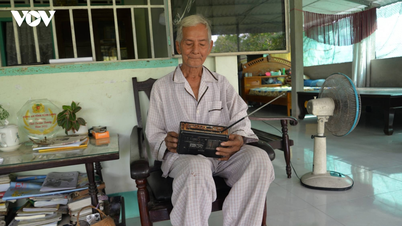
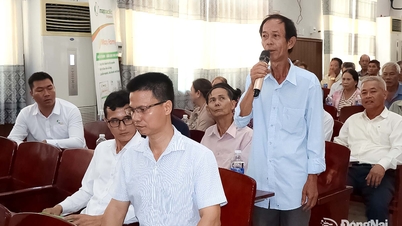
Let sound touch the emotions.
Each segment or program lasts only 15-20 minutes. But to create a complete product, broadcasters must go through many stages—from selecting content, writing scripts, recording, to sound processing. This work takes place quietly behind the studio doors, but it is a crucial link in the journey of delivering news to the public.
Unlike news articles or television programs, radio requires content to be conveyed entirely through voice and sound. Therefore, each piece must be edited before airing to suit the characteristics of spoken journalism.

Ms. Huynh Thi Thuy Duong, a reporter in charge of the radio program on health and children for Tay Ninh Newspaper and Radio & Television, shared: "Not every newspaper article can be broadcast verbatim. We have to edit it to be concise and to the point, while still ensuring the accuracy of the information and suitability for the characteristics of radio broadcasting."
According to Ms. Duong, besides content editing, the audio processing stage also requires a lot of time and creativity. “We have to carefully plan the climaxes and appropriate pauses, while simultaneously incorporating on-location sound, effects, and music to make the program more lively and engaging. To complete a 15-minute radio segment, we usually spend about two hours on post-production,” Ms. Duong said.
Over the years, the "Radio Stories" and "Village Stories" segments of Tay Ninh Newspaper and Radio and Television have become familiar to a large audience. With relatable content that vividly reflects social life, these segments not only convey the Party's guidelines and policies, and the State's laws, but also serve as a bridge between the government and the people.



Regularly at 5:02 AM and 5:30 PM each day, the "Village Stories" program of Tay Ninh Newspaper and Radio and Television brings listeners simple, witty stories full of everyday life.
For dramatized radio programs like "Village Stories," the biggest challenge lies not only in content creation but also in conveying the characters' emotions through their voices. Without visual aids, all events, moods, and messages must be transmitted through dialogue and sound.
According to Ms. Mai, due to the specific nature of the program's personnel, a team member often has to take on multiple roles. "To portray many different voices, we have to listen and observe a lot. From the way elderly people speak, to adults and children, we need to recreate the characters as authentically as possible," Ms. Mai shared.
Beyond its entertainment and educational value, "Village Stories" is also an effective channel for disseminating local policies, guidelines, and current affairs. "In addition to cautionary tales, the program also updates on current events such as the Party Congress, disease prevention and control, and other important political events in the province," added Ms. Mai.
With its relatable, lively, and authentic portrayal of life, "Stories from the Village" has become a familiar source of entertainment for many listeners, contributing to delivering information to the people in a gentle, easily accessible, and effective way.
Broadcasting is "transforming" in the digital age.
In the digital transformation of modern journalism, radio broadcasting is no longer simply a one-way channel for transmitting information via radio waves. The rapid development of technology and digital platforms has changed the way content is produced, distributed, and received by the public.
This places new demands on broadcasters, especially those working in live radio or podcasts, forcing them to constantly innovate to adapt to the multi-platform media environment.
At Tay Ninh Newspaper and Radio & Television, along with maintaining the quality of traditional radio programs, the team of reporters and editors is gradually innovating content and presentation methods to meet the increasingly high demands of listeners in the digital age.


![[Podcast] - Capital City Law 2026: Attracting Strategic Investors](https://vphoto.vietnam.vn/thumb/192x108/vietnam/resource/IMAGE/2026/06/23/1782187473633_thiet-ke-chua-co-ten.png)

According to editor Le Thi Cam Tu, the development of technology has opened up many opportunities but also poses many challenges for those working in radio broadcasting: "The current trend in radio broadcasting is no longer one-way listening as before. The strong development of technological platforms demands that radio content become increasingly dynamic so that listeners can interact directly with the program."
Today's radio programs are also being disseminated across many digital platforms such as Facebook, Zalo, TikTok, and online streaming applications. "When content is delivered across multiple platforms, we must constantly innovate both in content and presentation to make the program more engaging and appealing, thereby reaching a wider audience of different ages and regions," Ms. Tú shared.
Adapting to the digital media environment not only helps radio expand its reach but also allows this long-standing form of journalism to continue to thrive in modern life. With investments in content, technology, and human resources, radio is gradually transforming to meet the increasingly diverse information needs of the public.
Source: https://baotayninh.vn/giu-lua-phat-thanh-giua-thoi-dai-so-149771.html

![[Photo] General Secretary and President To Lam attends the Central Public Security Party Committee Conference](https://vphoto.vietnam.vn/thumb/1200x675/vietnam/resource/IMAGE/2026/06/24/1782302063612_a1-bnd-9302-9166-jpg.webp)
![[Photo] The 13th National Congress of the Youth Union conducts personnel work.](https://vphoto.vietnam.vn/thumb/1200x675/vietnam/resource/IMAGE/2026/06/24/1782299943080_ndo_br_1-6868-jpg.webp)

![[Photo] Opening Ceremony of the 13th National Congress of the Ho Chi Minh Communist Youth Union](https://vphoto.vietnam.vn/thumb/1200x675/vietnam/resource/IMAGE/2026/06/24/1782286753905_ndo_br_1-8510-jpg.webp)