

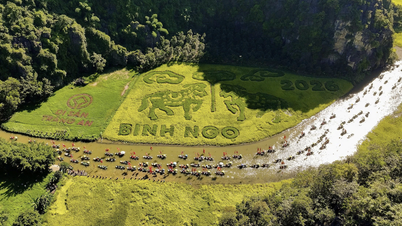
This special event also marks the opening of the "Returning to the Heritage Region - 2026" Festival, a large-scale cultural and tourism series aimed at honoring and spreading the heritage values of the Kinh Bac region.
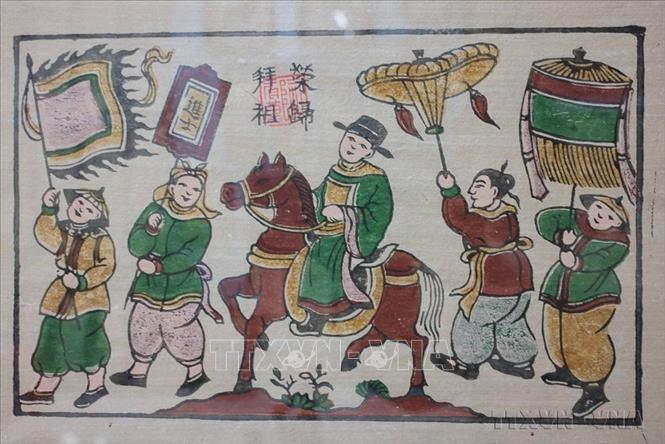
Traditional Dong Ho folk paintings were often produced at the end of the year to serve the decorative and worship needs of Vietnamese families during the Lunar New Year (2025). Photo: Hoang Hieu/TTXVN
Dong Ho paintings: the soul of Vietnam in every brushstroke.
The concise lines, the clear distinction between light and dark; the realistic yet simple imagery; the harmonious composition following enduring folk rules – all contribute to the unique character of Dong Ho folk paintings (Thuan Thanh ward, Bac Ninh province).
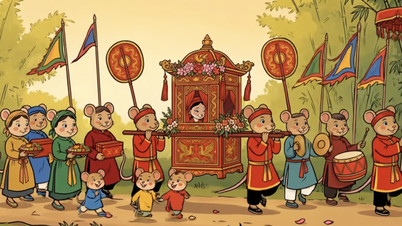
There, the indigenous beauty and cultural essence of Vietnam are preserved and passed down through generations, like a silent but enduring stream in the spiritual life of the Vietnamese people. Dong Ho paintings are, first and foremost, a living cultural space. There, the paintings are not just for viewing, but for hanging in homes during Tet (Lunar New Year), to convey hopes for a prosperous and peaceful new year; not just for preservation, but to tell stories about family, village, people, and nature in a harmonious worldview . Images that seem simple: yin-yang pigs, mother hen and chicks, a baby hugging a chicken, a mouse wedding… are actually profound expressions of the Vietnamese philosophy of life, where happiness is measured by abundance, balance, and harmony.
Not only captivating in its content, Dong Ho paintings are considered by art researchers to be true works of art with their unique color combinations, distinctive printing techniques, and rustic aesthetic, reflecting the beauty of folk songs and poetry. Poet Hoang Cam once wrote: “Dong Ho paintings of chickens and pigs have vibrant lines/The national colors shine brightly on the gilded paper.” It is this “national color” and “gilded paper” that give this style of painting its unique character and, along with other folk painting styles, enrich the treasure trove of Vietnamese art heritage.
Made entirely from natural materials, Dong Ho paintings possess a unique, warm, and intimate color palette that is perhaps exclusive to Vietnam. Using only a few basic colors—black, yellow, red, and blue—artists create incredibly vibrant, harmonious, and distinctive paintings.
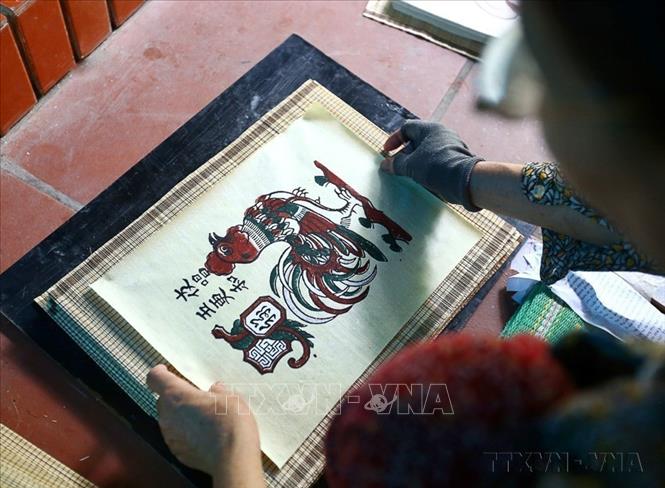
After printing, Dong Ho paintings are removed from the printing plates, glued onto bamboo trays, and then dried in well-ventilated areas. Only when the paintings are dry are the other colors printed. The black outlines are always printed last. Photo: Minh Quyet/TTXVN
The process of producing these paintings involves many stages: creating the design, carving the printing plate, preparing the colors, and printing the painting. All stages of the painting process are done entirely by hand. Therefore, each painting is imbued with the emotions and meticulous care of the artisans.
Creating the design for a Dong Ho painting is quite time-consuming. First, a meaningful subject matter must be selected, with profound content, harmonious colors, a tight composition, and high artistic value. When creating the design, artisans usually use brushes and ink to draw on thin, flat paper, which the woodcarvers then carve according to the design. The creation of the design is not solely the work of individual artisans but is often the collective effort of an entire village, spanning many generations. Therefore, in Dong Ho paintings, there are cases where a single design has many variations, or a single design may have two or three different color arrangements.
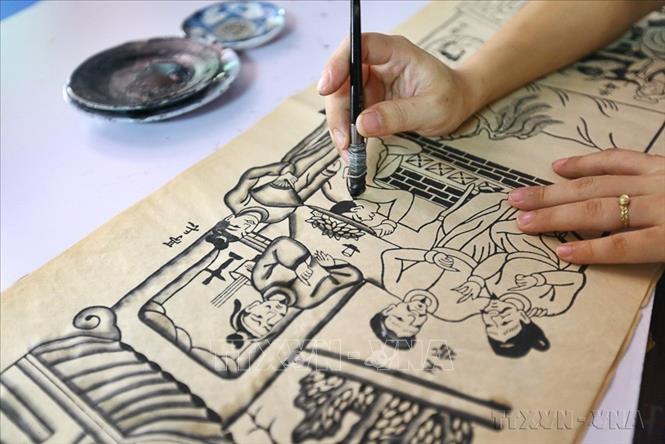
Creating Dong Ho folk paintings is a very time-consuming process. First, one must choose a subject matter with profound meaning and content, harmonious colors, a tight composition, and high artistic value. Photo: Minh Quyet/TTXVN
The finished design is carved onto the printing plate. This step is crucial to the value of the artwork. Typically, each plate can only print one color. Therefore, the number of plates that need to be carved equals the number of colors in the painting. In addition, a line-cutting plate is needed to create a border separating the colors in the painting during printing.
After the woodblock carving is complete, the next step is printing the paintings. The paper used for printing is dó paper (made from the bark of the dó tree), which is porous, soft, thin, durable, and easily absorbs color without smudging. This paper is coated with a layer of hồ điệp (made from crushed seashells) to create a distinctive shimmering effect. Furthermore, the colors used are also a unique aspect of the creative process, exploring, researching, and applying readily available natural materials to the art: blue from indigo leaves, red from cinnabar, yellow from pagoda tree flowers and gardenia fruit, white from weathered seashell powder, black from bamboo leaf ash and sticky rice straw... The color mixing method also depends on weather conditions, paper quality, etc. This is the experience, creativity, and even family secret of each artisan. It is thanks to this meticulous and careful color mixing that Đông Hồ paintings always remain bright, vibrant, and do not fade.
The painting is printed using a reverse-printing method with five primary colors on dó paper that has been coated with a layer of butterfly-shaped ink. The colors are printed according to the principle that red is printed first, followed by blue, yellow, and white. The black outline is printed last to complete the painting.
However, due to changes in lifestyle and tastes, the market for paintings is shrinking, forcing many families to switch professions to make a living, causing this traditional craft to face the risk of disappearing.
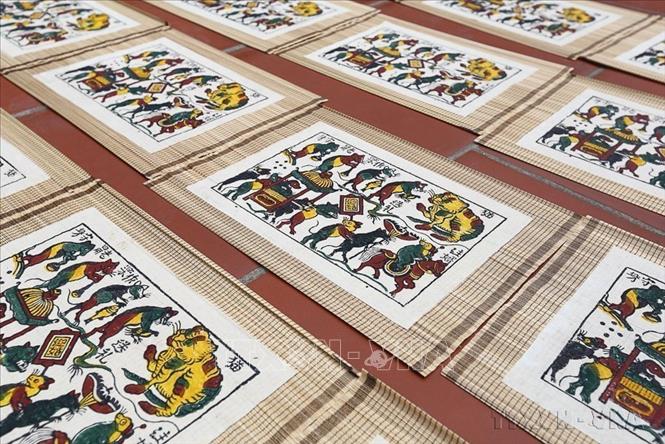
UNESCO has inscribed the Dong Ho folk painting craft on the List of Intangible Cultural Heritage in Need of Urgent Safeguarding. This is the 17th Vietnamese heritage item to be inscribed on UNESCO's Intangible Cultural Heritage Lists. Photo: VNA
In 2013, Dong Ho folk paintings were inscribed as a National Intangible Cultural Heritage and classified as requiring urgent protection. Building on this foundation, conservation and restoration efforts have been gradually implemented, transforming Dong Ho painting village into a cultural tourism destination rich in depth.
In particular, on December 9, 2025, at its 20th session held in India, UNESCO adopted Decision No. 20.COM 7.a.1 inscribing the Dong Ho folk painting craft on the List of Intangible Cultural Heritage in Need of Urgent Safeguarding. This is the 17th Vietnamese heritage item inscribed by this organization, presenting both opportunities and responsibilities in restoring and preserving this unique Vietnamese folk painting tradition.
To ensure that the "national colors" always shine brightly on the gilded paper.
Following its UNESCO recognition, the Dong Ho folk painting craft has entered a new phase, with high expectations for its restoration and sustainable development. According to Deputy Minister of Culture, Sports and Tourism Hoang Dao Cuong, this is a high appreciation from the international community for the unique, historical, and profoundly humanistic values of this painting style, which has been closely associated with Vietnamese cultural life for hundreds of years. The recognition also provides impetus to mobilize resources for the preservation of this heritage, which is facing a high risk of extinction.
According to Deputy Minister Hoang Dao Cuong, key tasks include opening intensive vocational training classes, inventorying and documenting the system of ancient woodblock prints, improving access to natural raw materials, supporting artisans in diversifying products and markets, and integrating heritage into education and cultural tourism activities…
At the local level, Bac Ninh province has implemented many practical action programs to preserve, protect, and promote this unique traditional folk art form. The focus is on strengthening the workforce of artisans, opening training classes for the next generation, restoring the practice spaces, and inventorying and digitizing the woodblock printing system, which is considered a "family heirloom" passed down from generation to generation.
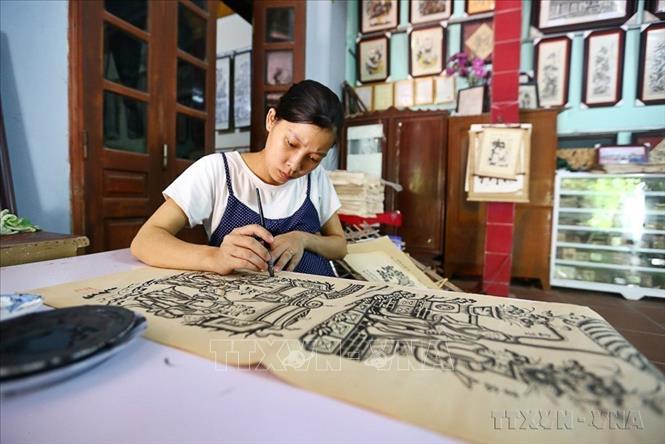
The craft of making folk paintings in Dong Ho village is now only maintained by a few families. Faced with this threat, the issuance of policies and measures to preserve and promote the value of the intangible cultural heritage of Dong Ho folk painting is essential (2019). Photo: Minh Quyet/TTXVN
Promoting and expanding the market, as well as diversifying products, are also identified as important directions for the art of painting to survive based on its own value.
Prior to this, in 2023, Bac Ninh province inaugurated the Dong Ho Folk Painting Conservation Center. This facility is not only a conservation center but also considered a vibrant living museum, preserving and promoting the value of Dong Ho folk painting art.
Since November 2023, the Department of Culture, Sports and Tourism of Bac Ninh province has organized traditional markets recreating the atmosphere of Dong Ho folk painting markets at the Dong Ho Folk Painting Conservation Center. Here, visitors can not only admire and purchase folk paintings but also learn about the craft of painting, from raw materials to the steps involved in creating a finished painting.
In the context of the developing cultural and tourism industries, Dong Ho paintings are being "reimagined" to adapt to the times. Artisans and designers have created many products using Dong Ho painting motifs, such as calendars, notebooks, ao dai (traditional Vietnamese dress), souvenirs, and interior decorations. Familiar motifs like herds of pigs, carp, and roosters are incorporated into graphic design, fashion, and tourist gifts, creating a connection between tradition and modernity. This helps Dong Ho paintings not only survive within the village but also spread widely throughout life.
Cultural tourism is also becoming an important "lever" for reviving the traditional painting village. Every year, tens of thousands of domestic and international tourists visit Dong Ho village, tour the painting workshops, meet artisans, and experience printing paintings. The interest of tourists helps the traditional craft generate additional revenue and provides impetus for development.
Furthermore, many schools and cultural organizations have incorporated Dong Ho paintings into their art education programs. Students learn about the printing techniques, symbolic meanings, and cultural values of each artwork. When love for heritage is passed down through generations, spread throughout the community, and especially among young people, Dong Ho folk paintings will have a solid foundation for sustainable preservation and development in contemporary cultural life.
Diep Ninh/VNA (compiled)
Source: https://baotintuc.vn/van-hoa/giu-mau-dan-toc-บน-tranh-dong-ho-20260327062056865.htm









![[Photo] Vietnam stands out at the World Cultural Festival in Beijing, China](https://vphoto.vietnam.vn/thumb/402x226/vietnam/resource/IMAGE/2026/05/05/1777998195248_a01-20260427101408-jpg.webp)









































































Comment (0)