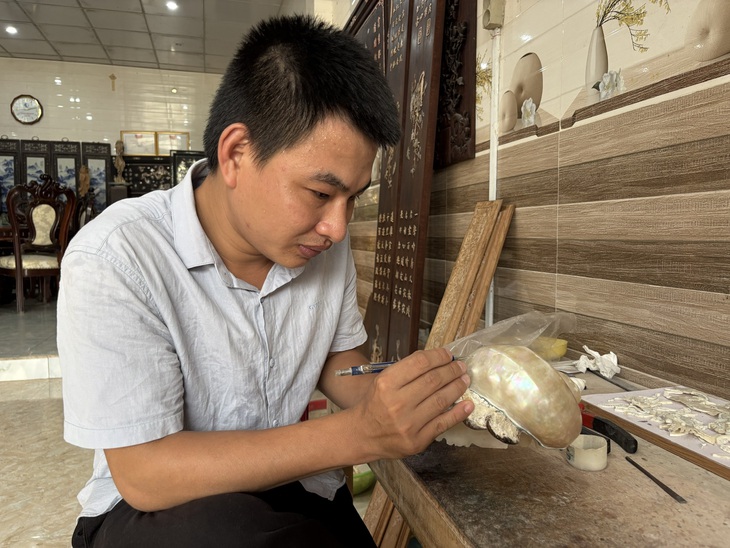
Phan Tan Dat meticulously saws each piece of shell, which is the first step in the mother-of-pearl inlay process - Photo: LINH CHI
Visiting Dat's mother-of-pearl inlay workshop on a rare sunny day in the middle of winter in Hue , the space was bustling with the sounds of drills, chisels, and saws. He was diligently working beside a large wooden board, meticulously assembling each small piece of mother-of-pearl as if piecing together fragments of memories of the ancient capital of Hue.
Preserving the spirit of the past through the skills of young people.
At 33 years old, Dat has spent 21 years dedicated to mother-of-pearl inlaying. For him, it's not just a means of livelihood, but a way to preserve the ancestral spirit amidst the hustle and bustle of modern life where many traditional values are gradually fading away.
Born into a poor family, Dat showed an early love for wood and handicrafts. He remembers that even as a child, he would be captivated whenever he saw people making handicrafts. His passion came about when he accidentally saw a mother-of-pearl inlay craftsman at work. The shimmering mother-of-pearl and the intricate curves captivated him, making him stop and admire them endlessly. Because he loved it so much, he sought to learn the craft.
While working, Dat slowly shared his passion, explaining that the art of mother-of-pearl inlay originated and flourished during the Nguyen Dynasty, closely associated with the imperial spaces of Hue. From screens, antique beds, and tea cabinets to horizontal plaques and couplets... all were decorated with hand-cut and shaped pieces of mother-of-pearl, assembled onto a wooden base to create images of dragons, phoenixes, pine trees, bamboo, chrysanthemums, and plum blossoms—symbols of wealth, nobility, and longevity.
The shells used for inlay must be sea shells harvested from the waters of Khanh Hoa , Phu Quoc, or possibly imported from Singapore or Japan. Some beautiful shells can cost up to several million dong. Dat then showed me a shell worth 6 million dong, its mother-of-pearl shimmering with a bluish-purple hue under the light.
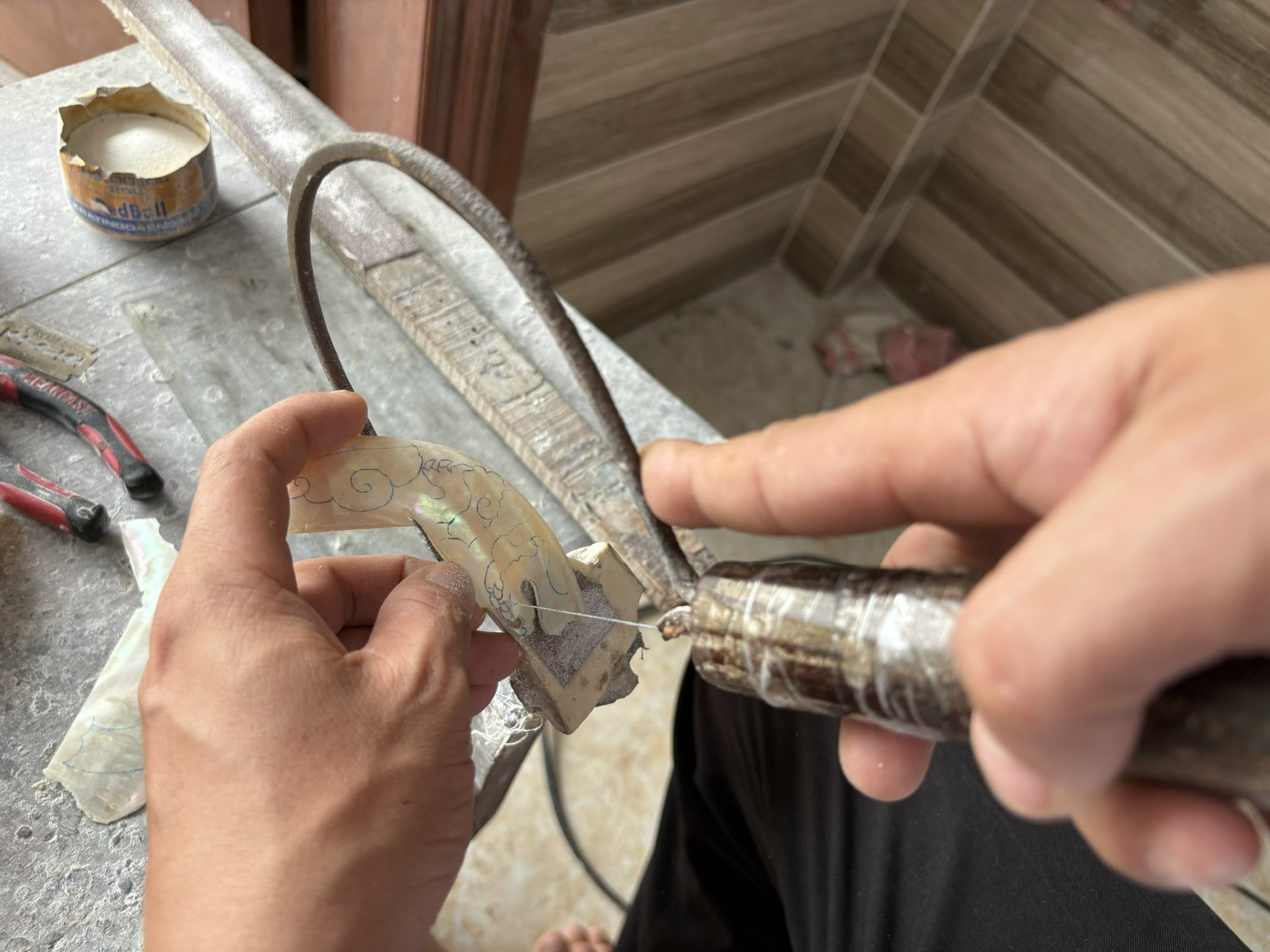
After being hand-polished, the seashells are cut into long strips and then finely chopped to create the desired shapes. The seashell inlay process involves many steps. First, a design is created on paper and the layout is finalized. Next, the design is drawn onto the seashell, the shape is carved, and then the design is engraved into the wood before the seashells are glued in place.
specialized.
Each stage of the process requires a very high degree of precision. Simple products like tea trays, vases, or small paintings take 15-20 days to complete. Larger products such as antique wooden beds, wall paintings, and altars can take half a year, or even several years. Dat said he spent two years working on a nearly 2-meter-tall screen that sold for over 600 million VND.
My greatest fortune was meeting a dedicated mentor. Four years of apprenticeship honed my patience and laid a solid foundation for my dedication to this profession today.
PHAN TAN DAT
The profession may be narrow, but the passion remains wide open.
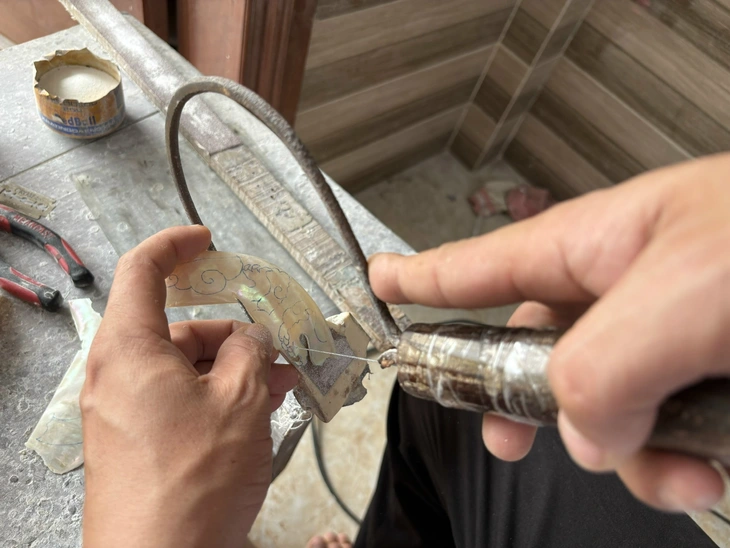
Each step in mother-of-pearl inlay requires high precision and meticulous attention to detail - Photo: L.CHI
With the times changing, many mother-of-pearl inlay workshops are now opting for a modern, minimalist approach to reduce costs. But for Dat, mother-of-pearl inlay must follow the traditional, entirely handcrafted method to ensure the essence of the craft is preserved, even if the price is not cheap.
"The wood can be new, the design can be new, but the style must be traditional, and the product must retain the spirit of those who came before," Dat said.
To do that, he spent a lot of time visiting ancient architectural works and scenic spots inside and outside the imperial city of Hue, studying museum artifacts to understand the composition, lines, and artistic spirit of the past. Because he chose to maintain the traditional methods, it was his way of reading and understanding what the ancients thought and did to create soulful works.
Passionate and articulate about his work, Dat's voice suddenly softened as he admitted the reality that the art of mother-of-pearl inlay is increasingly shrinking.
There are not many young people in Hue still pursuing this profession due to unstable income and precarious work. Furthermore, customers now mainly choose common products because of their low prices, while antique, exquisite products are expensive and appeal to a niche market.
His customers span the entire country and even abroad, people who truly appreciate his mother-of-pearl inlay products crafted on rosewood, ebony, and teak. The young artisan says that for everyone, no matter what profession they pursue, the heart of the craftsman must nurture passion every day.
That passion has helped him persevere in his unconventional path. His efforts were recognized when Phan Tấn Đạt was awarded the title of Hue Artisan in the field of handicrafts for 2025 by the Chairman of the People's Committee of Hue City at the end of December last year.
Participating in restoration work within the Hue Imperial Citadel.
In 2015, at the young age of 23, Dat became one of the rare young artisans selected to directly participate in the restoration of mother-of-pearl inlay details at the Hue Imperial Citadel. From the horizontal plaques at Trieu To Temple, the couplets at Thai Binh Pavilion to the rickshaws at Huu Vu… all bear the mark of this young artisan's hands.
It was also a recognition that most of the artisans participating in this project at that time were veterans in the profession, all in their 40s or 50s. That moment became the motivation for him to continue dedicating himself to the craft.
"Standing inside the imperial palace and looking at the products I helped restore, I felt a surge of pride. I knew I had the opportunity to contribute a small part alongside the artisans in preserving ancient values," Dat shared.
He has passed on his skills to hundreds of apprentices.
He can't remember all of them, but Dat says that over the years he has passed on his skills to more than 100 apprentices, although not all of them have pursued the trade. Some have opened their own workshops, and most of them focus on modern products. He still shares orders with his apprentices who lack work. For orders requiring high technical skills and precision, his apprentices still seek his help.
Currently, Dat's handicraft workshop includes a woodworking workshop, a carving workshop, and a mother-of-pearl inlay workshop. At peak times, it can provide work for about 20 workers, and even during off-peak periods, around a dozen. Besides selling directly at the workshop, Dat also promotes and sells through social media. "It varies, but sometimes we can't keep up with the demand; there's nothing left in the workshop because everything we produce sells out," Dat laughs.
Reishi
Source: https://tuoitre.vn/giu-nghe-kham-oc-xa-cu-20260115220010693.htm






![[Photo] General Secretary and President To Lam receives Amazon's Senior Vice President David Zapolsky](https://vphoto.vietnam.vn/thumb/1200x675/vietnam/resource/IMAGE/2026/05/22/1779466547770_a1-bnd-3513-6601-jpg.webp)













































































Comment (0)