The price of annihilation
From the coastal fields of South Central Vietnam to key swiftlet farming areas, thin nylon nets are still cast every day. Many believe that these are just a few wild birds caught for survival. But for those involved in the swiftlet farming industry, behind each trapped bird are immeasurable losses.
Speaking to Tien Phong newspaper, Mr. Pham Duy Khiem, Vice President and General Secretary of the Vietnam Swiftlet Association, said: "The most worrying thing is not the number of birds caught at any given time, but the long-term consequences for the population's ability to regenerate. Currently, the total swiftlet population in Vietnam is estimated at about 24 million birds with a lifespan of 8 to 12 years. If the number of adult birds is continuously hunted, the supply of young birds will not be sufficient to compensate for the natural aging process of the population," Mr. Khiem analyzed.
According to Mr. Pham Duy Khiem, swiftlets are a species that lives in flocks and has a very strong sense of community. When a few individuals get caught in a net and cry for help, many others often rush to their rescue and end up getting trapped as well. In some cases, just one net can cause damage to an entire flock. This is a major concern for those working in this profession. This worry is even greater when each adult bird dies, meaning the young birds in the nest lose their source of care and risk starvation. These losses are not immediately visible but are silently undermining the swiftlet colony's natural ability to recover.
According to the leaders of the Vietnam Swiftlet Association, the poaching of swiftlets is not a new issue. For many years, some people believed that anyone had the right to exploit wild birds. However, swiftlets are now considered a special resource and are protected by law. Unfortunately, in some areas, this awareness is still not fully realized.
Mr. Pham Duy Khiem believes that some localities still underestimate the issue of swiftlet hunting, leading to the continued existence of bird traps set up for a long time without being thoroughly addressed. “Behind those nets lies the silent demand of the market. Some restaurants and eateries still purchase wild birds under various names, inadvertently creating an outlet for hunting activities,” Mr. Khiem emphasized.


![[Video] Racing against time on the Quy Nhon - Pleiku expressway construction site.](https://vphoto.vietnam.vn/thumb/192x108/vietnam/resource/IMAGE/2026/07/03/1783035287954_dung01-11-46-12still010-png.webp)
The problem of conserving raw materials
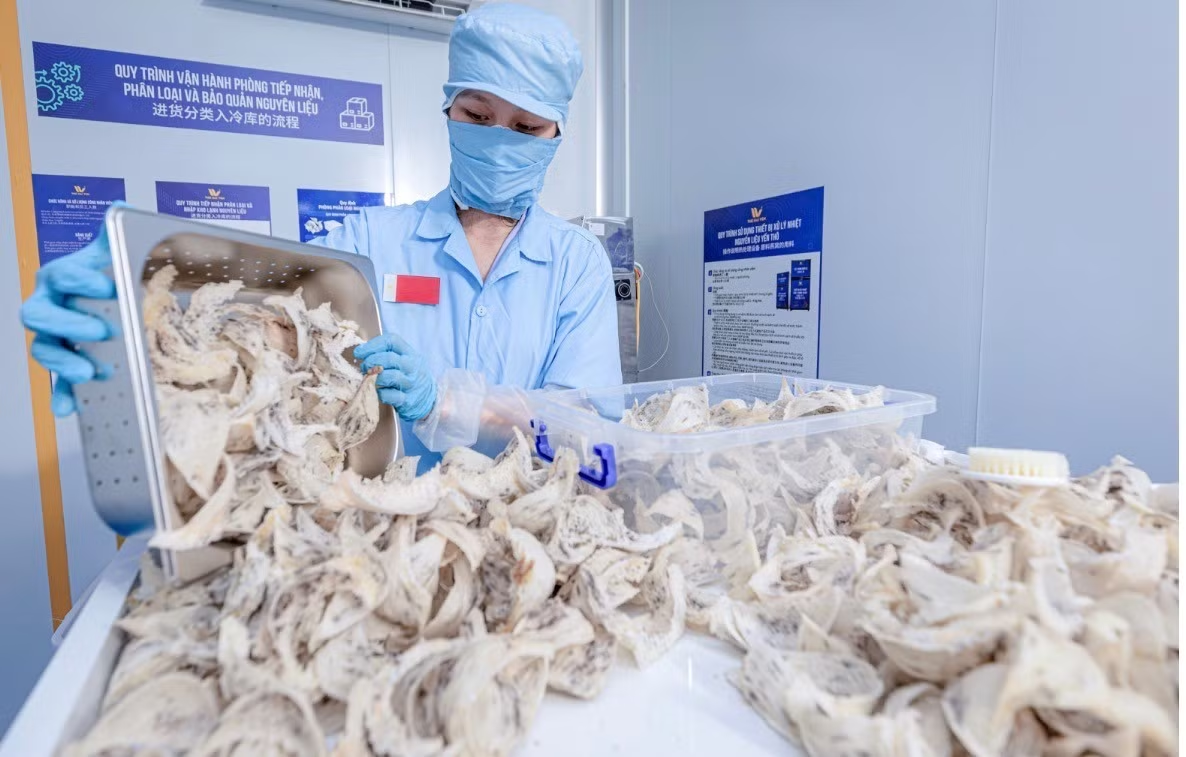
While nets are still present in swiftlet flight paths, Vietnam's swiftlet farming industry is facing an unprecedented opportunity for growth. Following the first official export of swiftlet nests to China in late 2023, Vietnam continues to open its doors to more demanding markets.
Ms. Tran Thanh Hai, Director of Hai Yen Nha Trang Company, said: "At the end of 2023, the company was the first to export bird's nest to the Chinese market. In April 2024, the company marked a special milestone when its first shipment of bird's nest was officially exported to France . To achieve this result, the company spent many years researching standards, perfecting production processes, and meeting a series of strict requirements of the European Union. 'Successfully bringing the first shipment of Vietnamese bird's nest to the French market is not only a source of pride for the company but also opens the door for Vietnamese bird's nest to access the European market more deeply,' Ms. Hai shared."
According to Ms. Tran Thanh Hai, the stringent requirements of the EU market also motivate businesses to standardize production processes and control quality from raw materials to finished products. To conquer large markets, it is essential to have a stable and high-quality source of raw materials. This also means protecting the swiftlet population.
Nha Trang has long been considered the "bird's nest capital" of Vietnam thanks to its unique natural conditions that produce the renowned quality of its bird's nests. This is also the biggest competitive advantage of Vietnam's bird's nest industry in the international market. However, according to Ms. Tran Thanh Hai, this advantage will lose its meaning if the birds' habitat is damaged. "In over 10 years of working in the bird's nest industry, I have always believed that without a healthy flock of birds, there will be no quality bird's nests. That is the survival rule of this industry," Ms. Hai said.
“To develop the swiftlet farming industry sustainably, two solutions are needed simultaneously: strictly punishing illegal hunting and supporting livelihood transitions for localities that previously relied on hunting swiftlets. When people understand that protecting swiftlets means protecting their own long-term income, conservation efforts will truly be effective.” – Mr. Pham Duy Khiem
Ms. Tran Thanh Hai stated that for the swiftlet farming industry to develop sustainably, protecting the ecosystem must be prioritized alongside economic growth. The quality of the raw material source is always the first factor that international partners assess. If the raw material source is not sustainable, Vietnamese swiftlet nest brands will struggle to compete in the global market.



Based on her experience working with international partners, Ms. Hai believes that Vietnam needs to quickly develop a synchronized set of standards for Vietnamese bird's nest brands, strengthen trade promotion, support businesses in expanding exports, and link the development of the bird's nest industry with experiential tourism. In addition, policies are needed to support businesses in investing in advanced processing technology and diversifying products to increase added value.
Sharing the same view, Mr. Pham Duy Khiem stated that if the swiftlet population is not protected and a stable supply of raw materials is not maintained, the goal of achieving $150 million in export revenue by 2030 will be very difficult to realize.
Source: https://tienphong.vn/giu-vang-trang-de-vuon-tam-the-gioi-post1855754.tpo