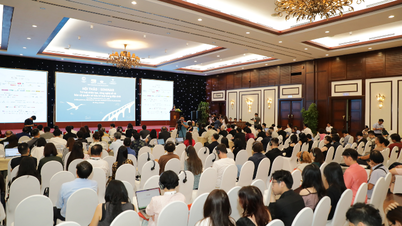
The seminar was organized by 1980 Books, with the participation of guest speaker Master of Science, Doctor Bui Phuong Thao - Psychiatrist at Mai Huong Day Psychiatric Hospital, and a large number of interested readers.
We live in an era where children know how to swipe on screens before they know how to tie their shoelaces. Owning smartphones, social media accounts, or spending hours each day in front of electronic devices is becoming commonplace. But is this "normal" truly harmless?
Sharing her experience of "quitting" social media from an adult's perspective, Master's degree holder and doctor Bui Phuong Thao recounted that there were times when she wished each day had 36 hours so she could have more time to develop other things. "Once, while traveling, I forgot my phone, and I felt very comfortable with the time without social media. There were even times when I found social media unappealing. The human brain has excellent capabilities; we can overcome social media addiction, but we must create a habit. If we break that habit, it only takes a very short time. Therefore, perseverance, loyalty, and willpower are very important," Dr. Bui Phuong Thao shared.
For busy parents who constantly work on electronic devices but worry about their children seeing and imitating them, Dr. Bui Phuong Thao says that children can completely recognize and distinguish between the working and leisure states of adults, unless their parents work in specific entertainment-related professions.



To set a good example for their children, doctors advise parents to focus solely on using their phones while working. For leisure time, they should try to limit their use or only use them when their children are not present.
“No matter how busy you are, you still need to dedicate ‘quality time’ to your children in the real world . This is when you ask them what they ate at school, what the teacher taught, if anything fun happened, or read stories with them for 25-30 minutes without electronic devices. I myself am extremely busy, but my children never feel that I am absent from their lives. We still maintain the habit of having dinner together on time, going to bed together, and keeping the habit of reading before bed. Families should also maintain traditions such as traveling or going to amusement parks together,” the doctor said.
Dr. Bui Phuong Thao also emphasized the importance of parents genuinely interacting with their children without electronic devices: “Parents need to remember that: If you are present without electronic devices for just 20-25 minutes, your child will tell you that you played with them all evening. But if you are with your child for 3 hours while still holding your phone, the child will feel that you didn't play with them at all that evening. That is the importance of quality presence.”
One of the "magic phrases" to get children away from electronic devices is "Come on, let's do something together...". Dr. Bui Phuong Thao says children won't need phones if parents are willing to play with them. Suggest things like, "Come on, let's go read a book," "Mommy will play pretend with you," or invite them to go swimming, for a walk, to the supermarket, or to a cafe. When we involve children in a real-world activity, they will put down their phones.
“At home, I limit my children's screen time by using a projector and setting a specific time for entertainment each day. The rest of the time, I invite them to look at travel picture books or let them explore medical instruments like stethoscopes and brain models. I interact with them by asking them to fetch medicine, pack packages, and praising them when they do well. When children feel praised and are doing meaningful things, they enjoy it and gradually develop good habits. With young children, it's very easy to get them away from screens if parents know how to interact,” the doctor said.
Dr. Bui Phuong Thao also mentioned books that help children balance entertainment between the real world and electronic devices, including "The Amazing Generation," with its very relatable stories of children who choose to spend time on real-life hobbies, and young people who look back on their teenage years and regret having wasted too much time on phones and social media. From there, she raises the question: how can children grow up with technology without losing their ability to explore themselves, build real relationships, and live a more balanced youth? The book is not only for ages 9-13, but older children like 15, 16, and parents can also read it to support, connect with, and share.



"There are many ways to educate children, but we need to understand that children don't grow up based on mere instruction, but rather on how we work, how we behave, and how we react to them," said Master's degree holder and doctor Bui Phuong Thao.
Source: https://nhandan.vn/giup-con-tre-cai-game-and-social-media-post973190.html