


Residents of Tay Nha Trang ward ( Khanh Hoa province) clean up accumulated debris after the historic flood. Photo: Hieu Giang
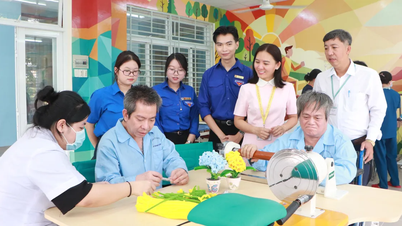
Thousands of people received medical examinations.
In Khanh Hoa, while many residential areas, schools, and health centers were still covered in mud, medical teams from Ho Chi Minh City quickly arrived. Without an opening ceremony or banners, the makeshift examination tables offered much hope to the people after the natural disaster.
Over the past week, dozens of doctors and nurses from Thong Nhat Hospital, Cho Ray Hospital, People's Hospital 115, Orthopedic and Trauma Hospital, and many other hospitals, along with 50 young doctors from Ho Chi Minh City, have provided medical care to approximately 1000 people in Khanh Vinh, Dien Khanh, Ninh Hoa communes and some other deeply flooded areas. Many units also donated "family medicine kits" containing fever reducers, diarrhea medication, oral rehydration solution, antiseptics, etc.
At Cao Ba Quat Secondary School (Nam Nha Trang ward), from November 22nd until now, dozens of elderly people and young children have been lining up for examinations. Ms. Nguyen Thi Lan said emotionally, “They not only examined and provided medicine but also advised on preventing post-flood diseases. My blood pressure medication was swept away in the flood. Now that doctors have come to examine me here, I feel very reassured.”
Dr. Pham Minh Cong, Head of Group 1, Ho Chi Minh City Young Doctors Association, said: “Upon receiving information about the need for assistance, we only had a few hours to prepare before setting off. At that time, everyone thought that we had to get to the flood-affected people as soon as possible.”
In Dak Lak , a delegation from the Dong Nai Department of Health visited and provided medical care to residents in the flood-stricken Tuy An Dong area. Dr. Nguyen Trong Nghia, Deputy Director of Dong Nai Children's Hospital, reported that the hospital had provided free medical examinations to thousands of people and distributed preventative medicine kits, mainly to support cases of fever, colds, malnutrition, and respiratory illnesses caused by the damp and cold weather after the floods.
Ms. Nguyen Thi Luu (residing in Tuy An Dong commune) shared: "The timely and compassionate actions of the doctors and nurses will never be forgotten by the people."
On November 28, the Ho Chi Minh City Committee of the Vietnam Fatherland Front announced that units in Ho Chi Minh City plan to support the repair and renovation of 33 schools in Khanh Hoa province, with a total budget of over 27.7 billion VND.
To date, various organizations have provided support to 15 schools, with a total budget of nearly 10 billion VND.

Volunteer doctors provide free medical examinations and treatment to residents of Tuy An Dong commune, Dak Lak province. Photo: MAI CUONG
Environmental hygiene prevents disease outbreaks.
Meanwhile, environmental remediation efforts in Khanh Hoa are being urgently implemented. Many roads in Dien Khanh and Tay Nha Trang ward are covered with garbage, animal carcasses, and mud, causing severe pollution.
Ms. Tran Truc Lam (Tay Nha Trang ward) said that garbage has accumulated for many days on Trung Tam street, causing a widespread foul odor due to the presence of animal carcasses, which worsen over time. The Dien Dien commune People's Committee mobilized 7 excavators and 17 trucks to handle the garbage, but the temporary landfill is overloaded.
In the South, West, and North Nha Trang areas alone, the Urban Environment Joint Stock Company deployed 750 workers to work through the night until 2-3 am, collecting over 7,500 tons of garbage, but about 60% still remains unprocessed.
In that situation, Ho Chi Minh City promptly provided support, deploying 11 garbage collection vehicles, 6 garbage compacting vehicles, and 300 personnel. The task force will provide support until early December, when garbage collection in Khanh Hoa becomes more stable.
The Khanh Hoa Provincial Department of Health has supplied over 2,700 kg of Chloramine B and 1,400 liters of mosquito repellent. Mr. Tran Truc, a resident of Dien Dien commune, said that the well water had changed color and had a strange smell, causing him great concern. After receiving instructions on how to treat the water, the people felt more at ease.
In Dak Lak, the decomposing carcasses of livestock and poultry after the floods are causing a strong, foul odor. It is estimated that approximately 55,000 livestock and 1.5 million poultry were swept away. The Department of Animal Husbandry and Veterinary Medicine is preparing 13,000 liters of chemicals and 29,000 doses of vaccine and has requested additional support from the central government.
According to Nay Phi La, Director of the Dak Lak Provincial Department of Health, the locality is disposing of animal carcasses, disinfecting wells, schools, and markets, and monitoring water quality to prevent disease outbreaks.
The health departments of Khanh Hoa and Dak Lak provinces advise people to clean their homes, cook food thoroughly, boil water before drinking, treat drinking water properly, and eliminate stagnant water to prevent digestive and respiratory diseases, conjunctivitis, and dengue fever.
On the afternoon of November 28th, the Ministry of Health sent a document to the People's Committees of provinces and cities and health units nationwide, requesting them to tighten measures to prevent and control infectious diseases that are showing a strong upward trend: seasonal influenza, respiratory syncytial virus (RSV) disease, and hand, foot, and mouth disease.
Accordingly, the Ministry of Health requested localities to strengthen surveillance, detect cases early, thoroughly handle outbreaks, and ensure safe patient triage, admission, and emergency care to prevent cross-infection in hospitals.
According to the Ministry of Health, the transition period between autumn and winter, with its erratic weather and high humidity, creates ideal conditions for the development of respiratory and digestive pathogens. From the beginning of 2025 to the present, the country has recorded more than 132,000 cases of seasonal influenza, including 3 deaths.
The main influenza virus strains circulating in Vietnam currently are influenza A/H1N1, A/H3N2, and influenza B.
The latest monitoring data from the World Health Organization on seasonal influenza for 2025-2026 shows that influenza virus activity is increasing globally, with the A/H3N2 strain becoming dominant in regions such as Northern Europe, West Asia, South Asia, and Southeast Asia.
REPORTER TEAM
Source: https://www.sggp.org.vn/giup-dan-ngua-dich-benh-sau-mua-lu-post826059.html



![[Photo] National Assembly Chairman Tran Thanh Man attends the policy seminar to promote Vietnam-Türkiye cooperation.](https://vphoto.vietnam.vn/thumb/1200x675/vietnam/resource/IMAGE/2026/04/16/1776351415367_vna-potal-chu-tich-quoc-hoi-tran-thanh-man-du-toa-dam-chinh-sach-thuc-day-hop-tac-viet-nam-tho-nhi-ky-8705791-jpg.webp)





















![[Image] Bridges and roads connecting the eastern part of Ho Chi Minh City](https://vphoto.vietnam.vn/thumb/1200x675/vietnam/resource/IMAGE/2026/04/16/1776328595108_ndo_br_bh-vt5-jpg.webp)
































![[Infographic] Details of the Hanoi-Quang Ninh High-Speed Railway Project](https://vphoto.vietnam.vn/thumb/402x226/vietnam/resource/IMAGE/2026/04/16/1776338188424_anh-man-hinh-2026-04-16-luc-18-16-10.png)

![[Photo] National Assembly Chairman Tran Thanh Man meets with the Speaker of the Georgian Parliament](https://vphoto.vietnam.vn/thumb/402x226/vietnam/resource/IMAGE/2026/04/16/1776338494029_anh-man-hinh-2026-04-16-luc-18-21-21.png)























Comment (0)