

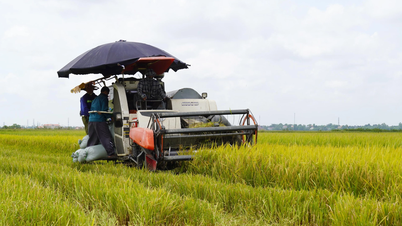
Recently, there have been many opinions reflecting the disparity between land prices and people's financial capabilities. A typical example is the story of Mr. Dinh Cong Phuong's family in Ba Vi commune, Hanoi city, who, when allowed to convert more than 210m² of land used for perennial crops to rural residential land, had to pay nearly 900 million VND in land use fees, equivalent to more than 4.3 million VND/m² according to the new land price list.
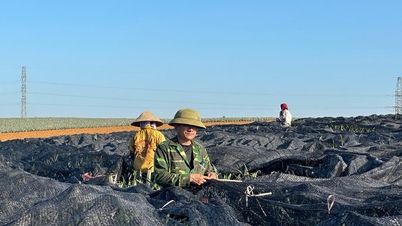
Similarly, the family of Mr. Tran Duy Dong in Nghe An province was shocked to have to pay 4.5 billion VND to convert 300m² of garden land into residential land, equivalent to a conversion rate of nearly 15 million VND/m²... These figures are beyond the financial capabilities of rural and mountainous households...
These cases are not isolated incidents. They are an inevitable consequence of land price tables not being based on accessibility for the majority of the population, but rather on market fluctuations. The equalization of financial obligations between the rich and the poor, between urban and rural areas, is turning land policy, which is supposed to be a tool for equitable regulation, into a burden for the majority of the population, especially those in difficult circumstances...
According to Mai Van Phan, Deputy Director of the Land Management Department ( Ministry of Agriculture and Environment ), abolishing the land price framework is a step forward, but if the new price list does not closely reflect reality, the policy will lose its social effectiveness. Especially since the 2024 Land Law, effective from January 1, 2026, requires each locality to issue a new land price list with a valuation database down to each individual plot, with extensive public consultation and regular updates.
The Ministry of Agriculture and Environment has recommended that the Ministry of Finance and local authorities urgently update market prices, build a land price database, organize public consultations, and establish a suitable adjustment roadmap. The Ministry's consistent stance is that land prices must be in line with reality, accurately reflecting the socio-economic development conditions of each region and population group, and cannot be applied mechanically or based solely on market prices.
Following feedback from local authorities, the Ministry of Finance has drafted amendments to Government Decree No. 103/2024/ND-CP on land use fees and land lease fees, focusing on amending and supplementing several articles related to land use fees, land lease fees, and the land development fund. The aim is to narrow down the cases requiring specific land price determination and ease financial obligations for citizens in certain transitional situations. Specifically, for cases of changing land use purposes from garden and pond land attached to housing, the Ministry of Finance proposes that citizens only need to pay 50% of the difference between the price of residential land and agricultural land, instead of 100% as currently.
It is time to recognize that land price lists cannot be merely technical "price charts" for revenue collection, but must be tools to support development, ensure social equity, and protect the legitimate rights of citizens. Therefore, localities need to be cautious and responsible in the process of developing new land price lists, focusing on clear zoning, thorough consultation with the people, specific socio-economic impact assessments, and avoiding the overuse of market-based price references...
Untangling the "bottleneck" of land price tables is not just about amending laws or changing the calculation method, but rather a process of creating a policy system that is both fair and feasible, placing people at the center of development. Land price tables need to become a bridge for people to access land policies legally, not a barrier to livelihoods and sustainable development.
Source: https://hanoimoi.vn/go-nut-that-bang-gia-dat-708346.html


![[Photo] General Secretary and President To Lam and his wife begin their official visit to Thailand.](https://vphoto.vietnam.vn/thumb/1200x675/vietnam/resource/IMAGE/2026/05/27/1779881249412_anh-man-hinh-2026-05-27-luc-18-10-51.png)
![[Photo] The courage of new recruits of Brigade 144 on the training ground.](https://vphoto.vietnam.vn/thumb/1200x675/vietnam/resource/IMAGE/2026/05/27/1779881651341_anh-man-hinh-2026-05-27-luc-18-32-52.png)


















































![[Photo] The courage of new recruits of Brigade 144 on the training ground.](https://vphoto.vietnam.vn/thumb/402x226/vietnam/resource/IMAGE/2026/05/27/1779881651341_anh-man-hinh-2026-05-27-luc-18-32-52.png)




























Comment (0)