

In the digital age, global and Vietnamese education are undergoing a rapid transformation: from rote learning to developing students' competencies. As a result, advanced educational activities such as STEM education, digital skills, artificial intelligence (AI), and life skills are now commonplace in Vietnamese schools.
Integrated teaching creates equity in education.
In recent times, to meet the diverse and evolving learning needs of students, many educational institutions have intensified their efforts in socializing education through "collaborative learning" programs. These institutions have played a crucial role in introducing new technologies, international curricula, and modern teaching methods into schools, especially in areas where resources are limited.
Thanks to collaborative organizations, the appearance of STEM, AI, life skills, foreign language, and computer science classes has undergone positive changes, helping students access education more quickly in advanced countries.
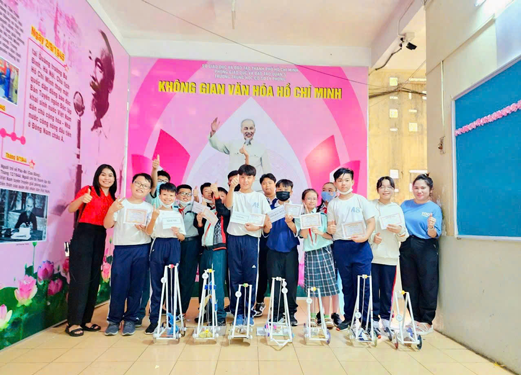
The teacher and students of class 6 at Ly Phong Secondary School (Ho Chi Minh City) during a lesson on the topic "Building a pulley system" (Photo provided by the teacher)
However, the practical implementation has revealed several issues that need to be addressed, such as General Secretary To Lam 's directive to review the collaborative teaching activities in schools, emphasizing that they must be based on the principle of voluntariness and should not be distorted into a form of "coercion," causing financial burdens for parents and overloading students.
The question is: How can students still benefit from the finest values of advanced, modern education (STEM, AI, life skills, enhanced foreign language and computer skills, etc.) in a fair and effective way without increasing the financial burden on families or overwhelming students? The answer lies in "Integrated Teaching" - a method that has been directed by the Ministry of Education and Training (MOET) and has been thoroughly implemented by provincial Departments of Education and Training in every school.
Integrated teaching is not a new concept, but in the context of the 2018 General Education Curriculum reform, with educational institutions implementing both the national curriculum and their own school curriculum, it has become the "backbone" of the approach.
Unlike joint education (which is usually a standalone program taught by external teachers with their own curriculum, schedule, and fees), integrated education operates on four principles:
- The school's teachers are the main actors: The subject teachers – those who have received formal training from teacher training colleges and understand the psychology of their students best – will be the ones to design and organize integrated lessons, a topic for which they have received thorough training from the Departments of Education and Training in recent years.
- Every student gets to learn: Because these educational activities are integrated into regular class time, every student gets to participate and be tested and evaluated fairly.
- Reduced time constraints: Because content such as life skills, STEM, and digital literacy are directly integrated into daily teaching and educational activities, even within regular class periods.
- Limited additional fees: Because it is carried out within the teacher's teaching load and utilizes the school's existing facilities, students rarely have to pay any extra money for this integrated teaching activity.
Thus, integrated teaching not only helps optimize available resources but also reduces the financial burden on families, lessens the content and time load for students, and ensures that all the best aspects of advanced and modern educational programs reach every student in a transparent, natural, and responsible manner.
No student should be left behind.
Developing integrated teaching in schools brings about enormous social benefits:
- Holistic development for students: Integrated teaching helps students access STEM, AI, life skills, etc., right during regular class time, thereby reducing time pressure and giving them more time for rest, play, and arts and culture activities, contributing to the holistic development of qualities and abilities in line with the goals of the 2018 General Education Program.
- Ensuring social equity: All students have access to the same modern educational methods, ensuring the fairest possible treatment in all regular classes.
- Affirming the teacher's status: When teachers themselves teach STEM, life skills, AI, etc., their prestige in the eyes of students and parents is enhanced. This promotes self-learning and research among educators.
- Optimizing school resources: Instead of paying a large sum of money monthly to affiliated organizations, parents and the school can cooperate to invest that money in facilities and equipment that will have long-term use for many generations of students, in accordance with local regulations.
It's necessary to frankly acknowledge the reasons why integrated teaching with life skills, STEM, AI, enhanced foreign languages and computer skills, etc., hasn't developed as expected by industry leaders: This is because the infrastructure in some educational institutions is still limited, some teachers are still unfamiliar with integrated teaching methods, and some educational institutions haven't yet implemented integrated teaching. To implement the integrated teaching roadmap, sustainable solutions are needed.
Schools need to design flexible experiential learning spaces where students can easily access these educational programs without needing expensive equipment.
Simultaneously, training for teachers on integrated teaching activities must be more in-depth, enabling them to design lesson plans and successfully organize integrated teaching. Collaboration with other schools is also necessary to develop curricula and learning resource libraries.
When implementing the industry's directive to prioritize integrated subject teaching during regular class hours with new content, a segment of teachers will undoubtedly be concerned about their ability to design and organize integrated activities; meanwhile, many parents wonder whether not participating in "extracurricular" programs will affect their children's access to STEM, AI, life skills, or digital literacy.
However, these very concerns highlight the urgent need for proper investment in integrated teaching in schools.
When teachers receive proper training, have access to shared learning materials, and receive professional support, integrated teaching not only does not reduce the quality of education but also helps modern competencies develop naturally, regularly, and closely linked to the main curriculum. At the same time, implementing integration within the framework of the 2018 General Education Program ensures standardization, transparency, and fairness.
Teachers can take on this role.
For STEM education, depending on the grade level, STEM education is organized flexibly through the following forms: STEM lessons: This is the core form. Lesson content from various subjects (mathematics, natural and social sciences, technology, computer science, etc.) is integrated to solve a specific problem.
This process takes place during regular class hours; STEM experiential activities: organized in the form of clubs, STEM festivals, or learning projects. This format emphasizes the voluntary participation and interests of students, helping them discover their individual talents; familiarization with scientific and engineering research: for gifted students, providing an initial introduction to the research process to solve real-world problems...
According to the directives of the Ministry of Education and Training, the main forms of implementing digital and AI competency development in schools are: teaching computer science (core form), integrating digital competencies (primary form), and enhancing and experiential education activities (supplementary forms)...
The school can organize for teachers to apply integrated teaching methods at different levels.
Absolutely no financial pressure.
Regarding collaborative teaching in schools, Mr. Ho Tan Minh, Chief of the Office of the Ho Chi Minh City Department of Education and Training, stated that there is no concept of "collaborative subjects" or "voluntary subjects" in schools; there is only the school's educational program, and collaboration is merely a method of organization when the school lacks sufficient resources. "The organization of collaborative subjects is based on the implementation of the 2018 General Education Program, aiming to form and develop students' competencies and qualities through both the subject and other educational activities," Mr. Minh affirmed.
Mr. Minh added that the development of students' competencies and qualities according to the 2018 General Education Program takes place not only during regular class hours but also through experiential activities and supplementary education. According to current regulations, principals of educational institutions have the right to develop school education plans, which may include collaborations with businesses and organizations to carry out appropriate educational activities.
However, the Department of Education and Training requires that the organization of these programs must ensure the following principles: fairness, openness, transparency, quality assurance, and absolutely no financial pressure on students. "Schools are required to make maximum use of available resources such as teachers and facilities to organize clubs and extracurricular activities. Only when resources are insufficient should social mobilization be considered, and this social mobilization must comply with regulations and specific guidelines from the education sector," the Chief of the Office of the Ho Chi Minh City Department of Education and Training stated. For joint programs, the department requires each program to have at least two options for parents and students to choose from.
Participation must be voluntary, with parental input, and the content, objectives, and costs, if any, must be made public. There should be no coercion of students or parents. If any educational institution is found to be violating regulations, the department will take decisive action without cover-up. The overarching principle of the education sector is to ensure fairness in education, transparency in programs, and respect the right of parents and students to choose.
D. Trinh
Source: https://nld.com.vn/go-nut-that-day-hoc-lien-ket-196260106212037922.htm

















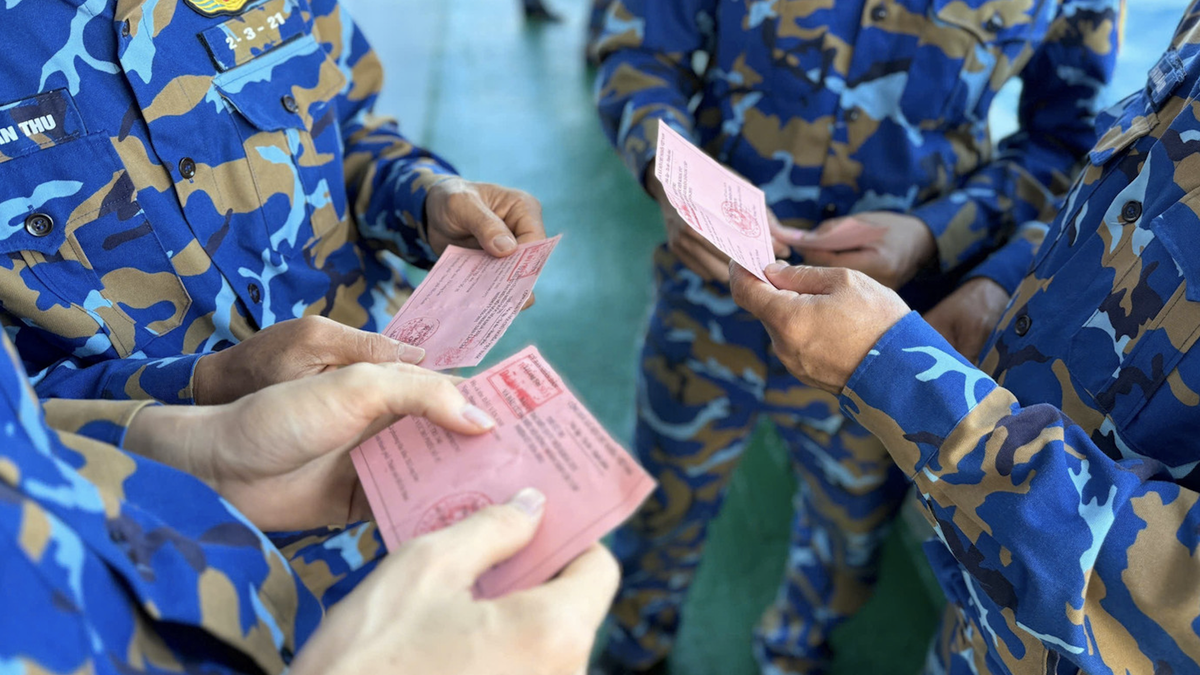
![[Photo] New recruits happily exercise their right to vote at their unit.](https://vphoto.vietnam.vn/thumb/1200x675/vietnam/resource/IMAGE/2026/03/14/1773473286544_stug0337-6388-jpg.webp)












































Comment (0)