Speaking at the international scientific conference "Thang Long Imperial Citadel - Achievements and Challenges After 15 Years of Research (2011-2025)" organized by the Institute of Archaeology (Vietnam Academy of Social Sciences) on the morning of November 4th in Hanoi, the Vice President of the Vietnam Academy of Social Sciences, Dr. Dang Xuan Thanh, affirmed: "For Thang Long Imperial Citadel to truly revive and become an invaluable national asset, we need a breakthrough vision, synchronized investment, and the integration of science, technology, and society."
According to Dr. Dang Xuan Thanh, over the past 15 years, research results have contributed to clarifying and affirming the scientific position and outstanding global value of the Thang Long Imperial Citadel heritage, a place where the finest aspects of Asian civilization converge, crystallize, and shine. However, for the heritage to truly realize its value, it is necessary to shift from a mindset of "praise" to an action of "revival," transforming the heritage into a resource for the economic , cultural, and tourism development of the capital and the country.
Dr. Ha Van Can, Director of the Institute of Archaeology, stated that research on the Thang Long Imperial Citadel has yielded many important results, contributing to clarifying the cultural layers and historical values of the national power center for over 13 centuries. The current focus is not only on summarizing research results but also on how to ensure that archaeological discoveries truly spread throughout society.
Dr. Ha Van Can believes that scientific achievements will only be meaningful when they are translated into awareness and action in the conservation, education , and promotion of heritage. Therefore, it is necessary to promote the publication of research results, strengthen the application of digital technology in displaying and interpreting heritage, and expand international cooperation to access modern research methods.
The Institute of Archaeology will continue to coordinate with relevant agencies to implement in-depth research steps, creating a solid scientific basis for the preservation, restoration, and promotion of the value of Thang Long Imperial Citadel in the new phase.
Associate Professor, Dr. Bui Minh Tri, former Director of the Institute of Imperial City Research (now part of the Institute of Archaeology), the unit in charge of the project "Revising, researching, evaluating the value and creating a scientific dossier for the Thang Long Imperial Citadel relic site," said that after 15 years of implementation (2011-2025), the project has achieved many outstanding results in urban archaeological research, contributing to the restoration of the historical appearance of the Thang Long Imperial Citadel.
From tens of thousands of archaeological artifacts, 53 traces of building foundations, 7 wall foundations, and 6 wells discovered in the area of 18 Hoang Dieu and the National Assembly building, scientists have gradually deciphered the architectural form of the Ly Dynasty palace.
Over many years of research, the Imperial City Research Institute has reconstructed 3D models of the Ly Dynasty palace architecture, helping the public to better visualize the splendor of the ancient capital. In particular, the identification of the bracketed structure and the complex and sophisticated roof support techniques has opened up new avenues of research in comparing Vietnamese architecture with ancient palaces in China, Japan, and Korea.
In 2022-2023, the Institute continued to complete its research on the reconstruction of the Kính Thiên Palace, the center of power of the Thăng Long Imperial Citadel during the early Lê Dynasty. The structure was recreated on a large scale, with a roof covered in gold-glazed dragon tiles, and wooden components painted in red and gold, reflecting the power and prosperity of the dynasty. This achievement contributes to clarifying the value of Vietnamese palace architecture within the broader context of Eastern civilization. Beyond architectural research, scientists also focused on clarifying life within the Thăng Long Imperial Palace through millions of artifacts that were organized and classified.
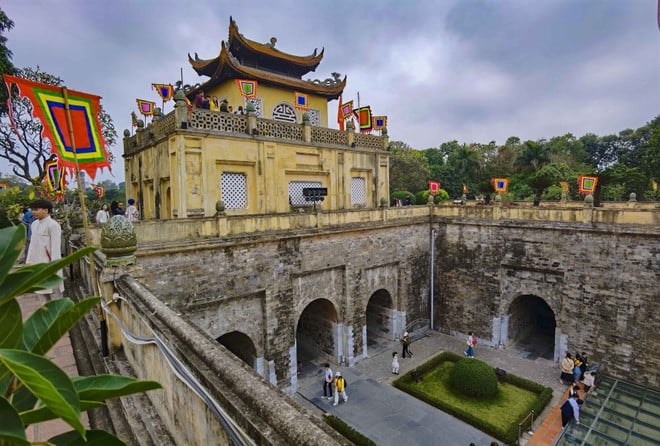
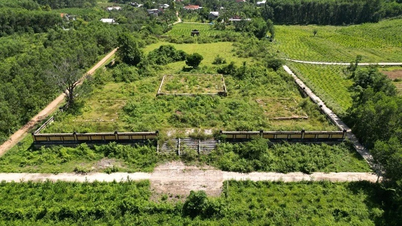
The area leading to the entrance of the Thang Long Imperial Citadel historical site. (Photo: VNA)
According to Associate Professor, Dr. Bui Minh Tri, the Institute has analyzed and identified high-quality porcelain from the Ly Dynasty, reaching a level equivalent to Chinese porcelain from the Song Dynasty, proving that Vietnamese ceramic craftsmanship reached its peak from the 11th century. In particular, the ceramics bearing the characters "Quan" and "Kinh," decorated with dragon motifs, produced at the Thang Long royal kiln, were imperial items reserved for the king and queen, reflecting court life and royal authority.
Furthermore, the Imperial City Research Institute clarified the origins of imported ceramics from China, Japan, Korea, and West Asia, thereby demonstrating Thang Long's role as a center of international trade within the Asian economic network. These findings not only deepen the archaeological value but also help identify the cultural stature and diplomatic position of Dai Viet in regional history.
Delegates believe that Vietnam has full potential and scientific basis to build a modern archaeological museum model and develop a heritage economy. The application of digital technology, virtual reality, and artificial intelligence in researching and presenting heritage is an inevitable trend that will help spread the cultural values of Thang Long to a wider audience both domestically and internationally.
Many opinions also suggested the need to strengthen international cooperation in human resource training, technology transfer for conservation, and the digitization of heritage, while promoting the publication of research results from 2026-2030 to raise public awareness and promote Vietnamese heritage to the world.
Source: https://www.vietnamplus.vn/can-mot-tam-nhin-dot-pha-de-hoang-thanh-thang-long-thuc-su-hoi-sinh-post1074828.vnp




![[Photo] General Secretary and President To Lam presides over a meeting on preparations for the review of one year of operation of the three-tiered government system.](https://vphoto.vietnam.vn/thumb/1200x675/vietnam/resource/IMAGE/2026/06/02/1780391821195_a1-bnd-4595-9717-jpg.webp)
























































Comment (0)