

From the 'most expensive ring road on the planet'
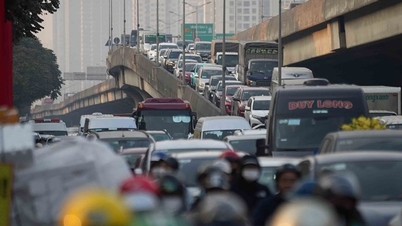
After the Lunar New Year, traffic flow resumed smoothly on the section of Ring Road 1 from Hoang Cau to Voi Phuc – a route that had been mentioned for decades as an "unsolvable bottleneck" in Hanoi . While congestion persisted in the old sections, on the new route, machinery and personnel worked almost non-stop, as if racing against time to unblock the traffic flow that had been severely congested for years.
The figures clearly show the change. The total area reclaimed exceeded 153,000 m², affecting nearly 2,000 households and organizations. In just over 5 months before Tet, the wards of O Cho Dua, Giang Vo, and Lang completed compensation, support, and resettlement for 1,295 households – whereas in the previous 7 years, the entire project had only resolved the cases of 686 households. Procedures didn't change overnight, but the approach has changed.
The official opening of the Hoang Cau – Voi Phuc section of Ring Road 1 to traffic not only closes a decades-long infrastructure bottleneck but also sends a more important signal: Hanoi has moved to action.
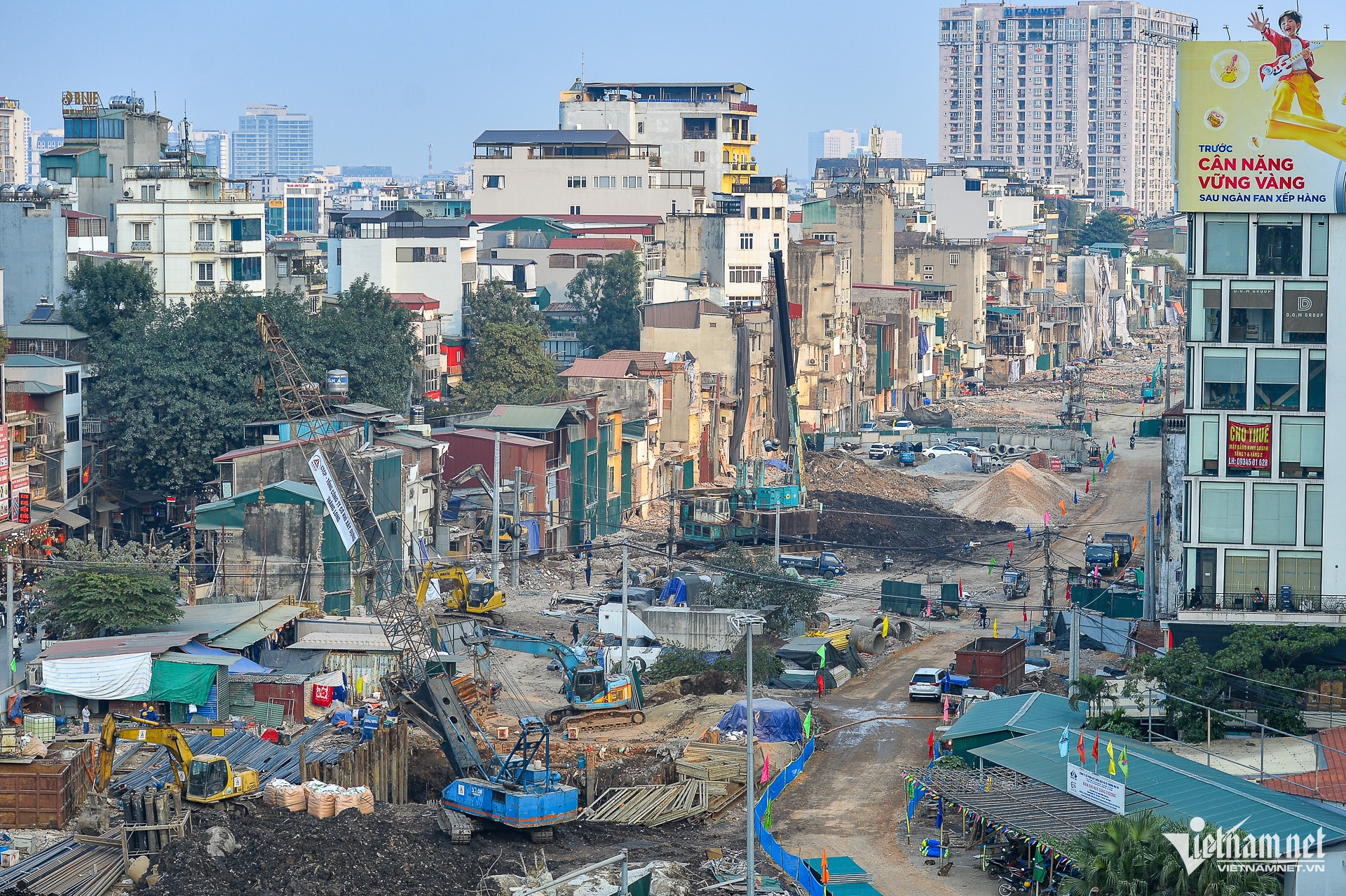

The Ring Road 1 project, specifically the Hoang Cau - Voi Phuc section, will complete the technical opening of the road before January 15, 2026, as directed by the Hanoi City Party Committee. Photo: The Bang
Former Minister of Planning and Investment Vo Hong Phuc said he was very impressed with how Hanoi handled this road project. According to him, the section of Ring Road 1 from Hoang Cau to Voi Phuc had been discussed since the 1990s, and through many leadership terms, sections were opened but ultimately could not be completed due to obstacles in land clearance, procedures, and compensation.
Unfortunately, he said, if it had been done earlier, the land acquisition costs would have been very low. Most of the land along the route was then agricultural land, not residential land, so the compensation value was not high. The prolonged hesitation led to missed opportunities, and costs escalated over time. Only when new leaders intervened decisively did things that were once considered "impossible" begin to be resolved. The lesson learned is clear: Defining the goal is not enough; the deciding factor lies in whether action is taken early and decisively enough.
This change is linked to a new governing spirit. Hanoi Party Secretary Nguyen Duy Ngoc emphasized the overarching principle: Dare to think, dare to act, dare to take responsibility, and see things through to the end; using work efficiency and quality of service to the people and businesses as the benchmark.
This spirit goes beyond mere slogans and is concretized through a "six clear" approach – clear responsibilities, clear tasks, clear timelines, clear accountability, clear authority, and clear results – and a focus on addressing five long-standing urban bottlenecks: traffic congestion, urban order, environmental pollution, flooding, and food safety and hygiene.
... up to 5 megacities
From the opening of Ring Road 1, a new wave of infrastructure development is beginning to emerge, leading to changes in how Hanoi reorganizes its development space. The Chairman of the City People's Committee has signed 10 decisions ordering the urgent construction of projects with a total investment of over 5,500 billion VND, requiring completion by 2026. The message is clear: Long-standing pressing issues can no longer be handled at a slow pace.
From the end of 2025, after announcing a plan to relocate approximately 860,000 people from the inner city over the next 20 years, Hanoi truly entered a phase of accelerated infrastructure development on an unprecedented scale.
On December 19, 2025, the city simultaneously commenced construction on 7 key infrastructure and urban projects, with a preliminary total investment of nearly 1.9 trillion VND. These are not just individual projects, but pieces of a new development structure.
Prominent among these are the Olympic Sports Urban Area and the Red River Landscape Boulevard – two iconic projects representing the open development direction of the capital. Alongside these transportation axes and ring roads, the nearly 40km-long Metro Line 5 (Van Cao – Hoa Lac) is identified as the backbone of the public transport-oriented urban development model, connecting the city center with the western part of the city.
In particular, Hanoi's preparation to construct seven bridges over the Red River is of strategic significance, not only supplementing traffic capacity but also restructuring the entire development space of the capital. Once the new bridges are completed, the Red River will no longer be a natural boundary dividing the city, but will become a connecting axis, a scenic axis, and a new driving force for growth.
It is noteworthy that these projects are being "chained" into a connected network comprising ring roads, radial routes, metro lines, and a system of bridges over the Red River. The same legal framework yields different results when responsibilities are clearly defined and determination is maximized. When land-related bottlenecks are resolved, infrastructure not only opens up opportunities but also creates room for economic restructuring.
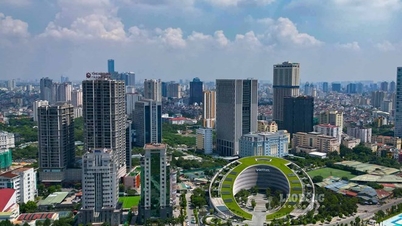
In the long term, these developments are part of a very ambitious framework. Hanoi has just approved the task of developing a master plan for the capital city with a 100-year vision, applicable to all 126 commune-level administrative units across an area of approximately 3,360 km².
The city is organized according to a 'multipolar – multi-center, multi-layered' model, developing in depth, aiming for a green, smart city with rich identity and closely linked to satellite cities; in which the Red River plays the role of a green axis and a new driving force for development.
To concretize this plan, the Hanoi People's Council has approved a list of strategic projects for the period 2026–2035, notably including the plan to form 5 new large-scale urban areas with a total area of approximately 49,700 hectares and an estimated total investment of nearly 4 trillion VND.
Urban areas are distributed along Ring Road 4 and strategic development directions of the capital, aiming to reduce density in the core area, increase green spaces and social infrastructure, create new development opportunities, and alleviate pressure on the historical inner city.
It can be said that Hanoi is entering a new development cycle, where organizational and implementation capabilities and the ability to open up space become the most important measures of growth.
Great ambition and a difficult challenge.
Economically, Hanoi aims for an average annual GRDP growth rate of over 11% during the period 2026–2045; GRDP per capita is projected to reach approximately US$17,000 by 2035, US$45,000 by 2045, and around US$100,000 by 2065. Specifically for 2026, the growth target is set at 11% or higher. The aspirations have been set. The remaining issue is the capacity to translate those aspirations into actual growth.
However, according to Dr. Nguyen Dinh Cung, former Director of the Central Institute for Economic Management Research, Hanoi's biggest challenge lies in the long-term trend of declining economic growth.
During the period 2011–2015, the city's GRDP increased by an average of 7.35% per year; this was around 7% during the period 2016–2020; and is projected to remain around 6.6% during the period 2021–2025.
In order for Hanoi to achieve an average growth rate of 8.5% for the entire period of 2021–2030 as planned, it must grow by approximately 10% annually for the remaining five years – a very significant challenge.
The issue lies not only in the pace but also in the structure of growth. Hanoi has formed a 'post-industrial' economic structure quite early, with the service sector accounting for up to 66% of GRDP, while industry and construction only account for about 21%, and manufacturing and processing industries alone around 15%.
Another paradox is that Hanoi has mobilized a very high amount of social investment capital, equivalent to nearly 39% of GRDP, but the investment efficiency is low, as shown by the high ICOR coefficient. State investment still accounts for a large proportion; the private sector accounts for about 56% while FDI is only around 6.5% and has tended to decrease since 2020.
Notably, real estate – a sector that contributes little to GRDP growth – attracted approximately 13% of total social investment, while fundamental sectors for long-term growth such as science and technology, healthcare, and education have not received commensurate investment.
Speed up, but change your approach.
From that perspective, the greatest significance of the current phase lies not only in the scale of the projects or the amount of investment capital, but in whether Hanoi can take advantage of the 'infrastructure window' to change its development model. Hanoi cannot and does not need to become an 'industrial province' in the purest sense.
The challenge for the capital city is to build a growth model based on productivity, knowledge-based services, high-tech industries, logistics, and a creative economy, commensurate with its role as the political, administrative, scientific, and educational center of the country.
The opening of Ring Road 1 not only helps reduce traffic congestion, but it also demonstrates something more important: when the system operates smoothly, seemingly impossible tasks can still be accomplished.
Hanoi is entering a period of accelerated growth, so the question is no longer whether it dares to accelerate, but rather in what direction it should accelerate on its long-term development path.
Vietnamnet.vn

![[Photo] Prime Minister Pham Minh Chinh receives the Chinese Ambassador to Vietnam](https://vphoto.vietnam.vn/thumb/1200x675/vietnam/resource/IMAGE/2026/04/05/1775397481797_ndo_br_dsc-5512-jpg.webp)

















































Comment (0)