

A recent study published in the journal Monthly Notices of the Royal Astronomical Society reveals that astronomers have discovered a pair of supermassive black holes spiraling closer together and on the verge of a violent collision.
Supermassive black holes typically have masses hundreds of millions to billions of times that of the Sun. Mergers of black holes are not uncommon on a cosmic scale, but systems like this one, in its final spiral phase and about to collide, are extremely rare. More importantly, this would be the first time in human history we have had the opportunity to observe such a massive supermassive black hole merger.
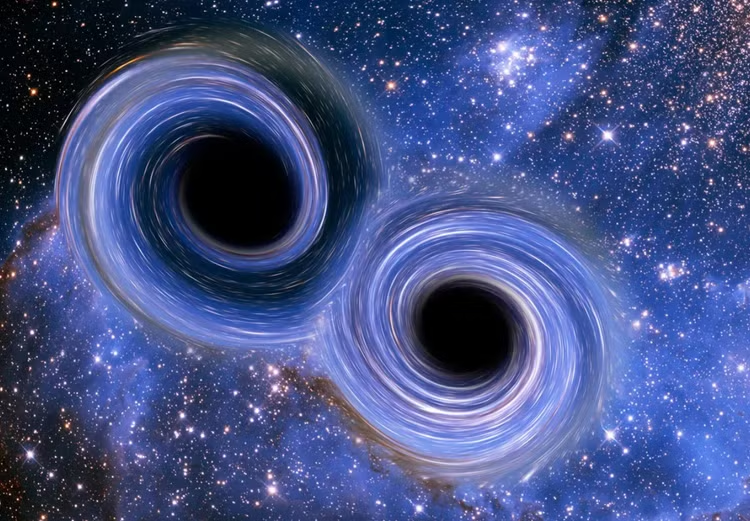
Scientists estimate that the merger of these two black holes could occur within 100 years and be detected by gravitational wave detectors on Earth. This is an extremely brief event in the long history of the universe, but it offers humanity a rare observational opportunity.
Silke Britzen, an astronomer at the Max Planck Institute for Radio Astronomy and one of the co-authors of the new study, said: "After the merger, we predicted that one of the two black holes would remain. I'm really curious to see how this 'dance' in space will continue."
The research team analyzed the galaxy Mark 501, located approximately 500 million light-years from Earth, using observational data from radio telescopes over 23 years. Previously, the center of this galaxy was thought to be a quasar driven by a single black hole, emitting bright streams of energy from its core.
However, new observations have revealed a hidden second jet stream, suggesting the existence of two supermassive black holes orbiting each other. Each jet stream is powered by a separate supermassive black hole with a mass ranging from 100 million to 1 billion times that of the Sun.
The study shows that these two black holes are currently orbiting each other clockwise, with an orbital period of approximately 121 days, and the distance between them is only 250 to 540 times the distance between the Earth and the Sun. As their orbits gradually narrow, they will eventually merge.
Researchers point out that if these two black holes collide, they will release extremely powerful gravitational waves, potentially far exceeding the intensity of previously detected mergers of stellar-mass black holes.
If this prediction is accurate, future gravitational wave detectors on Earth could directly receive this signal, providing crucial clues to help scientists understand the formation and evolution of supermassive black holes.
Source: https://khoahocdoisong.vn/hai-ho-den-sieu-khoi-luong-dang-hop-nhat-post2149097995.html











![[GALLERY] A completely different iPhone for the 20th anniversary edition](https://vphoto.vietnam.vn/thumb/402x226/vietnam/resource/IMAGE/2026/05/25/1779686871893_212-jpg.webp)







































































![[INFOGRAPHICS] 25 targets and groups of targets that Can Tho City strives for by 2030](https://vphoto.vietnam.vn/thumb/402x226/vietnam/resource/IMAGE/2026/05/25/1779688983034_1779688951.webp)














Comment (0)