

Travel agencies face difficulties, and customers turn their backs.
High travel demand and double or triple airfare prices during holidays and Tet (Lunar New Year), reaching several million dong compared to normal days, immediately impact the business of travel agencies, while tourists become fearful and turn away from domestic tourism.
Mr. Pham Quang Hau, CEO of Rooty Trip, cited the example that a typical trip to Phu Quoc, including airfare and hotel accommodation, costs around 4 million VND, and even during peak summer season, it's only 5-6 million VND. However, with exorbitant prices, sometimes reaching 8-10 million VND per round-trip ticket, tourists are not traveling to Phu Quoc.
Meanwhile, Mr. Nguyen Tien Dat, Director of AZA Travel, expressed his frustration, noting that while airfares during holidays and Tet (Lunar New Year) are currently expensive, the reality is that customers who buy tickets early pay more, while those who buy closer to the departure time find them cheaper.
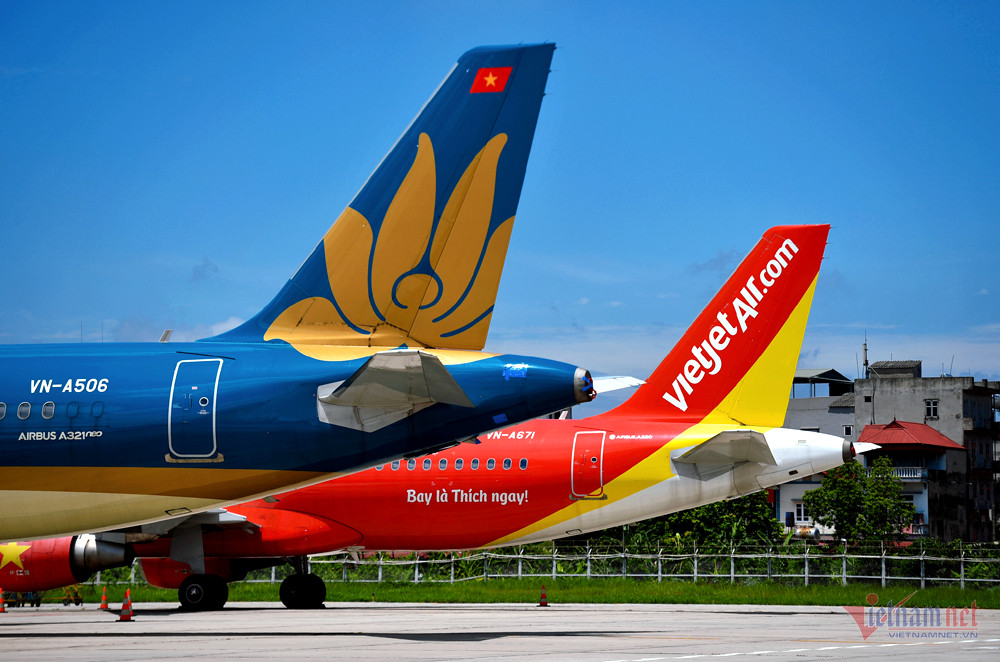
"It's unclear whether airlines set it up automatically or intentionally, but they suddenly increase the number of flights with low prices close to the holiday, putting early buyers at a disadvantage, not to mention the unsold tickets. Travel companies don't dare to 'stock up' on many tickets early, fearing losses when prices drop; and if we wait until prices are low, it's too close to the departure date, and we can't sell tours," Mr. Dat shared.
Clearly, according to Mr. Dat, the exorbitant airfare not only affects the travel plans and Tet holiday return trips of many workers, but also causes damage to the airlines themselves and entire tourist regions, such as Phu Quoc during the recent April 30th - May 1st holiday when the number of tourists dropped, hotels were empty, and transportation companies were idle.
Meanwhile, tourists flocked to travel abroad. Statistics from travel companies show that during the April 30th holiday, up to 70% of customers purchased tours to overseas destinations; some tours reached occupancy rates of over 90%, and were even fully booked, such as tours to Thailand, South Korea, and Bali.
This trend continued during the September 2nd holiday, when a significant number of tourists chose to travel abroad. Outbound tours had to share market share with domestic tourists.
Data from the Vietnam Civil Aviation Authority shows that domestic passenger numbers unexpectedly decreased while international passenger numbers increased sharply.
Specifically, in the first nine months of 2023, the total number of passengers passing through domestic airports was 89 million, a 20% increase compared to the same period in 2022. Of this, international passengers reached 23.7 million, a significant increase of 266.8%; while domestic passengers only reached 65.2 million, a decrease of 3.6% compared to the same period last year.
Regarding tourism during the upcoming peak Tet holiday season, Mr. Nguyen Tien Dat believes that domestic travel demand remains, but he is concerned that tourists will reconsider traveling abroad. They will make comparisons because Thailand does not celebrate the Lunar New Year, so service prices may increase, but not significantly. As for domestic tourism, if airfares remain sky-high and services are limited due to the Tet holiday, the scenario of Vietnamese people flocking to travel abroad again is very likely to repeat, and Vietnam's tourism industry will once again "lose on its home turf."
According to precedent, increasing flights before peak holiday seasons is inevitable. Travel agencies suggest that airlines need to plan for increased flights earlier, stabilize prices from the outset, and ensure ample supply. This not only allows customers to plan ahead but also maintains the airline's reputation and protects the interests of partners, including travel agencies.
We need a "conductor" role.
There are many reasons why Phu Quoc tourism has been "shunned" by tourists recently, including the excessively high airfare. To bring Phu Quoc tourism back to its heyday of 2018-2019, at a recent MICE tourism seminar, Mr. Phung Huu Hoang, Deputy Director of Saigontourist in Hanoi, suggested that without coordination with airlines, the problem of attracting tourists to Phu Quoc cannot be solved.

"We have repeatedly urged airlines, along with other businesses, to change their pricing policies so that Phu Quoc can return to its golden age. We have only received promises that there will be more flights and more reasonable prices between now and the end of the year and into 2024," Mr. Hoang said.
In May, the leaders of the People's Committee of Kien Giang province held a meeting with relevant parties to find ways to cool down ticket prices, but according to Mr. Pham Quang Hau, the situation has not changed much.
Drawing from the case of Phu Quoc, Mr. Nguyen Vu Khac Huy, General Director of Vina Phu Quoc Tourism Co., Ltd., believes that it is necessary to seriously learn from Thailand, where the tourism industry receives significant support from the "conductor," the Vietnam National Administration of Tourism, along with the consensus and cooperation of tourism units, airlines, hotels, shopping destinations, and management agencies.
This serves as a link between airlines and hotels, as well as service providers such as transportation and entertainment venues, thereby helping to reduce airfare and tour prices, and stimulate tourism. They recoup their investment from tourists' spending when they visit the country. Thailand does this very well and has been successful.
According to Mr. Nguyen Tien Dat, Thailand has an "art" of attracting tourists that Vietnam has not yet mastered, not to mention the lack of coordination, with each country acting independently and without a comprehensive strategy. For example, the exorbitant airfare during peak seasons not only harms the tourism industry, but also the aviation industry itself, and more broadly, the economy .
Therefore, the need for a "conductor" in Vietnam's tourism development is always urgent and never too late. As Mr. Hoang Nhan Chinh, Head of the Secretariat of the Tourism Advisory Board (TAB), stated, it is necessary to establish an agency or unit with the responsibility of acting as a conductor to guide travel agencies, airlines, and tourism service businesses towards balanced development, mitigating the impact of market fluctuations; guiding businesses to rise and fall together, to harmonize and create the best possible "chorus."
In April 2023, the Thai government considered a policy to subsidize airlines operating flights to less popular destinations to stimulate tourism. Additionally, authorities are also introducing incentives for airlines to return unused flight slots for reallocation, thereby increasing frequency and reducing airfares. Last month, the country announced plans to purchase some vacant air force slots at airports to meet the growing demand from airlines aimed at boosting tourism. Thailand also subsidizes airfares to stimulate tourism. In 2020, the Thai government subsidized 2 million air tickets at a rate of $70 per person. Tourists purchasing round-trip tickets received a subsidy of no more than 1,000 baht ($30) per ticket. Another subsidy package totaling $722 million was also approved by the Thai government in June 2020. This included subsidies for 5 million hotel nights and a 40% discount on standard accommodations, with a maximum subsidy of $100 per night. Malaysia has also begun stepping up efforts to stimulate demand and increase competitiveness in tourism, with the Minister of Transport urging domestic airlines to adjust or reduce airfares for the upcoming festival season to serve the needs and welfare of the people. |

Source
![[Photo] First session of the 14th Congress of the Vietnam Trade Union](https://vphoto.vietnam.vn/thumb/1200x675/vietnam/resource/IMAGE/2026/06/03/1780465947883_ndo_br_img-3852-jpg.webp)


![[Photo] General Secretary and President To Lam presides over a meeting with the Central Organizing Committee.](https://vphoto.vietnam.vn/thumb/1200x675/vietnam/resource/IMAGE/2026/06/03/1780482764658_a1-bnd-4741-3342-jpg.webp)
![[Photo] Secretary of the National Assembly Party Committee, Chairman of the National Assembly presides over the meeting of the Standing Committee and Executive Committee of the National Assembly Party Committee.](https://vphoto.vietnam.vn/thumb/1200x675/vietnam/resource/IMAGE/2026/06/03/1780480353201_ndo_br_bnd-2585-jpg.webp)













































![[Video] Sunset at Lap An Lagoon – Where the sun sets over the fishing nets](https://vphoto.vietnam.vn/thumb/1200x675/vietnam/resource/IMAGE/2026/05/31/1780192137701_beach-landscape-sea-water-nature-grass-745871-pxhere-com.jpeg)





























Comment (0)