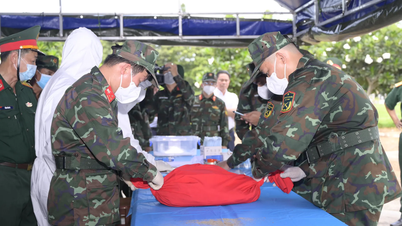
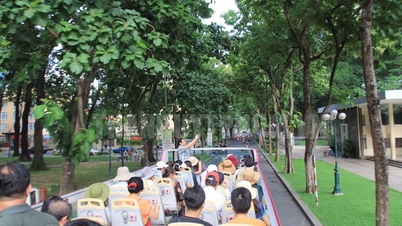
Amidst the scorching summer heat of Central Vietnam, soldiers from the Hue City Military Command and other forces are diligently excavating and collecting biological samples from 1,456 martyrs' graves at the Hue City Martyrs' Cemetery. The "500-day and night" campaign, implemented urgently, decisively, carefully, and accurately by the Steering Committee for the Search, Collection, and Identification of Martyrs' Remains (Steering Committee 515) of Hue City, aims to quickly identify the remains of fallen soldiers.

Expedite DNA sampling before the rainy season.
According to Lieutenant Colonel Thai Su Quan, a professional at the Hue City Military Command Clinic, before launching the "500 Days and Nights" campaign, the soldiers received training in Hanoi and then returned to instruct their comrades in the local area on how to collect samples.
“We carry out our work with a high sense of responsibility, strictly adhering to the sampling procedures, ensuring no mistakes occur. The ‘500 Days and Nights’ campaign carries profound meaning of gratitude, contributing to identifying the identities of martyrs and helping relatives find their loved ones who sacrificed their lives. Despite the harsh weather, the participating forces still strive to complete the task,” Lieutenant Colonel Thai Su Quan shared. In Hue, there are more than 7,000 martyrs' graves in 40 cemeteries that have remained unidentified for decades and need to be sampled for DNA testing. According to the Hue City Military Command, sampling in the “500 Days and Nights” campaign has currently been implemented in 6 out of 40 cemeteries. In the coming time, Hue is determined to accelerate the progress before the rainy season.
Colonel Ha Van Ai, Deputy Political Commissar of the Hue City Military Command, reported: Sampling work at cemeteries is progressing smoothly, with localities implementing the plan ahead of schedule. The rainy season in Hue is often complex, so the unit is accelerating efforts to complete the sampling work in August, prioritizing cemeteries located in areas at risk of flooding during heavy rains.
This campaign will collect samples from all unidentified graves in Hue City and send them to the National Steering Committee for genetic analysis. The sampling and digitization of information on the remains of fallen soldiers is being implemented vigorously but with caution and a scientific approach. The process is flexibly arranged according to weather conditions, taking advantage of early mornings and late afternoons during hot days to ensure both progress and quality, while also protecting the health of the personnel involved.

Delineating the search area for mass graves of martyrs in the Hue Imperial City.
Mr. Nguyen Van Manh, Vice Chairman of the Hue City People's Committee and Head of the Hue City 515 Steering Committee, said that in recent times, through information dissemination, some witnesses have provided valuable information to the 515 Steering Committee regarding mass graves of martyrs. Among these is an area near the West Gate inside the Hue Imperial Citadel.
“To date, after two rounds of field surveys and meetings, we are implementing various solutions to quickly identify the fallen soldiers and bring them back to rest in the cemetery. Besides disseminating information and gathering witness testimonies, we are encouraging those who may have information to provide clues to aid the search. At the same time, the unit is researching, learning from experience, and proposing support in terms of equipment and technology to develop a scientific and effective survey and excavation plan, contributing to the early identification of the fallen soldiers,” Mr. Nguyen Van Manh informed.
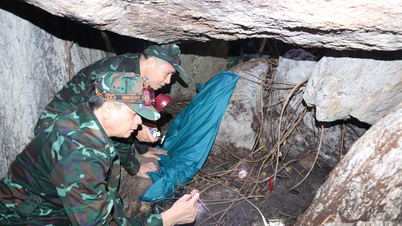
Previously, Mr. Nguyen Van Luot (70 years old, residing in Phu Xuan ward) provided information about having witnessed the mass burial of martyrs in a bomb crater near the Chanh Tay gate during the Tet Offensive of 1968. Several surviving witnesses in the area also confirmed similar information; furthermore, they provided information indicating that there were also martyrs' graves near the Huu gate (Southwest gate), the Hau gate (North gate), and the old Tay Loc airport.
Based on this information, with the support of the National Steering Committee 515 and international friends, the authorities contacted and received relevant documents from the United States. This suggests a high probability of mass graves of revolutionary forces from that era being located near the entrances to the Hue Citadel.




“The Tet Offensive of 1968 was a historical milestone in Hue, and the Citadel was the site of fierce battles. Information gathered so far confirms the immense sacrifices and losses suffered by the revolution. Therefore, we will combine specific locations with battle plans and operational diagrams to conduct a comprehensive review of sites where we believe there is a high probability of finding the remains of fallen soldiers,” Mr. Manh said.
According to a representative from the Hue City Military Command, based on information received from various sources, the unit conducted analysis, interviewed witnesses, and distributed survey questionnaires in each area to compile and cross-reference data. After assessing the high probability of finding the remains of fallen soldiers, the Hue City 515 Steering Committee recommended that the National Steering Committee and relevant agencies provide ground-penetrating radar equipment to survey the aforementioned locations. This is considered an important scientific basis for delineating and identifying locations with information.
The Steering Committee 515 of Hue City continues to promote the dissemination of information about the humanitarian significance of the "500-day and night campaign to search for, collect, and identify the remains of fallen soldiers," calling on historical witnesses, veterans, and citizens who have witnessed or heard stories from previous generations to provide information to connect the journey of searching for the heroic martyrs who fell for the country.
Source: https://baovanhoa.vn/doi-song/hanh-trinh-tim-lai-ten-cho-cac-anh-239652.html

![[Image] National conference summarizing one year of operation of the overall organizational model of the political system, the three-tiered government model.](https://vphoto.vietnam.vn/thumb/1200x675/vietnam/resource/IMAGE/2026/07/01/1782882811691_ndo_br_1-jpg.webp)