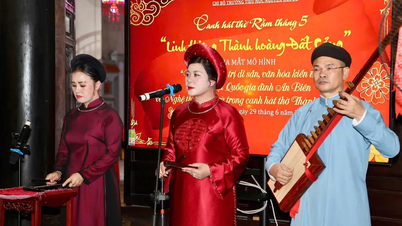
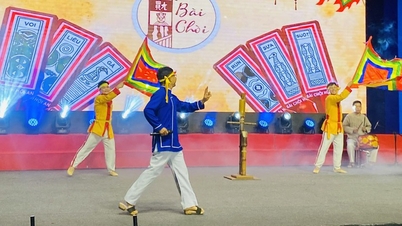
A scene from the excerpt "On Dinh beheads Ta".
Watch the artist transform.
Some people sat waiting early in the front row with professional cameras, while others enjoyed watching from the wings as the artists spent hours meticulously applying their theatrical masks.
The sun was getting intense. Even the powerful fans on either side of the stage, running at full power, couldn't alleviate the stifling heat. The audience below fanned themselves with their hands or used mini electric fans to cool down, yet the artists, dressed in layers of clothing, covered in flags and banners, and with thick layers of makeup, were drenched in sweat…
At exactly 9 o'clock, the ceremonial drums sounded, followed by the simultaneous sounds of trumpets, stringed instruments, percussion, and more, accompanied by the breathtaking appearance of the artists in their magnificent costumes. The audience gasped in delight, showering them with applause. The lively sounds served as an invitation, and the audience grew larger and larger. That day, the artists performed two classic excerpts, "On Dinh Executes Ta" and "The Swan's Dress," lasting approximately 70 minutes. The audience was captivated by the dazzling costumes, colorful theatrical masks, and the graceful horseback riding, sword-wielding, and other beautiful dance movements.
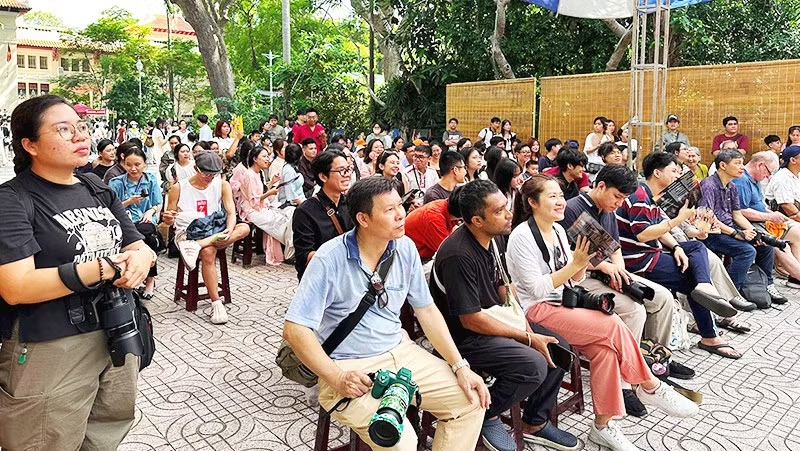


Audiences watch traditional Vietnamese opera at the City History Museum.
Getting closer to traditional Vietnamese opera.
The Q&A session with the audience was equally lively. Artist Thuy Quyen asked the audience about the formation of traditional Vietnamese opera (hat boi), the contributions of figures in its development such as the patriot Dao Duy Tu, Dao Tan, and General Le Van Duyet, along with questions about opera masks. The "challenge to be an artist" segment was full of laughter as audience members performed opera movements under the guidance of the artists, such as riding horses, rowing boats at varying speeds, mounting horses, and dismounting boats. At the end of the performance, the audience took photos and interacted with the artists in a warm and friendly atmosphere.
Audience member Tran Tan Vu, 22 years old, from Binh Phuoc (now Dong Nai), a student at the Ho Chi Minh City University of Culture, said: “This is my first time watching traditional Vietnamese opera. I was very excited to go on stage to interact and perform horse-riding movements under the guidance of the artists. I will share these pictures from today so that my friends can learn about traditional Vietnamese opera.” French photographer Ludovic shared: “I am very impressed and love the traditional Vietnamese opera of your country. I have seen it many times, here, at the Le Van Duyet mausoleum... Each time I watch it, I am captivated by the beauty of the artists, their movements, lyrics, and performances. I also like the musical instruments the artists play; they are very interesting and completely different from the musical instruments I have known before.” Ludovic took quite a few photos of traditional Vietnamese opera, from portraits of the artists, opera masks, colorful costumes, and posted them on his personal Instagram page.
Preservation through engagement with the people.
Over the past five years, traditional Vietnamese opera (Hát Bội) has experienced a resurgence, showcasing its unique beauty. Mr. Nguyen Thanh Binh, Head of the Performance Organization Department at the Ho Chi Minh City Traditional Opera Theatre, shared that the theatre is diversifying its content and performance spaces, no longer confined to the theatre or communal houses as before. It is now being performed in public places such as the city museum, the Le Van Duyet Mausoleum, and Nguyen Van Binh Book Street; "Hát Bội on the Boat" programs are being offered on Saigon River buses; and performances are being held at cultural centers and in remote areas. Regarding content, the theatre develops programs tailored to different audiences, with varying durations, such as promotional performances in public spaces, school stage programs introducing Hát Bội art to schools from elementary, middle, and high school to university; programs for children; and programs performed at village communal houses during the Ky Yen festival.
“In reality, when performed in public, traditional Vietnamese opera (hat boi) is loved by audiences, especially young people, tourists from all over, and international visitors. Audiences don't just passively watch; they interact, try singing along, paint on the opera masks… The sharing of audiences on social media also contributes to spreading the art of hat boi. This is a great motivation for artists and theaters to continue striving to contribute to the public,” Mr. Binh said.



As the audience leaves, the artists remove their makeup, the crew packs up the props, and prepares for the next performance. "Being able to perform and receive audience attention is a great happiness for an artist. It's also the most practical way for traditional Vietnamese opera to survive in modern life," artist Khong Minh Khuong confided.
According to Nhandan.vn
Source: https://baoangiang.com.vn/hat-boi-dang-den-gan-cong-chung-a490850.html




![[Photo] Strengthening character and expertise: Intense training for artillery soldiers.](https://vphoto.vietnam.vn/thumb/1200x675/vietnam/resource/IMAGE/2026/06/30/1782815602541_lu-368-1875-4571-jpg.webp)