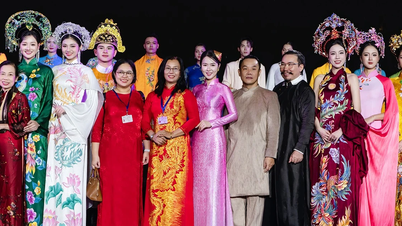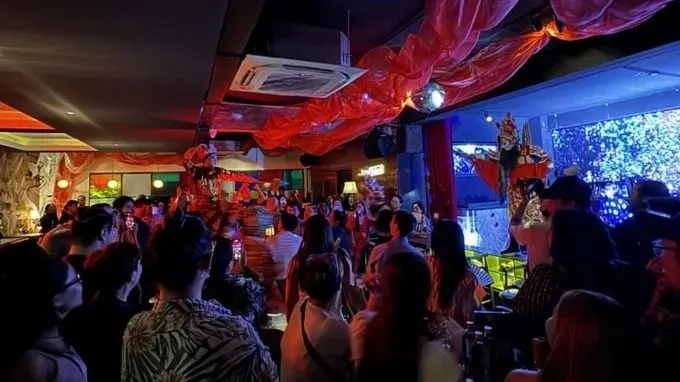
The model of bringing traditional Vietnamese opera (hat boi) into bars has been tested for over a year and has received mixed reactions. However, during the recent September 2nd holiday, the performance of hat boi in bars officially became professionalized, from organization and script development to performance and interaction. As soon as the information was officially announced, the number of customers to bars skyrocketed, with many bars being completely full for several consecutive days.
As an art form associated with temples and shrines, and with spiritually significant events like the Ky Yen festival or performances in formal theaters, the introduction of traditional Vietnamese opera (hat boi) into purely entertainment settings like bars has raised concerns among many: will it lose its inherent "sacredness"? In response to this question, many cultural researchers have frankly stated that it is the reverence felt by the audience that creates the "sacredness" of hat boi, not the performance space. The essence of hat boi is performance art, meaning it must be audience-oriented, adapting to the space and audience accordingly. In temples and shrines, hat boi adheres to traditional ritual standards. In theaters, hat boi offers a complete and full performance. And in open spaces such as sidewalks, parks, schools, and shops, hat boi reaches the public through its approachability, ease of listening, and accessibility. The appearance of traditional Vietnamese opera in bars or open cultural events does not diminish its core value; on the contrary, it affirms its contemporary vitality.


The issues of "preservation" and "development" always go hand in hand in the story of traditional culture. "Preservation" helps modern people establish their identity, connect with their ancestors, and maintain old customs amidst the flow of globalization. However, without "development," adaptation, and transformation to the times, traditional cultural heritage risks becoming isolated and gradually losing its foundation. Therefore, traditional art forms like hat boi (Vietnamese classical opera) must adapt and find their way into contemporary life – naturally, on the basis of understanding and respecting their core values.
For many years, museums and cultural spaces in Ho Chi Minh City have regularly organized performances of excerpts, seminars, and introductions to traditional arts for young audiences. A prime example is the traditional folk music genre, which originated from after-work performances on verandas and riverside docks, and is now performed in cafes and restaurants. This clearly demonstrates the adaptability and ability of cultural heritage to keep pace with modern life.
Whether or not to change the spaces for practicing certain cultural heritage needs to be considered more deeply: how to ensure that each innovation and expansion of space is based on knowledge and a sense of responsibility towards the heritage. We should not "frame" tradition as an immutable mold, but neither can we arbitrarily "renovate" heritage to chase fleeting trends. The important thing is that each step is directed towards a dual goal: protecting the identity and nurturing the contemporary vitality of cultural heritage.
From that perspective, bringing traditional Vietnamese opera (hat boi) into bars is not just a performance experiment, but also a lesson in how preservation can be combined with development. It shows that if we rely on solid understanding and the inherent value of the art form, we can transform modern spaces into a "launching pad" for traditional heritage. And it is the young public – who may seem unfamiliar with hat boi – who will become the new force to preserve and continue this unique art form.


Source: https://www.sggp.org.vn/hat-boi-o-quan-bar-post815151.html