What is a sweeper?
The sweeper, also known as the libero, is a crucial defensive position in football, with the term libero meaning "free man" in Italian. This position emerged in the 1960s, originating from the "Verrou" (pivot) tactic employed by coach Karl Rappan in Switzerland in the 1930s.
Liberos play behind the main defensive line and are not bound by any specific man-marking duties. Their primary role is to "sweep," providing cover for teammates when they are beaten, and preventing attacks before they reach the goal.
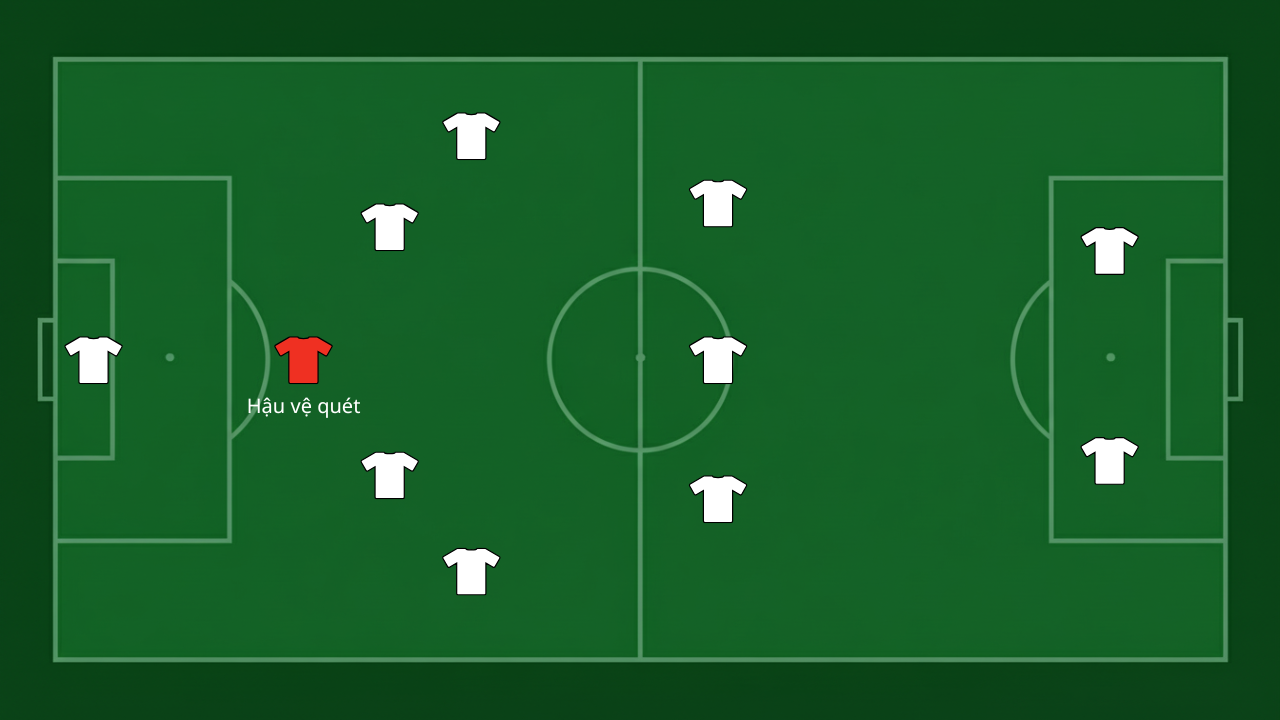
To succeed, sweeper defenders need excellent game reading and judgment skills, along with a broad tactical vision. They are not purely defensive but also play a crucial role in initiating quick counter-attacks with accurate long passes from the back.
This position reached its peak in the famous Catenaccio tactic of Italian football. Franz Beckenbauer is considered the person who shaped the role of the "modern libero," when he elevated this position to a creative and attacking playmaker.
Although once iconic, the traditional sweeper role is gradually disappearing in modern football due to the shift towards zonal marking instead of man-marking, along with changes to the offside rule.
What is the Catenaccio tactic?
Catenaccio is a football term of Italian origin, meaning "door latch." It is a tactical system that focuses heavily on defense, with the core philosophy being to protect the goal securely and minimize the opponent's scoring opportunities. Essentially, Catenaccio is built on a well-organized, effective, and highly disciplined defensive system.
The Catenaccio system is defined by several core tactical characteristics, making it one of the greatest tactics in football history.
| Characteristic | Detailed description |
| Mass defense | This involves using a large number of players in defense. This structure often includes a special player called a "libero" or "sweeper," who plays in the deepest position, behind the main defensive line. |
| The role of the Libero/Sweeper | This is the true "gatekeeper" of the system. The libero doesn't mark a specific opposing player but moves freely to "sweep" the ball, provide cover for other defenders when they are beaten, and is the last line of defense in front of the goalkeeper. |
| Tactical discipline | Catenaccio demands a very high level of discipline and tactical adherence. Defensive players must always maintain their positions and keep a tight formation to avoid leaving any gaps for the opponent to exploit. |
| Quick counterattack | Despite its defensive focus, Catenaccio is not an entirely negative tactic. Its strength lies in its lightning-fast counter-attacks. After regaining possession, the team will quickly launch attacks with long passes or rapid runs of technically skilled attacking players. |
| Man-marking | Essentially, Catenaccio utilizes the defenders' excellent man-marking skills to win one-on-one duels. The libero acts as a third player, ensuring absolute victory in these challenges. |
Decline and Legacy in Modern Football



Despite their former dominance, the role of sweeper defenders and the Catenaccio tactic have almost disappeared from top-level football today. The main reasons include:
- Changes to the Offside Rule : In the 1990s, the offside rule was amended to favor attacking players. A libero playing deeper than the main defenders would inadvertently break the offside trap, allowing opposing forwards to easily get through. This was a critical factor that diminished the effectiveness of this position.
- The Rise of Zonal Marking : Modern teams primarily employ zonal marking systems instead of man-marking. In a horizontal defensive system, each player is responsible for a specific area. The presence of a free-moving libero disrupts this structure, leaving an unprotected space and depriving the team of a player in other areas.
- The development of the pressing style of play : Modern football emphasizes high-pressure pressing and a fast tempo. The entire team must move forward synchronously to create pressure. A deep-lying libero is completely unsuitable for this philosophy.
- The evolution of other positions : The libero's function has been "broken down" and integrated into other positions:
+ Ball-playing Defender: Modern center-backs are required to have good ball-handling and passing skills to initiate attacks from the back.
+ Sweeper Keeper: Modern goalkeepers often play higher up the pitch to act as sweeper defenders, intercepting balls behind the defensive line.
+ Defensive Midfielder: Many defensive midfielders tend to drop deep between the two center-backs to receive the ball and orchestrate the play, taking on the organizing role of a libero.
Although no longer widely used, Catenaccio and the libero have left a profound legacy in defensive thinking and its evolution into another system called Zona Mista (Mixed Zone). This is a combination of the organizational nature of zonal defense and the "double man-marking" capability (1 defender man-marking + a sweeper providing cover) of Catenaccio. In this system, the sweeper moves freely while the other center-backs defend in their respective zones. Zona Mista is considered a model for modern defensive systems, demonstrating the evolution and adaptability of the Catenaccio philosophy.
Legendary sweepers
No one defined the role of the modern libero more clearly than the legendary German Franz Beckenbauer, nicknamed "Der Kaiser" (The Emperor). He is considered to have reinvented and elevated this position.
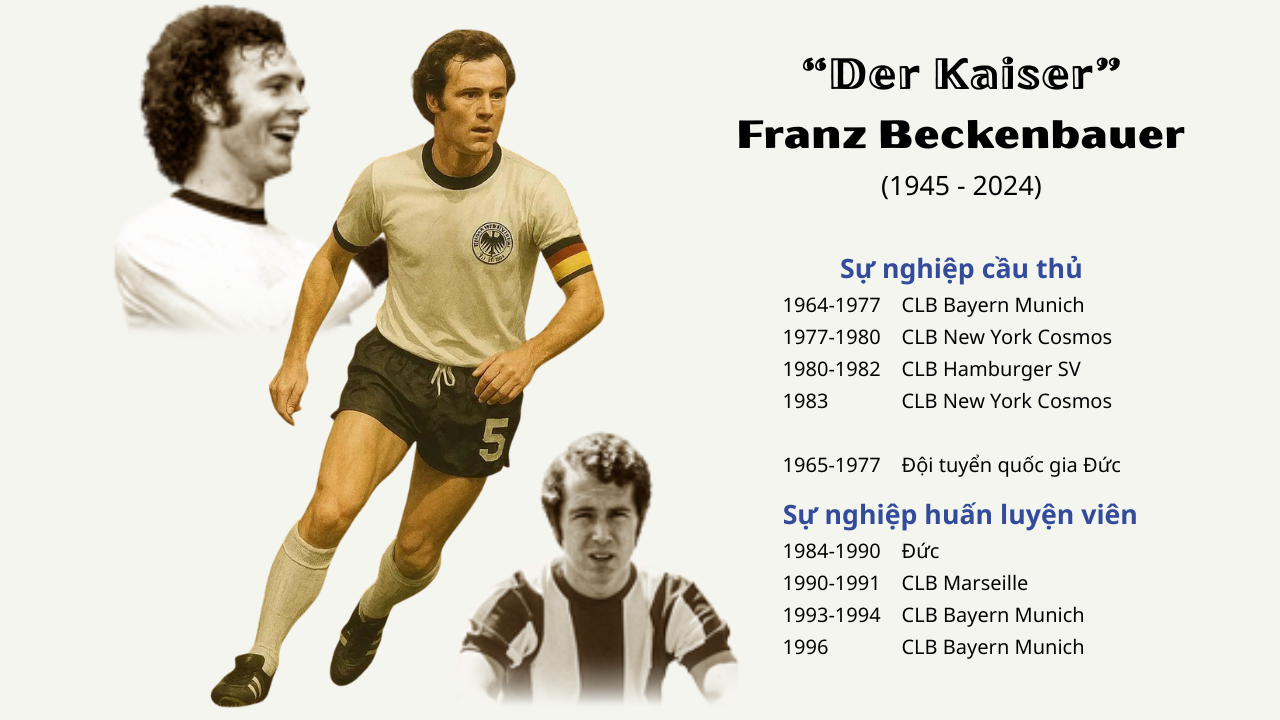
Beckenbauer began his career as a winger, then as a midfielder. However, he felt he could have a greater impact on the game from a deeper position, free from opposition marking. Inspired by the attacking runs of Inter Milan full-back Giacinto Facchetti, Beckenbauer urged coaches to deploy him as a libero.



Unlike early liberos who were purely defensive, Beckenbauer transformed the position into an attacking role. He exploited the space in front of him, accelerated with the ball at his feet, and distributed the ball with short and long passes with keen vision. He was not only one of the most talented players in history but also created a new tactical role for himself.
In this attacking libero role, Beckenbauer led West Germany to victory in Euro 1972 and the 1974 World Cup, and helped Bayern Munich dominate Europe with three consecutive European Cup titles.
- Gaetano Scirea (Italy): A legend of Juventus and the Italian national team, renowned for his intelligent, calm, and elegant playing style. He was the heart of the Italian defense that won the 1982 World Cup.
- Franco Baresi (Italy): An icon of AC Milan, a libero with exceptional game reading ability and commanding skills in defense.
- Matthias Sammer (Germany): The 1996 Ballon d'Or winner for his outstanding performance as a libero, combining solid defense with the ability to create chances and score goals, helping Germany win Euro 1996.
Source: https://vietnamnet.vn/hau-ve-quet-sweeper-la-gi-2474742.html



![[Image] National conference summarizing one year of operation of the overall organizational model of the political system, the three-tiered government model.](https://vphoto.vietnam.vn/thumb/1200x675/vietnam/resource/IMAGE/2026/07/01/1782882811691_ndo_br_1-jpg.webp)