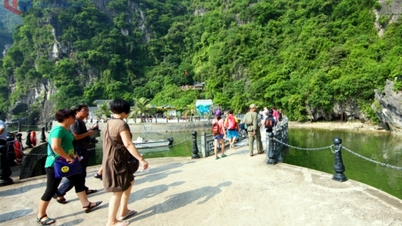
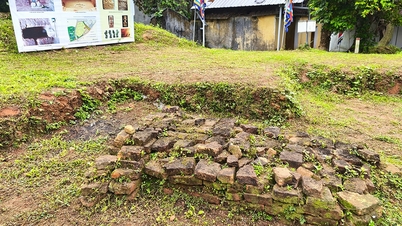
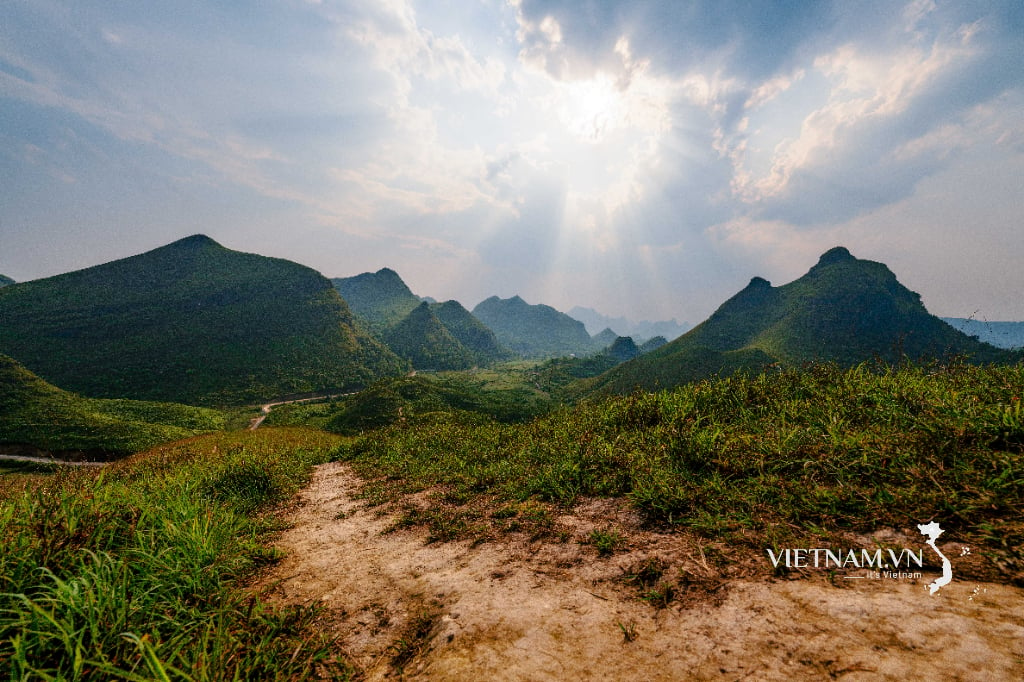
Standing by the paved road, presumably the old location of the train station, I fondly recalled the first day I followed my father to this second homeland to start a new life. My father was an official from the Iron and Steel Zone who had been appointed as the mine director. Back then, he would take me on his old Thong Nhat bicycle from Dong Quang station, through Thai Nguyen city, to Trai Cau Iron Mine. It was a region of rolling hills and mountains. Our family's thatched-roof house was located at the foot of the highest hill in the mining area, with the railway line running right below it. From the yard, I looked around and saw that every house had large pineapple plantations on the hillside. I took a deep breath; the fragrant pineapple scent enveloped me, even permeating my disheveled hair. For the first time, I was immersed in the scent of pineapples, and I stretched out my arms and chest, inhaling deeply into the vast expanse of the land and sky, savoring the moment.
The Trai Cau iron mine was then a crucial mining area in the country's nascent heavy industry. My father said that the iron ore mine was established before I was born. The Kep - Luu Xa railway line transported essential supplies and military weapons provided by our allies to the South to fight against the American imperialists, and more importantly, it transported tens of thousands of tons of ore each year to be used as raw material for the iron and steel production complex.

|
Illustration: Dao Tuan |
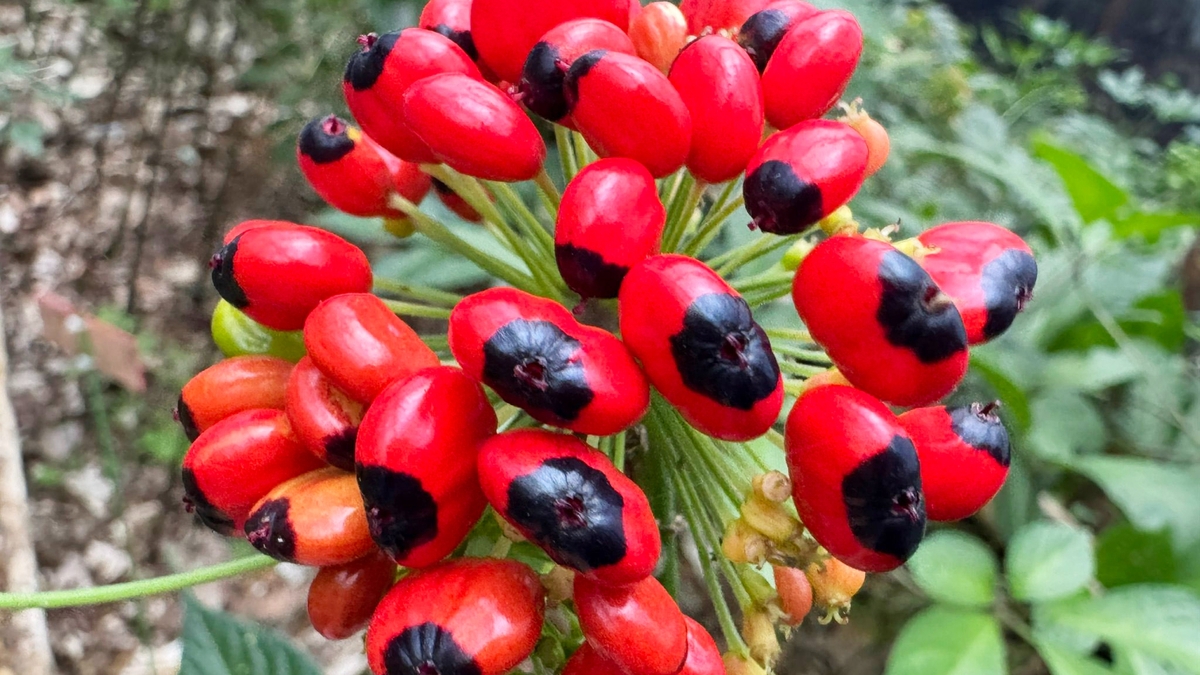
Every day, we children would go to school, herd cattle, and often climb onto the railway tracks, spreading our arms wide for balance as if it were a source of pride. Many times, we heard the railway worker recount how the small railway and station had witnessed the sacrifice of so many people. His stories of the railway were like legends… I listened intently, absorbing every word. The railway line that passed through my village was a bypass route, going through a tunnel in the mountains. A short distance past that was the Khuc Rong station. I wonder if it's because the slightly winding track made the trains seem to fly into the station that it got its name, Khuc Rong (Dragon's Curve). During the war against the Americans, this section of track and the station were constantly bombed and destroyed, requiring frequent restoration. But the trains still stood firm, steadily carrying their full loads of goods southward. But back then, there was something strange: although the ginger flower hill was devastated by bombs, a very long patch of ginger growing next to the bomb crater seemed to forget the bombs and bullets, and the flowers continued to bloom. The patch of flowers stretched out, leaning in the sun, looking like a bright red scarf covering a corner of the hill. Despite dozens of bombing raids, the ginger flowers still bloomed profusely. At that time, no one could explain this strange phenomenon.
For me, the ginger patch holds an unforgettable memory. Once, on my way home from school, I stood on tiptoe, reaching out to pick a ginger flower, when I slipped and fell into a bomb crater. While struggling desperately in the deep water, I vaguely felt someone grab my hair and pull hard. I lay there unconscious, my eyes closed. When I woke up, I saw Kien, a classmate, his eyes red and swollen, whispering:
- You're awake now. Don't be so reckless next time.
Thinking back to that near-drowning incident, I often chuckle to myself. If Kien hadn't been there that day, I don't know what would have happened. Actually, I knew that picking flowers on the edge of a bomb crater like that was very dangerous, but my love for ginger flowers was so deep that I took a bit of a risk. Ginger flowers are not only beautiful, but according to my grandfather, a renowned traditional healer, they are also a precious medicinal herb. Because I loved medicine and wanted to follow in my grandfather's footsteps, I always sought out folk remedies for medicinal plants to use in my studies later.
You may also like
Beekeeping 'artisans'QTO - In Minh Hoa mountainous commune, when mentioning Mr. Dinh Long (75 years old), beekeepers affectionately call him "master." This is because, with over 30 years of experience in the profession, Mr. Long's beekeeping techniques have reached the level of a "master craftsman." What is truly admirable is that Mr. Long doesn't keep his knowledge to himself, but diligently "passes on" it to hundreds of farmers in the surrounding area, helping them rise out of poverty and become wealthy through beekeeping for honey production. 
Artist Ngo Xuan Khoi: AI is not a match for painters.The trend of using AI to design book covers and illustrate literary works is sparking much debate in the creative community. Supporters see it as an irresistible trend; opponents argue that it is an abuse of technology, eroding the identity and visual memory of reading culture. Regarding this issue, a reporter from Nghe An Newspaper and Radio and Television had a conversation with artist Ngo Xuan Khoi (from Nghe An province) – who has been involved in book cover design for nearly 30 years. From then on, Kien and I became closer. Kien joined the girls in our neighborhood. Every afternoon, he would follow us up the hill to chop firewood and break brooms. When we came back, our mouths were all black from eating the plump, ripe, sweet sim berries. We would look at each other and laugh uncontrollably. Some afternoons, we would sneak away from our parents to catch fish in the ditches, wade in the mud to catch eels and mudfish, cover the fish with mud to grill them, and have a feast right by the small stream in the forest. The most fun was when, on those occasions, Kien would always pick a bunch of ginger flowers for me amidst the thunderous applause of our friends. Back then, we all knew I had a special affection for ginger flowers, a traditional Vietnamese medicine.
Time flew by, and we grew into awkward young men and women. After the university entrance exams, we parted ways, each pursuing our own dreams. I studied medicine. Kien, on the other hand, passed the economics entrance exam but deferred his studies to fulfill his military service.
The evening before he left, Kien came to my house, holding a bouquet of bright red ginger flowers. He mumbled a gift for me: a handkerchief with our names intertwined on it. Although it was somewhat sudden and I wasn't mentally prepared, I accepted it wholeheartedly and with deep emotion. The next day, Kien had to march north. These were mementos from the departing to the one being left behind. For some reason, that day, Kien uttered a remarkably beautiful sentence:
- Wait for me to come back, "Red Ginger Flower"!
Kien marched to the northern front while I went to medical school. Kien wrote home very often. He told me many stories, but what made me happiest was when he mentioned that the area where he was stationed had vast fields of red ginger flowers. I also wrote to Kien, sharing that I chose medicine because my maternal grandfather was also a military doctor who served in many battlefields. Before he passed away, he had left his research on the red ginger plant unfinished, and I really wanted to continue his work. I promised Kien that after graduation, we would go to the northern mountainous region together. With the red ginger plant, I would research medicine, and Kien would help the local people develop their economy.
***
But our good intentions didn't come to fruition. Kien sacrificed his life on the day I was studying for my final exams.
Keeping my promise to Kien, after graduation, I visited his unit, where he served and fell. Kien's grave lies amidst a forest of red ginger flowers. My eyes welled up with tears as the commander recounted how bravely Kien fought, holding his position to the last bullet. Blood gushed from his chest, yet he refused to retreat to the rear. When he died, one hand still clutched his rifle, the other held a bouquet of blood-stained ginger flowers.
After graduating with excellent academic achievements, I was assigned to the Central General Hospital, but I volunteered to go to the highlands, where Kien's old unit was stationed, a vast area of hills covered with red ginger flowers. There, I always felt like I was gazing at the ginger flower fields with him.
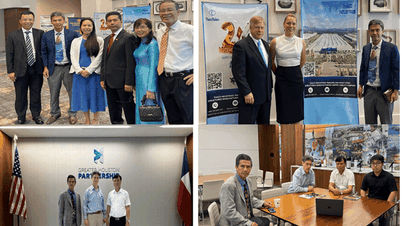
Strengthening the friendship between Vietnam and the United States.On July 3rd, as part of the Pacific Partnership - Friends of the Pacific 2026 program, the U.S. Army Pacific delegation, led by Lieutenant General Joel Vowell, Deputy Commander of the U.S. Army Pacific, paid a courtesy visit to the Quang Tri Provincial Military Command. As the deputy director of the district hospital and head of the Traditional Medicine Department, I have utilized local medicinal resources, especially red ginger, to prepare for a national-level research project on traditional Vietnamese medicine. I have gathered sufficient evidence to demonstrate the possibility of combining Western and traditional medicine to treat coronary artery disease, kidney disease, and peripheral hemorrhage using red ginger.
***
Today I returned to Trai Cau. Kien is no longer there. I wandered along the new streets, trying to recall the images of the past. I tried to picture the railway, the small station, the bomb craters, the patches of ginger plants with their year-round red flowers. I suddenly remembered the story of the patch of ginger flowers that never faded beside the bomb craters, despite dozens of bombing raids. In a faint glimmer of hope, I hurried towards the ginger flower hill of yesteryear. Unexpectedly, from afar, I recognized the patch of red ginger flowers. The bomb craters had been filled in, but the patch of ginger flowers remained almost unchanged. The flowers, blooming at an angle, stretched out in the sunlight, still looking like a crimson shawl covering a corner of the hill. It seems that when building the park, the designers intentionally preserved the patch of ginger flowers as a relic of war. And rightly so. I remember that patch of ginger flowers was a strange phenomenon, a miracle of Trai Cau that no one has been able to explain to this day.
Tears welled up in my eyes as I gazed at the patch of ginger flowers before me, my heart filled with thoughts of Kien. It was here that he had brought me back to life. His hands had picked and cherished each ginger flower petal to give to me as a token of our friendship and first love. Those flowers were stained with so much blood and tears. Standing before the shimmering blossoms in the sunlight, I suddenly realized something: it seems there are certain flowers of love in this world that, despite being crushed, destroyed, and suffering the pain of separation, never fade. For me, and for Kien too, that was the red ginger flower.
Source: https://baothainguyen.vn/van-hoa/202601/hoa-dong-rieng-do-tham-79c0758/