Winter honey specialty
March is the season when bees collect honey. That's the usual practice, but in the mountainous region of Minh Hoa, for many years, based on accumulated experience, Mr. Dinh Long has also been "making" his bee colonies produce honey in the winter.
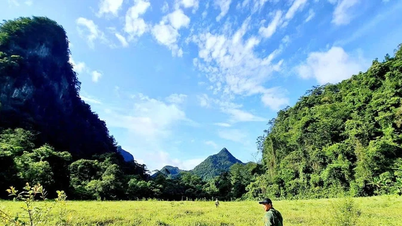
According to Mr. Dinh Long, the communes in the former Minh Hoa district have large areas of natural forest, a clean climate, and abundant wild flowers, so beekeeping for honey production has long been very developed, bringing significant income to the people.
Most forest trees bloom in spring, but nature always holds many wonders. In the Minh Hoa region, there are two types of forest trees that bloom in winter: the Tri-leaf tree and the Five-Leaf Aralia. Coincidentally, these are two species of flowers classified as precious "medicinal herbs," highly favored by honeybees.

|
With its vast area of natural forests, Minh Hoa district has a thriving beekeeping industry for honey production - Photo: PP |
"The 'tría' tree is a tall, large tree that grows in clusters in mountainous areas. The 'tría' tree flowers around the 11th lunar month. Its flowers are white, have a light fragrance, and are rich in nectar and pollen."
During the flowering season of the Triangular Ixora plant, bees only need the first two days to collect pollen and three days to produce honey. By the sixth day, the bees have filled the honeycomb with honey and sealed it with a cap (creating a thin membrane to seal the honeycomb). Triangular Ixora honey has a yellowish-white color, a subtly sweet taste, and a light aroma.
Following the season of the Terminalia catappa flower is the season of the Schefflera arboricola flower, a plant traditionally used as a medicine to relieve coughs, prevent cancer, and lower blood pressure. Schefflera arboricola flower honey also has a pale white color, a sweet taste with a slight bitterness afterwards,” Mr. Dinh Long shared.
According to Mr. Long, honey from the flowers of the Terminalia catappa and Acanthopanax senticosus trees is very valuable. Besides their medicinal properties, these two trees only bloom in winter, at the end of the year. At this time, the weather is cold and dry, resulting in honey that is thick and has a low moisture content, only about 20%.
Therefore, from the 11th lunar month to the 2nd month of the following year, when bees in other places usually "hibernate," the bees at Mr. Long's house, thanks to careful care and "training," diligently collect nectar from flowers, producing the special winter honey that brings a considerable income to his family.
Diligently passing on the craft.
In the Minh Hoa region, Mr. Long was perhaps the earliest to take up beekeeping. In 1990, after many trips through mountains and forests to collect honey, he decided to bring a few wild bee colonies back to his garden to "domesticate" them.
However, things are not that simple. Due to the lack of proper beekeeping techniques, wild bees remain highly untamed; they stay where they like and fly away when they don't, so the income from beekeeping is negligible.
Mr. Long's real opportunity came in 1996 when the "Food Security" project, funded by the German government , was implemented in Minh Hoa. One of the project's key components was teaching beekeeping to local people, and Mr. Long was one of the first households selected for the pilot project.

|
Mr. Dinh Long takes care of his family's bee colony - Photo: PP |
With his inquisitive nature and technical support from the project, Mr. Long found a way to keep his wild bees attached to his home and achieve the desired honey yield. After a long period of accumulating experience, Mr. Long's beekeeping techniques have reached the level of a "master craftsman." Not only is he highly experienced in beekeeping, but he is also a "master" in the techniques of creating new queen bees and splitting colonies for sale.
Currently, Mr. Long not only earns income from selling honey but also successfully breeds hundreds of bee colonies. His bee colonies are sold for 600,000 VND each and are highly favored by beekeepers who trust in their guaranteed quality and ease of care.
What is truly admirable is that, throughout more than 30 years of beekeeping, Mr. Dinh Long never kept his skills a secret but instead "passed on" them to hundreds of other farmers in the region, helping them escape poverty and become wealthy.
Mr. Dinh Long was formerly the Chairman of the Beekeeping Association of Minh Hoa district (formerly). Currently, he is the Director of Xuan Hoa Beekeeping Cooperative. From the first experimental bee colonies raised as part of the "Food Security" project, beekeeping for honey production has now developed widely throughout the communes of Minh Hoa district (formerly), with over 2,000 colonies and revenue reaching tens of billions of VND.
Dr. Ngo Van Hong, Director of the Center for Research on Resource Management in Highland Areas (under the Vietnam Union of Science and Technology Associations) - an organization with many years of experience in research projects on indigenous knowledge and livelihood support for the poor and ethnic minority communities - said: For decades, Mr. Dinh Long has been considered the "main lecturer" in the workshops and technical training courses on honey beekeeping organized by the center.
Even now, at the age of 75, Mr. Long still doesn't mind traveling long distances, riding his motorbike hundreds of kilometers to "teach his trade" to farmers in many localities throughout the province.
Phan Phuong
Source: https://baoquangtri.vn/xa-hoi/202602/nghe-nhan-nuoi-ong-d9948aa/


![[Image] Nearly 125,000 Hanoi students completed the Literature exam for the 10th grade entrance exam.](https://vphoto.vietnam.vn/thumb/1200x675/vietnam/resource/IMAGE/2026/05/30/1780117233041_ndo_br_thiet-ke-chua-co-ten-2-png.webp)












































































Comment (0)