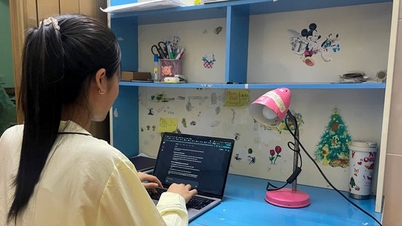
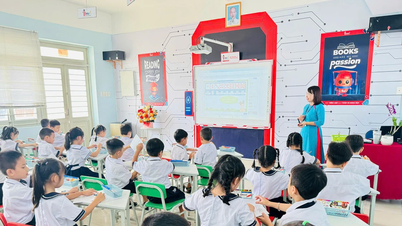
Digitization not only reduces the pressure of storing paper records but also contributes to building a synchronized educational database, serving the digital transformation of the entire sector.
A significant step forward.
Starting from the 2023-2024 school year, Ho Chi Minh City will pilot the implementation of digital school records for first-grade students in primary schools, using personal identification codes to manage data. The model will then be expanded to secondary and high schools, contributing to the modernization of student learning information management and storage.
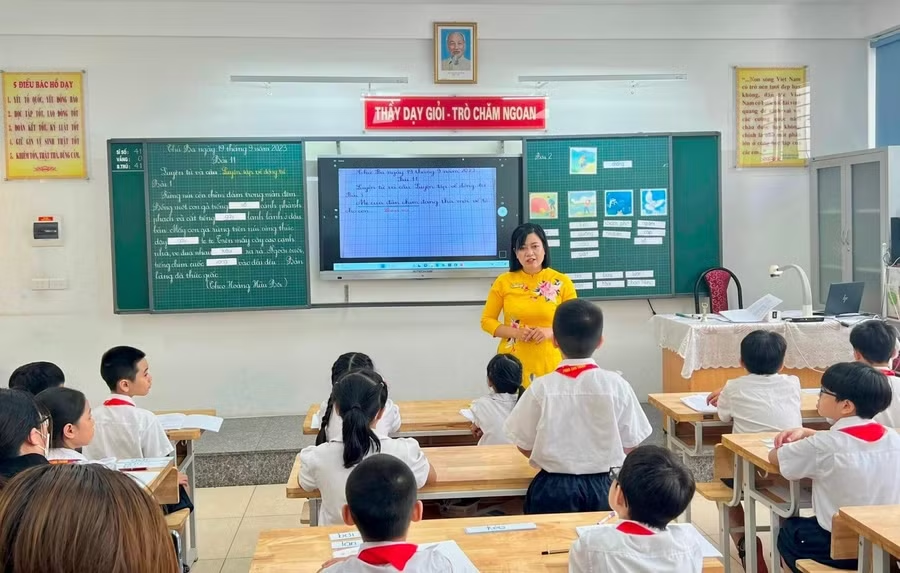
As a direct user of the system, Ms. Nguyen Thi Thanh Thao from Thuan Kieu Primary School (Dong Hung Thuan Ward) said that digital student records bring many practical benefits. Students' academic and behavioral results are updated directly on the system, ensuring centralized and accurate data storage, making retrieval convenient. Teachers can continuously monitor each student's learning progress to provide timely support or encouragement.
According to Ms. Thao, digital school records also significantly reduce the volume of paper documents and minimize errors in manual record-keeping. The processes of compiling, statistically analyzing, and reviewing data at the end of each semester or school year are carried out more quickly and conveniently.
From a management perspective, Ms. Phan Thi Thu Hien, Deputy Principal of Tran Thi Buoi Primary School (Phuoc Long Ward), believes that digital school records have created positive changes in school administration, contributing to promoting digital transformation and building a modern, transparent management environment.
According to Ms. Hien, all student data is now managed in a digital environment, significantly reducing administrative paperwork and enabling the school administration to monitor, check, and supervise students' academic performance more promptly and accurately.


Similarly, Ms. Pham Thuy Ha, Principal of Dang Tran Con Primary School (Vinh Hoi Ward), informed that digitizing student records helps schools reduce the need to dedicate significant space to storing paper documents, while also minimizing the risk of loss or damage to materials. Learning data is stored centrally on a digital system, ensuring security and convenience for access and use.
The application of digital student records combined with digital signatures enables quick and accurate operations in an electronic environment, reducing administrative pressure so that teachers can focus on their professional work. All updated and edited information regarding grades and comments is tracked, thereby enhancing transparency and the effectiveness of monitoring and supervision.
Reduce paperwork, increase transparency.
Ms. Phan Thi Thu Hien stated that digital school records not only improve the efficiency of school management and operation but also bring many benefits to students and parents. Through educational management systems, parents can quickly, transparently, and continuously monitor their children's academic performance and conduct. Meanwhile, students' academic records are stored securely and accurately, making it convenient when transferring schools, changing grades, or participating in admissions processes.
According to the Deputy Principal of Tran Thi Buoi Primary School, connecting and synchronizing data from the school to educational management agencies helps improve the efficiency of statistics, forecasting, and policy development. This is also the foundation for forming a unified educational database, serving the digital transformation process of the sector.
In particular, in procedures such as student admissions, school transfers, or academic record verification, digital transcripts demonstrate clear effectiveness as student information is directly accessed from a verified database. This reduces paperwork, shortens processing times, and ensures the accuracy and consistency of the data.
Sharing the same view, Ms. Pham Thuy Ha stated that in the context of Ho Chi Minh City promoting enrollment at the primary level using digital maps (GIS), digital school records combined with the population database have effectively supported the process of student placement and admission. For schools, the process of receiving transfer students is also simplified as learning data is transferred directly on the system, ensuring completeness, accuracy, and interoperability.



Verifying academic results through digital signatures and student identification codes significantly shortens processing time and reduces the risk of falsification, alteration, or inaccuracies in academic transcripts. This not only enhances transparency but also increases the reliability of data in management and use.
Digital school records not only serve student management but also become a crucial data source for educational policy planning. Through a real-time updated data system, management agencies can monitor student distribution and movement between areas and identify overcrowded zones. This provides a basis for the education sector and the city to build schools, allocate resources, regulate the teaching staff appropriately, and improve forecasting and better meet students' learning needs. - Ms. PHAM THUY HA - Principal of Dang Tran Con Primary School (Vinh Hoi, Ho Chi Minh City)
Source: https://giaoducthoidai.vn/hoc-ba-so-thay-doi-cach-quan-tri-post781371.html
![[Photo] Opening Ceremony of the 13th National Congress of the Ho Chi Minh Communist Youth Union](https://vphoto.vietnam.vn/thumb/1200x675/vietnam/resource/IMAGE/2026/06/24/1782286753905_ndo_br_1-8510-jpg.webp)

![[Photo] The 13th National Congress of the Youth Union conducts personnel work.](https://vphoto.vietnam.vn/thumb/1200x675/vietnam/resource/IMAGE/2026/06/24/1782299943080_ndo_br_1-6868-jpg.webp)
![[Photo] General Secretary and President To Lam attends the Central Public Security Party Committee Conference](https://vphoto.vietnam.vn/thumb/1200x675/vietnam/resource/IMAGE/2026/06/24/1782302063612_a1-bnd-9302-9166-jpg.webp)