

 |
Students of Ho Chi Minh City University of Technology. Illustration photo: Phuong Lam. |
In 2026, many training programs will continue to receive strong government support in terms of tuition and living expenses to attract human resources for essential, hard-to-recruit, or strategically important fields. This priority will not only be given to teacher training programs, but also to numerous fields within the military, police, medical, and science and technology sectors.
The majors are eligible for tuition fee exemption or reduction.
According to Decree 81/2021/ND-CP, students studying pedagogical majors such as Preschool Education, Primary Education, Secondary Education, High School Education , Special Education, Physical Education, or National Defense and Security Education are exempt from all tuition fees.
In addition, Decree 116/2020/ND-CP stipulates that teacher training students will receive an additional living allowance of 3.63 million VND/month for a maximum of 10 months each academic year.
However, after graduation, if students do not work in the education sector within two years or do not meet the required time period, they must repay all tuition and living expense support received.
Besides teacher training programs, schools under the police and military sectors continue to apply a policy of 100% tuition fee exemption for military programs. Students not only receive tuition support but also a living allowance, food allowance, and are guaranteed employment after graduation according to regulations. However, this policy only applies to military training programs and not to civilian programs within the schools.
In the healthcare sector, the Law on Medical Examination and Treatment, effective from January 1, 2024, stipulates many support policies for students studying specialties facing personnel shortages such as psychiatry, pathology, forensic medicine, forensic psychiatry, infectious diseases, and emergency resuscitation.
Accordingly, students studying these subjects at state-run health-related training institutions will receive full tuition and living expense support throughout their course of study. For students at private training institutions, the state will provide equivalent support as stipulated.
In addition, students with satisfactory academic and training results are also awarded scholarships to encourage learning. Those working at medical facilities in disadvantaged or extremely disadvantaged areas are also eligible for policy-based scholarships as prescribed.
Occupations and professions that are difficult to recruit for but are in demand, as listed in the catalog prescribed by the Ministry of Labor, Invalids and Social Affairs, are also 100% exempt from tuition fees. This catalog includes 36 fields such as wood carving, lacquer and mother-of-pearl inlay techniques, shipbuilding technology, rubber processing, forestry, fisheries, waste treatment, water supply and drainage, and bridge and road construction...
In addition to majors with completely free tuition, Decree 238/2025/ND-CP also expands support to many traditional arts, hazardous occupations, or those with low enrollment rates. According to the regulations, students studying majors such as Cheo, Tuong, Cai Luong, court music, Ca Tru, Bai Choi, traditional musical instrument performance, dance, circus, etc., will receive a 70% tuition fee reduction.
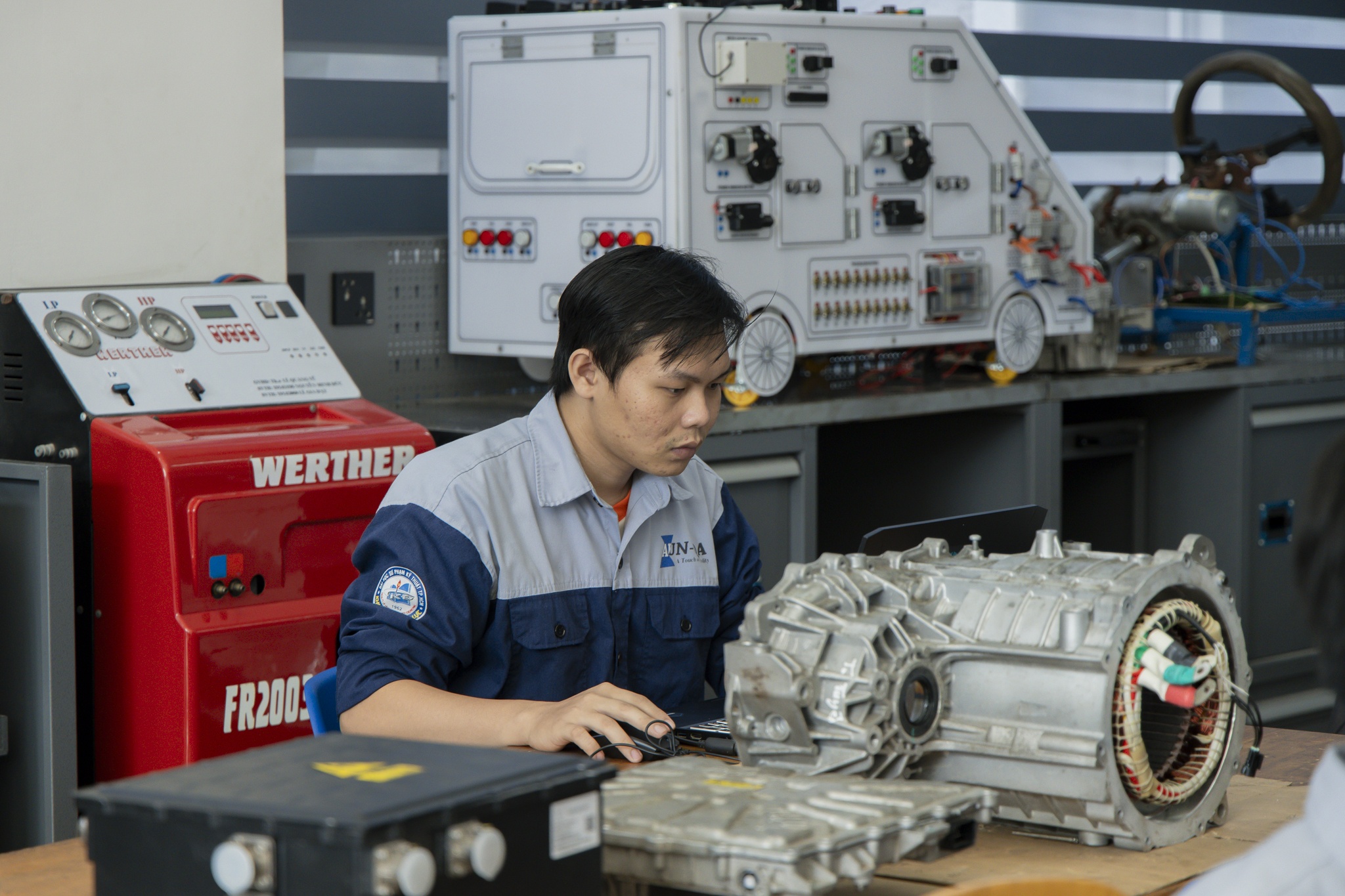 |
Engineering students at Ho Chi Minh City University of Technology. Photo: Phuong Lam . |
Scholarship policy for STEM students
One of the most notable points in 2026 is the first-ever large-scale scholarship policy issued by the Government for key basic science, engineering, and strategic technology sectors, as stipulated in Decree 179/2026/ND-CP.
The policy applies to students enrolled in gifted programs, semiconductor programs, or key science and technology fields. The list includes 15 subject groups such as Biology, Mathematics, Statistics, Computer Science, Information Technology, Mechanical Engineering, Electrical and Electronic Engineering, Chemical Engineering, Engineering Physics, Mining Engineering, and Civil Engineering.
According to regulations, university students are eligible for scholarships ranging from 3.7 million to 5.5 million VND per month, depending on their field of study and program. The maximum support period is 10 months per academic year, lasting no more than 4 years for bachelor's programs and 5 years for engineering programs.
However, the scholarship eligibility requirements are quite strict. For applicants applying based on high school graduation exam scores, the total score in Mathematics and two of the following subjects (Physics, Chemistry, Biology, or English) must be 22.5/30 or higher, excluding priority points. Furthermore, applicants must be among the top 30% of applicants nationwide with the highest admission scores for their chosen field of study.
During their studies, students must maintain the required academic performance and accumulated credits, and must not receive any disciplinary action at the level of reprimand or higher in order to continue receiving the scholarship.
Notably, the entire scholarship review and disbursement process is conducted based on the enrollment, academic, and training data managed by the educational institution. Students do not need to submit applications or complete any additional administrative procedures.
Source: https://znews.vn/hoc-nganh-gi-de-duoc-mien-hoc-phi-trong-nam-2026-post1653879.html























































































Comment (0)