

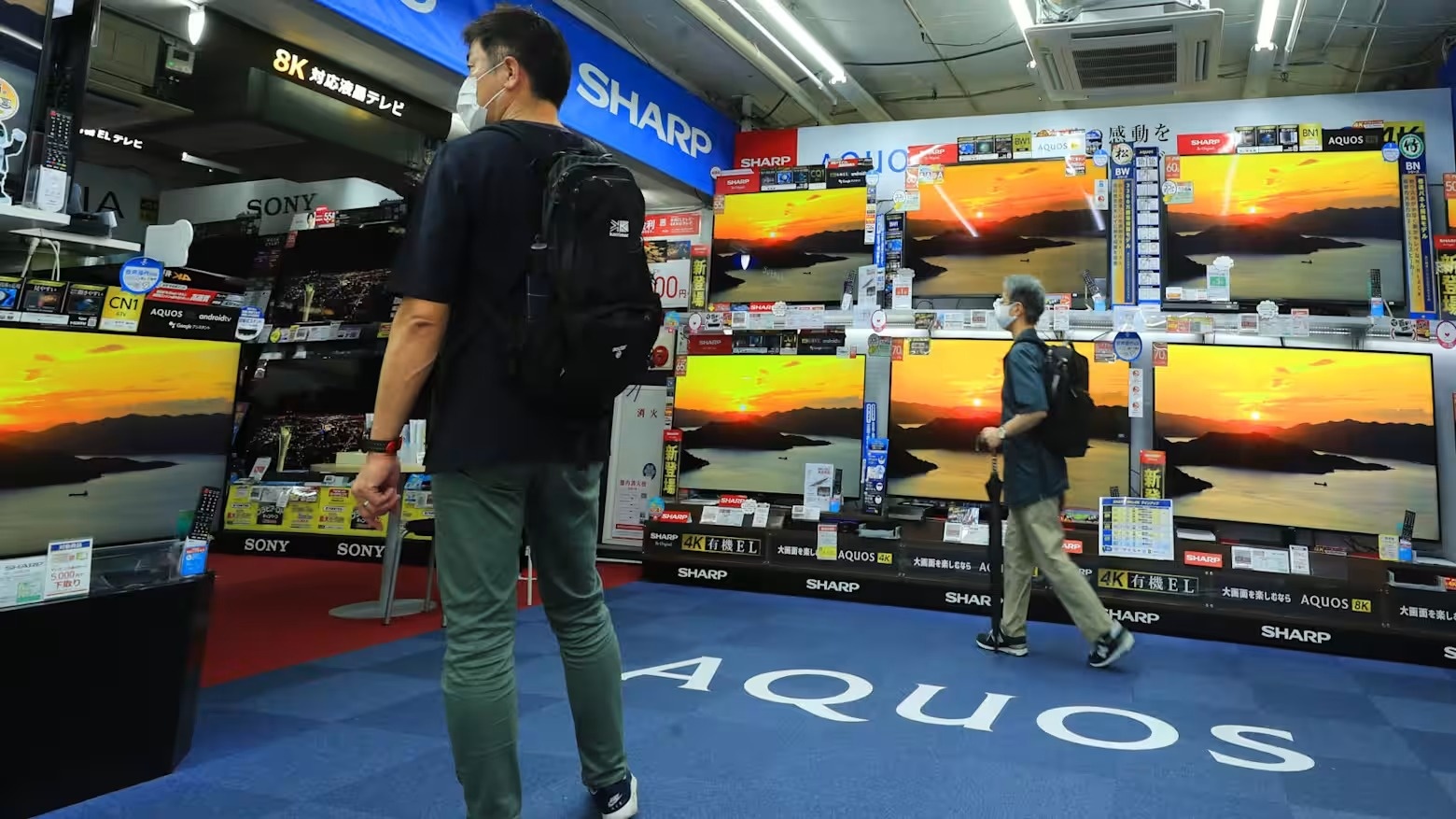
Once dominating the global TV industry, dominating market share and leading in technology, Japan faces the risk of having no manufacturers left in this sector. One by one, the major players are exiting the market, selling themselves or licensing their brands to foreign partners.
Despite their brand value and consumer trust in many countries, these companies' actual sales and technological content are no longer competitive. Strategic mistakes in choosing flat-panel display solutions or a lack of innovation have pushed Sony, Sharp, Toshiba, and JVC out of the territory where they once led.
Period of Domination
In the 1980s and 1990s, Japanese companies emerged and almost completely dominated the global electronics market. Around the 1980s, Japan surpassed the United States to become the world's largest manufacturer and exporter of color TVs.
This success stems from a superior technological foundation. Although Americans invented the television, it was Japanese companies that truly perfected it. In 1968, Sony introduced Trinitron cathode ray tube (CTR) technology. Unlike its competitors' Shadow Mark (hole mask) solution, the Japanese company used an aperture grid that allowed more electrons to pass through, resulting in brighter, sharper, and more vivid images. Trinitron became the global standard for televisions for 30 years. Sony easily priced its TVs 30-50% higher than its competitors and still sold out.
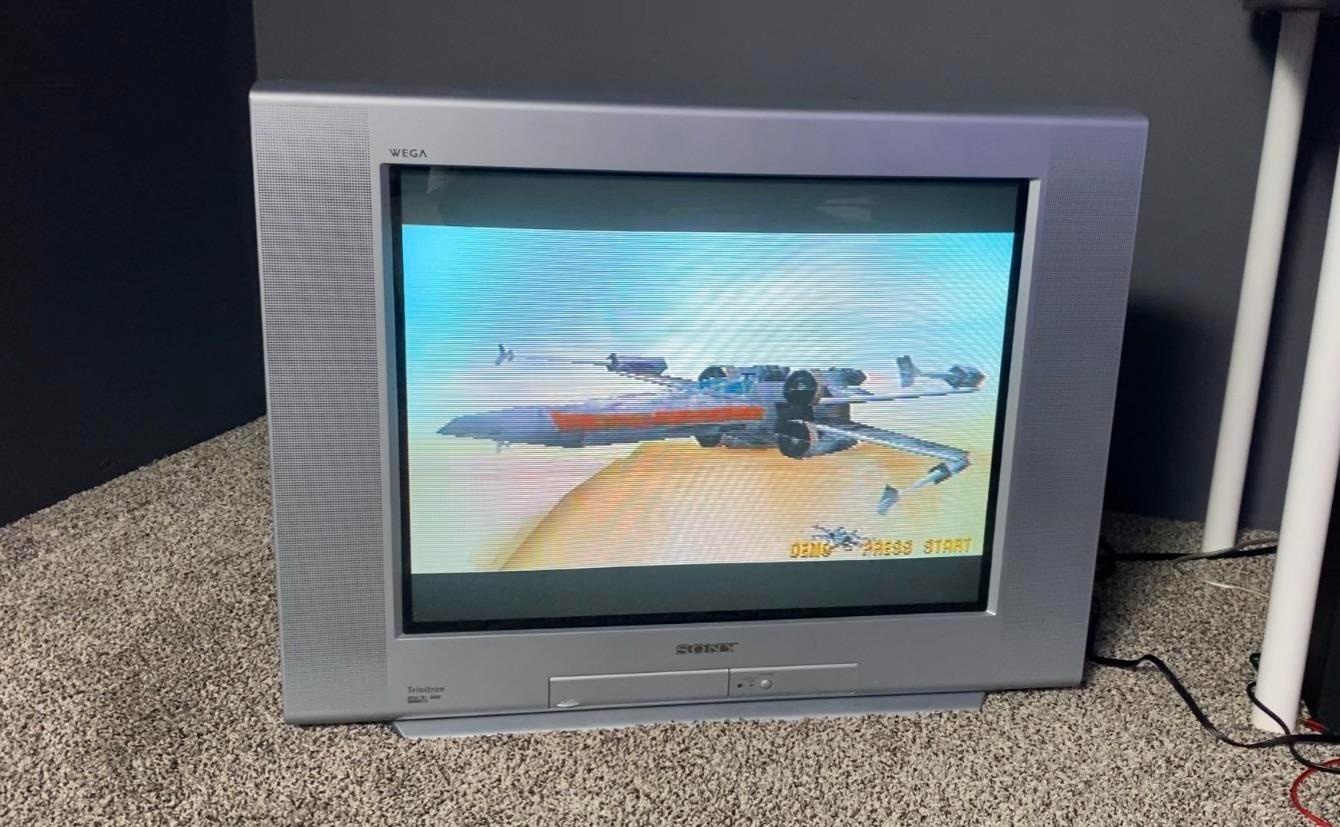 |
Sony Trinitron TVs helped the Japanese company dominate the market for decades. Photo: Reddit. |
Similarly, other Japanese companies also have outstanding R&D foundations, creating their own competitive weapons. Panasonic (formerly Matsushita) is famous for its optimized processes and robust durability. Sharp, since the 1980s, has been developing LCD (liquid crystal) and is considered the pioneer of this technology. Toshiba and Hitachi lead in signal processing technology and semiconductor TV manufacturing.
During their dominant period, Japanese companies pursued vertical development. This model prioritized in-house manufacturing, with each internal component produced by the company itself. This allowed them to control the quality of individual parts, optimize profits at every stage, and maintain technological secrecy. In the analog era, where precision engineering and material quality were key, companies like Sony, Sharp, and Toshiba demonstrated their global strength.
The long-term success of these Japanese companies has also positioned them highly among consumers in many countries. In developing markets such as China, Southeast Asia, and Latin America, owning a Sony or Panasonic color TV has become a symbol of achievement.
The period of mistakes
The Japanese TV industry didn't collapse overnight; it stemmed from small cracks that appeared in the early years of the millennium. This period saw a shift from CRT to flat-screen TVs. Japanese companies stumbled in the face of the powerful rise of Samsung and LG.
As the CRT era ended, TV manufacturers had to choose between betting on LCD or Plasma. Engineers at Panasonic, Pioneer, and Hitachi believed that Plasma was the future of large-screen TVs. It offered good contrast, deep blacks, and wide viewing angles. They invested billions of dollars in this solution.
 |
Plasma TVs were a poor choice for Japanese manufacturers. Photo: Abt. |
Samsung and LG also produce Plasma TVs, but they clearly saw the potential in LCDs. Although starting from a lower quality, liquid crystal technology is easier to manufacture and more versatile. Over time, the weaknesses of LCDs were overcome, while their prices quickly dropped and they became more accessible to consumers.
Conversely, plasma TVs, with their heavy structure and difficulty in cost reduction, consistently resulted in higher prices compared to competitors. Companies that chose this solution suffered heavy losses, like Panasonic. Pioneer also discontinued the Kuro Plasma line and shut down this production line in 2010.
During the same period, South Korean competitors expanded production, optimized their production lines, and focused on design rather than the decades-long durability of their Japanese counterparts. Samsung and LG TVs featured thin bezels and elegant designs. By the 2000s, Samsung officially surpassed Sony to become the world's largest manufacturer. This giant has maintained its leading position for over 20 years.
No more purely Japanese TV brands.
Inefficient investments and a loss of competitiveness led Japanese electronics companies to gradually abandon the TV business. The main buyers were emerging giants from China. These manufacturers possessed market advantages and production lines but lacked sufficient brand recognition. By acquiring declining Japanese companies, they gained easier access to international markets.
In 2016, Sharp became the first major Japanese electronics company to be sold to a foreign company. Under Foxconn's management, Sharp was forced to close its legendary Sakai factory by 2025 because it could not compete with China.
 |
Sony's split of its TV business, sharing it with TCL, marks the end of this industry in Japan. Photo: Reuters. |
In 2017, Hisense acquired 95% of Toshiba Visual Solutions (Toshiba's TV division) for approximately $113 million . This deal allowed Hisense to own the popular "Regza" TV brand in Japan. In Vietnam, Toshiba TVs are still distributed, but the products are mainly in the mid-range and low-cost segments, manufactured by Hisense.
Most recently, Sony announced plans to spin off its home entertainment business (including TVs) and form a new joint venture with TCL. The announcement on January 20th stated that the two parties had signed a non-binding agreement for the joint venture, with TCL holding 51% of the shares and Sony holding 49%.
Other brands are also licensed for sale in certain markets, no longer associated with their Japanese origins. Hitachi licenses its TVs to Türkiye's Vestel, which sells them in Europe. They also partner with Roku in North America, but their presence is minimal.
JVC is also fragmented, with various OEMs using the logo. AmTRAN (Taiwan) manufactures for sale in North America, while Vestel produces for Europe.
Panasonic, however, still retains this business segment and launches new products. Nevertheless, the company's in-house manufacturing model has ended. Many sources reveal that the Japanese manufacturer has outsourced production to Chinese OEMs.
Source: https://znews.vn/hoi-ket-cua-tv-nhat-ban-post1621868.html





![[Photo] Prime Minister Pham Minh Chinh receives the Director of RMIT University Melbourne (Australia)](https://vphoto.vietnam.vn/thumb/1200x675/vietnam/resource/IMAGE/2026/04/02/1775142120087_thiet-ke-chua-co-ten-2026-04-02t214220784-png.webp)















































































Comment (0)