

 |
| Bring the nets ashore. |
Memories of a bygone era
In the memory of Mr. Tran Duoc from Hai Nhuan residential area, Phong Quang ward, the Ngu Dien sea area was once famous as the "fishing hub" of the region, a place where all kinds of offshore fishing were practiced. After the season of catching mackerel, fishermen would switch to catching scad, silverfish, and squid near the shore. In the memories of many veteran fishermen, those years the sea near the shore was always bustling, with abundant fish and shrimp, and fishermen didn't have to worry much about sales or costs. With just a small boat and a few nets, fishermen could make a living from the sea.
In particular, the "bamboo shelter" fishing method was once a unique feature of this coastal region. Standing on the shore and looking out into the distance, one could easily spot hundreds of bamboo poles planted in horizontal rows, protruding above the water's surface. Under each bamboo pole, fishermen tied sacks of sand, dried banana leaves, and straw to create "roofs" for marine life to take shelter. Thanks to these artificial shelters, fish and shrimp thrived, gathering in ever-increasing numbers.
There was a time when fishermen in Ngũ Điền didn't need to venture far out to sea. Simply standing on shore and using a dragnet would yield hundreds, even tons, of mackerel, scad, anchovies, and other small fish per trip. Even on days when the sea was rough and they couldn't go out, the locals still had many coastal occupations to make a living, such as trawling, seine fishing, and fishing for barracuda and other small fish. These traditional occupations were once a "lifeline," helping many families maintain a stable life.
However, that joy did not last long. For a long time, due to overexploitation, coupled with destructive fishing methods such as trawling and dynamite fishing, the marine resources in the coastal waters gradually became depleted. Economically valuable fish species such as mackerel, tuna, barracuda, and snapper became increasingly scarce. Even small fish species like anchovies, scad, and scad, which were once abundant, gradually disappeared. Traditional fishing methods like "trawl netting," "netting with stakes," and "fishing with nets" that were once closely associated with coastal fishermen were forgotten, and many were forced to abandon the profession or switch to working as laborers or migrate further afield to make a living.
 |
| Fishermen in Phong Quang cast their nets for squid along the shore. |
Good news
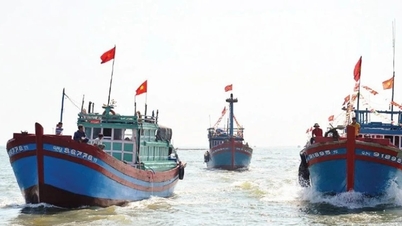
Just when it seemed that inshore fishing was heading towards a dead end, a welcome sign has emerged in recent years. Familiar seafood species are beginning to return to coastal waters in increasing numbers. In response to this significant change, many fishermen are boldly investing in boats and fishing gear, reviving offshore fishing methods such as seine nets, gillnets, and trawling nets. The images of seine nets and trawling nets, once only a memory, are now commonly seen again along the Ngũ Điền coastal strip, bringing immeasurable joy to those who have a deep connection to the sea.
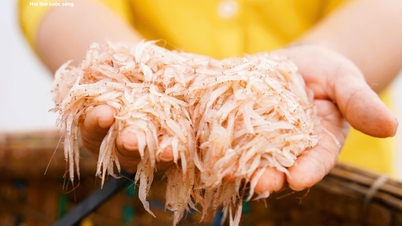
During the last days of the year and the beginning of the new year, local fishermen have been consistently catching large hauls of scad fish. So many fish are caught in the nets that many boats have to return to shore to unload their catch. On average, each boat can bring in several hundred kilograms of scad fish per trip, earning between 4 and 5 million dong. Fisherman Ho Dung, from Hai Nhuan residential area, Phong Quang ward, excitedly said: “The fact that so many scad fish are coming close to shore like this is very good news. It shows that the coastal marine resources are gradually recovering. Before this, many boats also had abundant catches of mackerel, anchovies, and other fish…”
According to Mr. Ho Dung, the recovery of marine resources is not a coincidence. It is the result of a long process in which destructive fishing practices have been drastically curbed. For many years, trawling and fishing with explosives have been almost completely eliminated. In addition, the "bamboo net" fishing method – an environmentally friendly fishing technique – has been revived by fishermen, creating conditions for fish and shrimp to return and breed. On calm summer nights, people can easily spot fishermen using lights to catch squid along the shore – an image that seemed to have disappeared long ago.
To further clarify this, Mr. Hoang Van Suu, Vice Chairman of the People's Committee of Phong Quang Ward, stated: "The marine resources in the coastal area are clearly reviving. Recently, many fishing trips have yielded abundant catches of herring, mackerel, anchovies, scad, and silverfish. High-value seafood species such as barracuda, tuna, cuttlefish, and squid, which were previously scarce, are now reappearing in relatively high densities."
 |
| Fishermen in Ngũ Điền catch a large haul of tuna at the start of the year. |
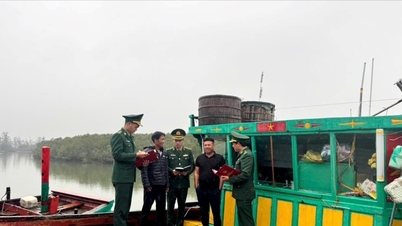
According to Mr. Suu, over the years, local authorities have closely coordinated with border guard posts, especially Phong Hai Border Guard Post, to strengthen patrols and controls, promptly detecting and handling illegal and destructive fishing activities in the marine environment. In addition, the fact that fishermen have limited near-shore fishing for a long period has inadvertently created conditions for the marine ecosystem to recover naturally.
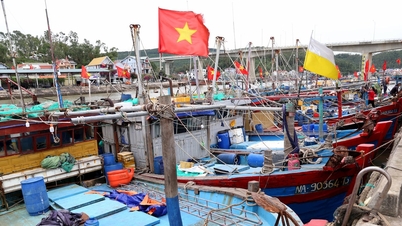
As marine resources gradually stabilized, the local authorities proactively encouraged fishermen to upgrade and increase the capacity of their motorboats, diversifying their fishing methods in the offshore area. Many fishing households who had previously abandoned the profession have returned to the sea, earning stable incomes and gradually improving their living standards. According to statistics, the coastal area still maintains approximately 1,900 boats, although this number has decreased compared to before due to some fishermen shifting to offshore fishing.
Nevertheless, nearshore fishing still contributes a significant proportion to the local seafood production. The revival of the offshore fishing grounds not only provides a livelihood for fishermen but also helps preserve traditional crafts and unique maritime cultural features that have been associated with this land for generations.
The sea has demonstrated its ability to regenerate when people learn to appreciate and exploit it rationally. Today, the vast waters of Ngũ Điền are gradually regaining their former vibrancy, opening up a brighter future for coastal fishermen in their journey of staying at sea, preserving their livelihoods, and building an increasingly prosperous and beautiful homeland.
Source: https://huengaynay.vn/kinh-te/hoi-sinh-vung-long-161575.html




















































































Comment (0)