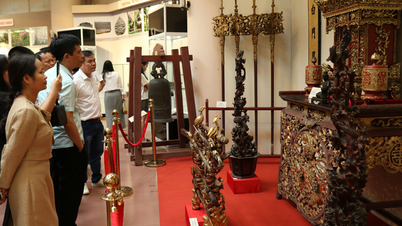
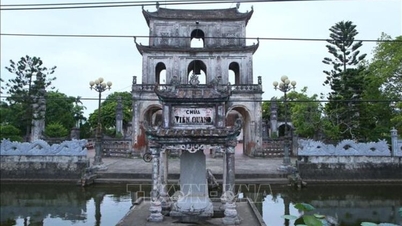
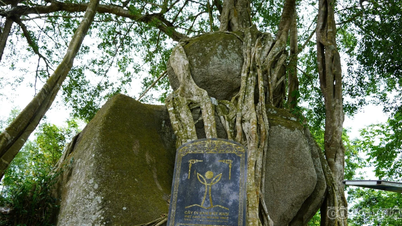
The Sai Temple Festival is associated with the belief in worshipping the deity Huyen Thien Tran Vu, who is said to have assisted King An Duong Vuong in building the Co Loa Citadel. Legend says that to thank the deity, the king himself once went to Sai Mountain to perform a ceremony. Later, to reduce the burden on the people, the king issued a decree allowing the villagers to represent the royal court in carrying out the ritual of "carrying the living king." Since then, this ritual has become the soul of the Sai Temple Festival, passed down almost intact through many generations.
During this year's festival season, from dawn, the streets of Thu Lam commune ( Hanoi ) resounded with the sounds of drums and gongs, blending with the vibrant colors of five-colored flags fluttering in the spring breeze. Processions of ceremonial attendants gathered at the communal courtyard and the Sai Temple area, arranging their formations, ready for the procession of the "Living King," the soul of the festival. Especially, the joy at the 2026 Sai Temple Festival is multiplied many times over as the festival has officially been recognized as a National Intangible Cultural Heritage. This is not just a title, but a recognition of a tradition that has endured through generations.
Ms. Nguyen Thi Hoa (born in 1970, residing in Thu Lam commune, Hanoi) expressed: “I have participated in the festival since I was a child. I feel very joyful and excited watching the procession of the ‘Living King’. This year, I came with my children and grandchildren to watch, so I am even more excited and happy.”
 |
A large number of locals and tourists attended the procession of the "Living King" at the Sai Temple Festival 2026. |
![[Video] Weather forecast for tonight and tomorrow, July 2nd, 2026: Tropical depression likely to strengthen into a storm; many areas will continue to experience thunderstorms.](https://vphoto.vietnam.vn/thumb/192x108/vietnam/resource/IMAGE/2026/07/01/1782911026600_thumb-dem-png.webp)
Traditionally, the procession includes the palanquin of the Lord, the palanquin of the King, and dignitaries such as the Royal Guard, the Chief Advisor, the Commander, and the Governor. Those playing the roles of the King, the Lord, and the officials performing the rituals must be elderly people from complete families. This year, the role of the King is played by Mr. Ngo Xuan Ta (born in 1953, residing in Thu Lam commune, Hanoi); the role of the Lord is played by Mr. Ngo Tien Thuc (born in 1953, residing in Thu Lam commune, Hanoi). Mr. Ngo Xuan Ta shared: “I was born and raised in the village. Therefore, I am very proud to be entrusted by the villagers with the role of the King at the festival.”
Amidst the resounding ceremonial music, leading the procession were the crimson banners and the palanquin of the Lord, followed by the palanquins of the King and the officials. The King's palanquin stopped at Dong Chau, where the "King" dismounted and ascended the Vong Hill to pay homage to the Holy Saint Huyen Thien at Sai Temple. At the same time, the Lord's palanquin proceeded towards Thuong Temple. The Lord performed the ritual of sharpening his sword, striking three blows against a stone, then entered the temple to perform the ceremony, after which he proceeded to the temple to pay homage to the ancestral tablet of Cao Son Dai Vuong.
The Lord entered the Upper Temple, bowed three times before the ancestral tablet of Cao Son Dai Vuong, then disappeared. The villagers carried the empty palanquin back to the village communal house. The King returned to the communal house, seated on his throne amidst the joyful cheers of the villagers. People gathered on both sides of the road to respectfully receive blessings from the King, praying for a new year of favorable weather, abundant harvests, and peaceful lives.
Ms. Nguyen Minh Thu (born in 1980, residing in Cau Giay Ward, Hanoi) shared: “What impressed me most was the enthusiastic participation of the villagers. I think it is this collective effort that gives the festival its vitality, allowing an ancient ritual to remain clearly present in today's life.”
Indeed, the Sai Temple festival in general, and the procession of the "Living King" in particular, is not only impressive for its unique ritualistic nature but also serves as a bond connecting generations in the locality. From selecting the people to play the roles of king and queen, assigning titles in the procession, to preparing robes, palanquins, flags, and ceremonial music, everything involves the joint efforts of clans, families, and a large number of local people. The elderly pass down each movement and chant; the younger generation learns how to walk, bow, and maintain discipline. In this flow, the ritual is not only practiced but also passed down as a "lesson" about tradition and community responsibility.
It is the proactive participation and transmission between generations that has created a solid foundation for the festival to survive amidst the changes of society. Therefore, being recognized as a National Intangible Cultural Heritage not only acknowledges the historical depth of the Sai Temple Festival, but also affirms its contemporary value, where the heritage lives on through the collective efforts of the community and continues to be nurtured in today's life.


Nguyen Thanh Luan, Vice Chairman of the People's Committee of Thu Lam Commune, shared: “The festival has profound significance in educating future generations, especially the younger generation, about historical traditions and the moral principle of 'drinking water and remembering the source.' At the same time, the festival creates a highlight in terms of cultural space and landscape, contributing to building cultural life in the residential area and promoting sustainable development of the locality.”
Source: https://www.qdnd.vn/van-hoa/doi-song/hon-viet-trong-mua-hoi-den-sai-1028124

![[Image] National conference summarizing one year of operation of the overall organizational model of the political system, the three-tiered government model.](https://vphoto.vietnam.vn/thumb/1200x675/vietnam/resource/IMAGE/2026/07/01/1782882811691_ndo_br_1-jpg.webp)


![[Video] Tropical depression likely to strengthen into a storm](https://vphoto.vietnam.vn/thumb/402x226/vietnam/resource/IMAGE/2026/07/01/1782920040993_dung00-58-54-15still008-png.webp)