|
Honda Motor CEO Toshihiro Mibe has apologized for the company's losses. Photo: Reuters . |
On June 26 (local time), Honda Motor CEO Toshihiro Mibe received support for his re-election to the board of directors at the annual general meeting of shareholders, after apologizing to shareholders for the company's poor business results, according to Reuters.
The misguided bet on electric vehicles.
Honda is working to rectify costly strategic mistakes after reporting its first annual loss in 70 years last month. This result stems from over $9 billion in restructuring costs for its electric vehicle (EV) division, coupled with increasing competition from Chinese automakers.
The release of Honda's worst financial report since its IPO in 1957 shows that betting too heavily on electric vehicles can be a risky strategy for traditional automakers, as market demand is much lower than expected.
In the fiscal year ending in March, Honda reported an operating loss of 414.3 billion yen ( $2.63 billion ), higher than the median forecast of 315.6 billion yen ( $2 billion ) in a survey of 22 analysts by LSEG . In the same period of the previous year, the company achieved an operating profit of 1.2 trillion yen ( $7.6 billion ).
Honda also recorded total losses of 1.45 trillion yen ( US$9.2 billion ) related to its electric vehicle business in the past fiscal year and expects to incur an additional 500 billion yen ( US$2 billion ) in costs in the current fiscal year. This figure is significantly lower than the maximum 2.5 trillion yen ( US$15.7 billion ) write-down cost estimate the company had made in March.
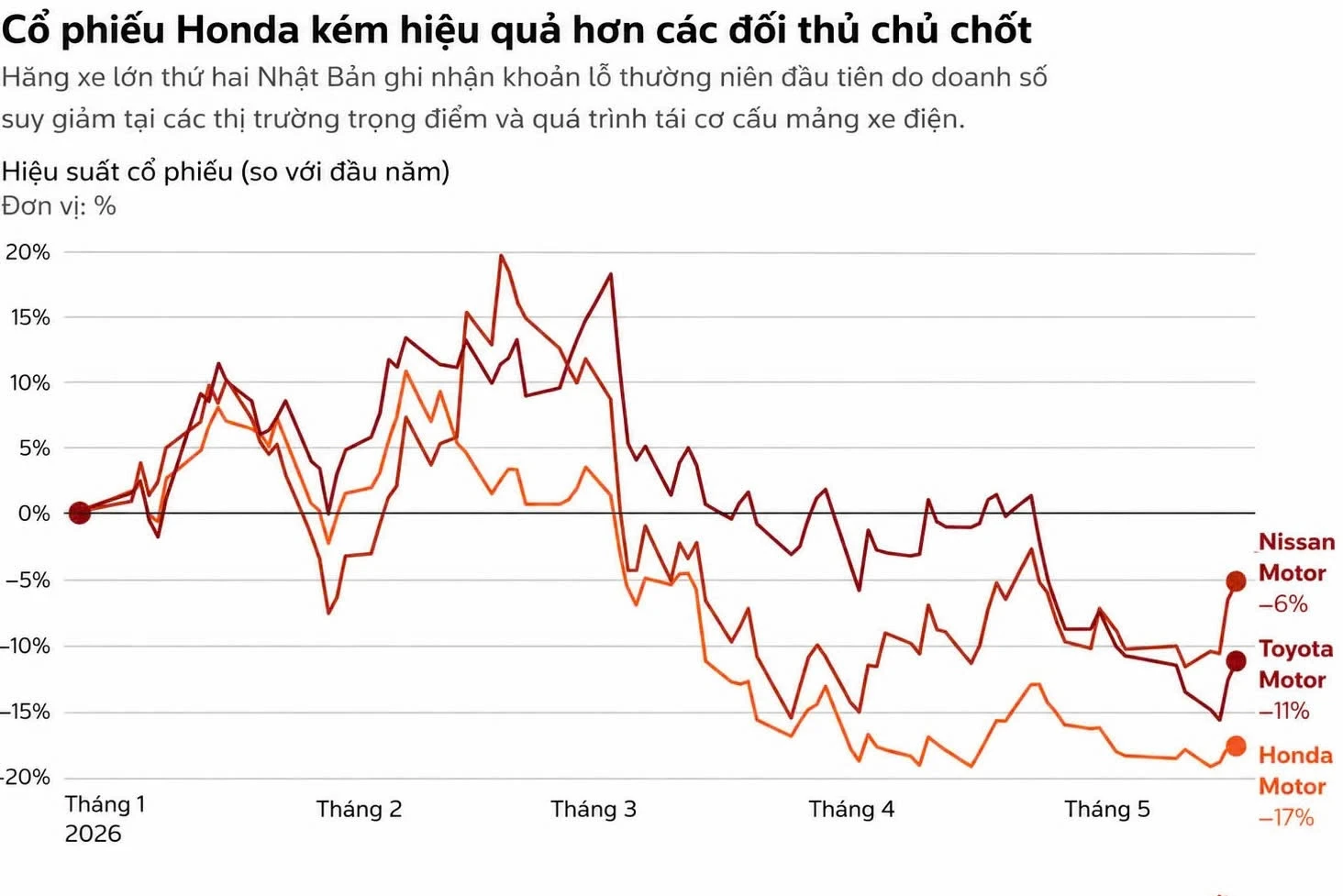 |
Honda's stock has underperformed its competitors. Chart: Reuters. |
In his opening remarks, Mr. Mibe offered his deepest apologies to shareholders for the significant concerns and inconvenience caused by the net loss in the last fiscal year's business results.
In addition to reappointing Mr. Mibe, Honda shareholders also approved the remaining 10 candidates for the Board of Directors, including 9 members nominated for reappointment and one new member. The voting results are in line with the recommendations of the two shareholder advisory firms, Glass Lewis and ISS, which both recommended that shareholders support all candidates.
Amidst cuts in electric vehicle subsidies, Honda recorded a decrease in asset value related to its EV segment after realizing its electric vehicle market share in the US was much lower than anticipated. According to Mr. Mibe, if Honda proceeds with its planned sales of electric vehicles, it will have to launch very large incentive programs to stimulate demand.
"If we continue selling electric vehicles as originally planned, it means the automotive segment will continue to be mired in losses for at least five years, possibly even seven years," Mibe said, emphasizing that this scenario could put the company in an extremely precarious situation.



According to Reuters sources, in recent months, Mibe has faced considerable criticism from former Honda executives regarding the company's strategic missteps. Some sources indicate that former CEO Nobuhiko Kawamoto visited Honda's Tokyo headquarters in April to personally urge Mibe to resign.
Former executives criticized Mibe for underestimating the Chinese market, the world's largest automotive market, and argued that Honda had bet wrongly on electric vehicles. These decisions not only led to significant losses but also exposed the company's growing reliance on motorcycles, which remain its primary profit-generating business.
Towards the end of the meeting, a shareholder even proposed that the general meeting vote on a motion to remove Mr. Mibe from his position as CEO. However, he refused to bring the proposal to a vote, arguing that the matter was not on the agenda and therefore ineligible for consideration at the meeting.
What opportunities await Honda?
Regarding the EV development plan, in March, Mr. Mibe stated that Honda would abandon its goal of electric vehicles accounting for 20% of new car sales by 2030, and would also cancel its plan to sell only pure electric or fuel cell vehicles by 2040. He also added that Honda would indefinitely suspend its electric vehicle project in Canada, an $11 billion investment plan aimed at producing electric vehicles and batteries, considered the company's largest investment to date in the country.
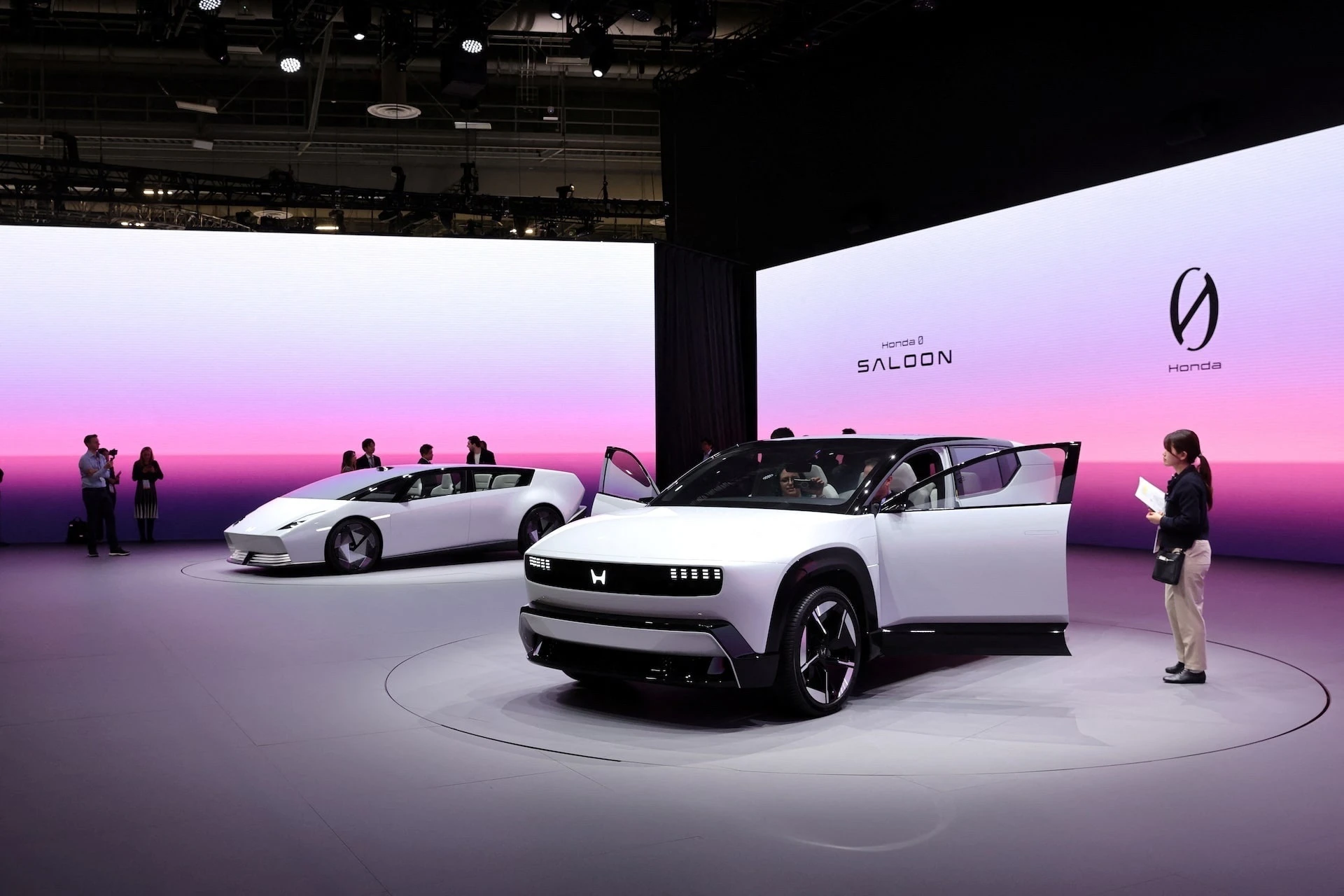 |
Honda's electric vehicle segment faces intense competition in China. Photo: Reuters. |
While Honda has largely resolved its pressing issues in the US, reviving its business in China may be far more challenging. The Japanese automaker acknowledges it can no longer keep pace with emerging Chinese electric vehicle companies, particularly due to their shorter product development cycles and superior advantages in software-driven vehicles, including advanced driver assistance systems (ADAS).
Vincent Sun, a senior analyst at Morningstar, commented that in today's fiercely competitive environment, the Japanese automaker cannot offer products with superior value compared to emerging electric vehicle manufacturers, leading to a decline in its competitiveness. This development further raises concerns about Honda's ability to maintain its technological competitiveness in the long term.
In China, the world's largest automotive market, Honda has launched several all-electric models, but last year only sold about 17,000 vehicles, equivalent to 2.5% of the company's total sales of approximately 677,000 vehicles in this market and only one-fifth of Honda's total global electric vehicle sales.
Despite having to address many issues related to electric vehicles, Mr. Mibe said that negotiations between Honda and Nissan Motor and Mitsubishi Motors on cooperation in developing next-generation vehicle technologies, which began in mid-2024, have now made significant progress.
On the other hand, Honda still expects to return to profitability this year, aiming for a profit of 500 billion yen ( US$3.2 billion ), thanks to cost-cutting measures and contributions from its motorcycle division.
In its earnings report, Honda stated that its motorcycle division will expand its production capacity in India and aims for record sales of 22.8 million units.
Strong sales in India and Brazil helped Honda's motorcycle division achieve record operating profits in the fiscal year ending in March, partially offsetting the impact of a large write-down on its electric vehicle segment as well as declining car sales in key markets such as China.



However, James Hong, Head of Automotive Research at Macquarie, argues that Honda's motorcycle division is also facing pressure to shrink profit margins due to the transition to electric vehicles in key markets such as India and Vietnam.
In addition, the company forecasts that rising raw material prices, including the impact of conflicts in the Middle East, will reduce operating profit by 313 billion yen ( US$2 billion ) in the current fiscal year.
Source: https://znews.vn/honda-ngam-dang-vi-xe-dien-post1663711.html