Connecting businesses to bring advanced nutrition solutions to the farm.
On June 30th, the International Rice Research Institute (IRRI), in collaboration with the Department of Agriculture and Environment of Hai Phong City, organized a seminar and exhibition on solutions for "Proper fertilization in high-efficiency, low-emission rice cultivation." The event brought together representatives from the Ministry of Agriculture and Environment , the U.S. Department of Agriculture (USDA), the U.S. Embassy in Vietnam, management agencies, businesses, cooperatives, farmers, and many international organizations.
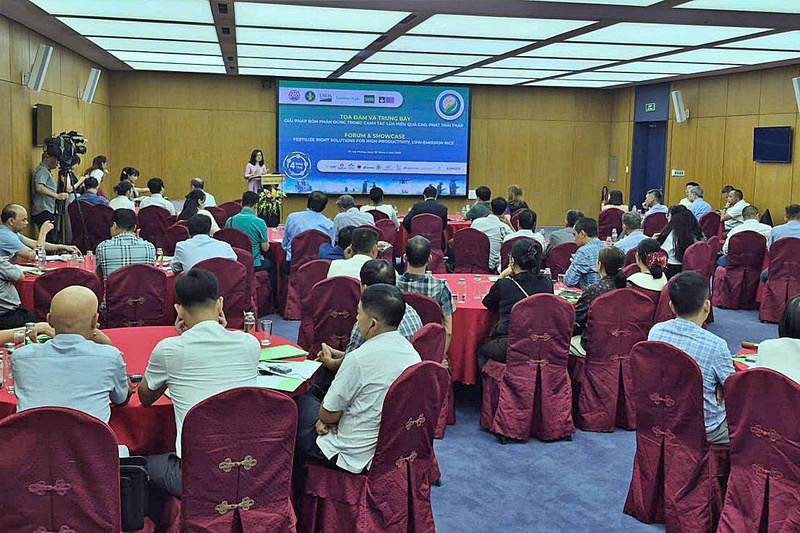
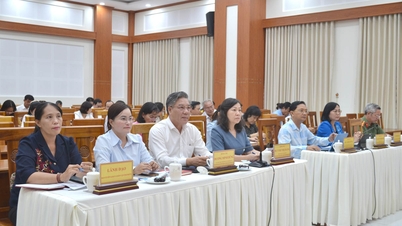
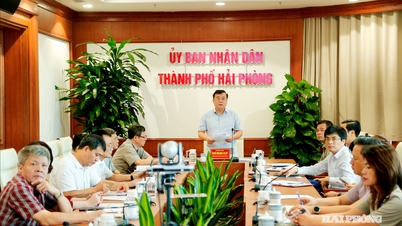
Full view of the seminar. Photo: Bao Thang
This program is part of the "Proper Fertilizer Use" Project, funded by the USDA and implemented by IRRI in Vietnam. Simultaneously, it contributes to the implementation of the Emission Reduction Plan in the Crop Production Sector for the period 2025-2035, with a vision to 2050, by improving fertilizer efficiency, increasing productivity and profitability, and reducing greenhouse gas emissions.
Unlike typical technical workshops, this event is designed as a forum connecting the public and private sectors, combining expert discussions with exhibitions showcasing solutions in improved fertilizers, biotechnology, mechanization, and digital transformation. This facilitates direct access to technological advancements for farmers, cooperatives, and local communities, while also promoting their transfer into practical production.
Speaking at the event, Dr. Clemen Gehlhar, Senior Agricultural Manager at the USDA and Project Manager of the "Right Fertilizer Use" project in Vietnam, stated that efficient fertilizer use plays a crucial role in building a productive and sustainable agricultural system. Through this project, the USDA hopes to work with IRRI and partners in Vietnam to promote the adoption of proven solutions to help farmers use fertilizers more effectively, increase their income, and reduce greenhouse gas emissions. Close cooperation between regulatory agencies, businesses, and producers will be key to replicating successful models nationwide.
From a business perspective, Mr. Le Van Hai, General Director of BiOWiSH Vietnam, said that the company is cooperating with many large domestic fertilizer manufacturers such as Ca Mau Petroleum Fertilizer Joint Stock Company, Lam Thao Superphosphate and Chemical Joint Stock Company, and Petrochemical Fertilizer and Chemical Corporation... to develop new generation microbial-supplemented fertilizers. Combining the production capacity of Vietnamese businesses with BiOWiSH biotechnology from the United States helps increase the nutrient absorption capacity of plants, reduce fertilizer loss, improve soil health, increase productivity, and contribute to reducing greenhouse gas emissions in agriculture.
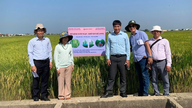
Mr. Nguyen Van Hung, Senior Scientific Expert and Head of IRRI's "Proper Fertilizer Use" Project, stated that the institute is collaborating with the private sector to research integrated nutrient management solutions, combining improved fertilizers, biotechnology, mechanization, and digital transformation. Through public-private partnerships, IRRI has developed sustainable rice farming models suitable for various ecological zones, particularly in the Mekong Delta and the Red River Delta.
According to results from eight pilot models under the Project for 1 million hectares of high-quality, low-emission rice in the Mekong Delta and three models in the Red River Delta, the amount of seeds sown has decreased by about 50%, the amount of nitrogen fertilizer has decreased by at least 30%, and pesticides have decreased by about 20%, while the yield and profit of rice farmers have both increased by over 10%.
Assessing the role of public-private partnerships, Mr. Pham Quoc Trung, General Director of MTK/Innovar Ag, believes that developing and promoting the use of new generation fertilizers combined with the principle of "proper fertilization" will open up many opportunities for cooperation, contributing to improving soil health and production efficiency. Meanwhile, a representative from BOF Import-Export Company stated that the harmonious combination of inorganic and organic fertilizers and biological solutions is an important direction to improve nutrient utilization efficiency, soil quality, and reduce emissions in rice cultivation. The company hopes to continue collaborating with IRRI, USDA, and partners to promote innovation, increase farmers' income, and develop green agriculture.
Local authorities hope to replicate this efficient, low-emission rice farming model.
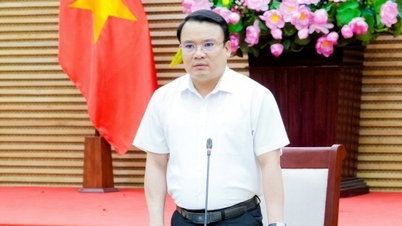
As a locality with a strong rice production advantage in the Red River Delta, Hai Phong is gradually transforming its agricultural sector towards improving quality, efficiency, and reducing environmental impact. According to Ms. Luong Thi Kiem, Deputy Director of the Department of Agriculture and Environment of Hai Phong City, the city highly appreciates the support of IRRI, USDA, and the business community in bringing scientific and technological advancements and advanced nutrient management solutions closer to farmers. " This event is not only a place to share experiences but also creates opportunities for all parties to strengthen cooperation, promote technology transfer, and replicate highly efficient, low-emission rice production models throughout the city," Ms. Kiem emphasized.
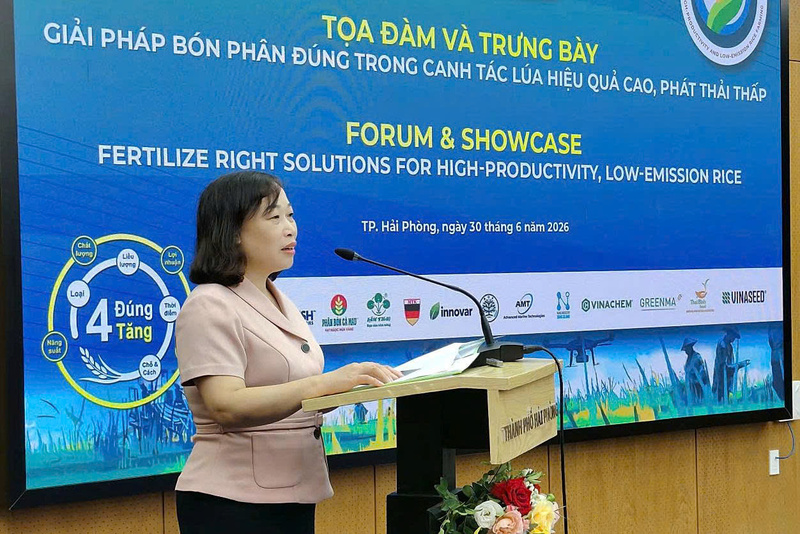
Ms. Luong Thi Kiem, Deputy Director of the Department of Agriculture and Environment of Hai Phong City, speaks at the seminar. Photo: Bao Thang
From the perspective of a direct producer, Mr. Nguyen Van Khien, Chairman of the Farmers' Association of Tan An commune, Hai Phong city, said that what farmers care about most is that solutions must be easy to apply, bring practical results, and help reduce production costs. Through participating in the pilot model of "Proper Fertilization" in the Spring 2026 crop, Mr. Khien realized that proper nutrient management not only helps rice plants grow better but also improves fertilizer efficiency, reduces input costs, and increases profits. Farmers also hope to have more opportunities to access new technologies and products suitable for their production conditions.
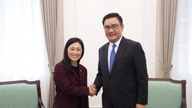


According to experts, combining nutritional management solutions, biotechnology, mechanization, and digital transformation is expected to contribute to improving production efficiency, reducing greenhouse gas emissions, and promoting the development of the rice industry in a green and sustainable direction.
IRRI representatives stated that they are committed to supporting Vietnam in building a sustainable food system that is adaptable to climate change and meets the requirements of low-emission agriculture development.
Source: https://congthuong.vn/hop-tac-cong-tu-thuc-day-canh-tac-lua-phat-thai-thap-463392.html





























































![[Live] Exchange program “80 Years of Keeping the Oath” commemorating the 80th anniversary of the People's Security Force's traditional day.](https://vphoto.vietnam.vn/thumb/402x226/vietnam/resource/IMAGE/2026/07/02/1782997764964_truc-tiep-nbsp-w1200t0-di2626d272d4194258t13840l1-banner-80-nam-n2.webp)