There is a common thread running through Ho Chi Minh City's development over the past 50 years: the pioneering spirit of removing barriers to facilitate the flow of goods.
From the rice exchange in the late 1970s, when city leaders dared to break free from outdated management thinking to address food shortages, to the construction of today's most vibrant commercial, retail, and logistics hub in the country, Ho Chi Minh City has always been the birthplace of practical innovations. This journey has not only transformed the city's commercial landscape but also paved the way for market-oriented economic thinking and the dynamic development of the entire nation.
To commemorate the 50th anniversary of the official renaming of Saigon - Gia Dinh to Ho Chi Minh City, the Vietnam News Agency (VNA) is publishing a series of two articles on the theme "Ho Chi Minh City: A Dynamic Commercial Market," documenting the development of the city's goods supply market, from stories of breaking the rules to alleviate hunger for millions of city dwellers to becoming the leading vibrant commercial market in the country.
In the late 1970s, driven by the urgent need to ensure food security for its citizens, Ho Chi Minh City launched the famous "rice exchange" campaign, marking a significant milestone in the city's economic development.
Not only did this event help alleviate food shortages during a difficult period, but it also opened up new thinking about goods circulation, laying the foundation for the dynamic development of Ho Chi Minh City's commercial market for many decades afterward.
A landmark that paved the way.
According to Ms. Ly Kim Chi, President of the Ho Chi Minh City Food and Beverage Association, in the early years after the country's reunification, the city faced many difficulties regarding food supply.
Despite being located next to the Mekong Delta, the country's largest rice granary, people in Ho Chi Minh City still frequently face rice shortages and have had to eat mixed grains for extended periods. Management barriers have prevented rice from moving smoothly from production to consumption, disrupting the market's natural supply chain.
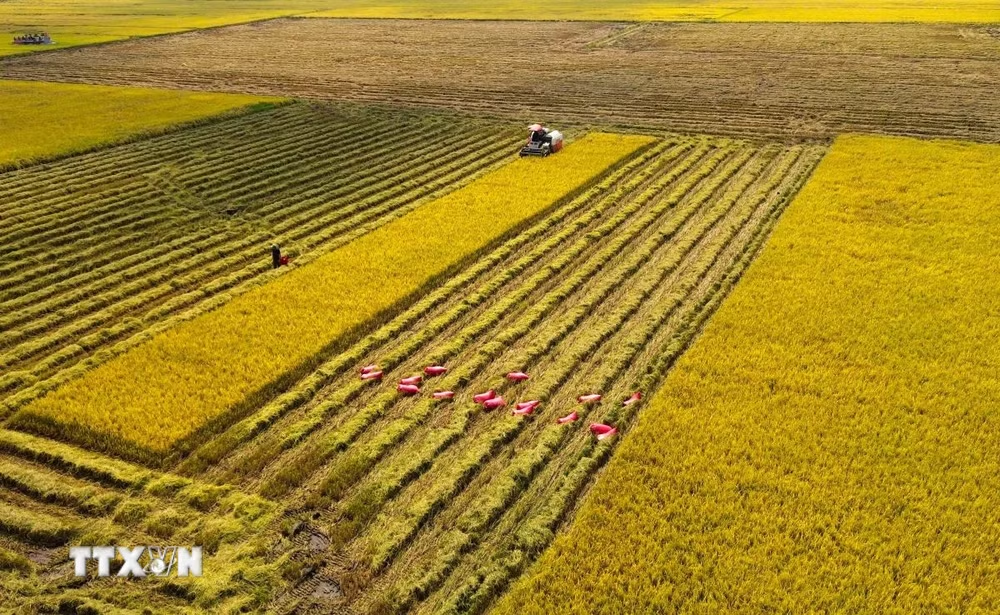
“The city is located next to the country’s largest rice granary, yet people still have to eat mixed rice with other grains and worry about rice shortages every day. It’s not that the Mekong Delta doesn’t have rice, but rather that barriers in transportation prevent goods from reaching where they are needed,” Ms. Ly Kim Chi recalled.
Referring to the rice procurement campaign in the late 1970s, Ms. Chi believes that the most significant impact of the event lies not only in its resolution of food shortages but also in the role of individuals who dared to think and act for the common good. The groundbreaking decisions of Ho Chi Minh City's leaders at that time clearly demonstrated a spirit of prioritizing the interests of the people over institutional barriers.
From a research perspective, Dr. Tran Quang Thang, Director of the Institute of Economics and Management of Ho Chi Minh City, argues that the event should be placed within the context of a centrally planned economy with a strict regulatory system; in which the transportation of food between localities was discouraged or severely restricted.


"According to regulations at the time, transporting food from one locality to another was almost discouraged. While the people of the city lacked food, goods could not circulate. This situation demanded a solution based on the best interests of the people," analyzed Dr. Tran Quang Thang.
According to this expert, the most noteworthy aspect is the courageous spirit of the city's leaders in daring to overcome rigid management thinking to find solutions that suit practical realities, creating a significant breakthrough in goods circulation over the past half-century.
Market economy mindset
According to Mr. Nguyen Nguyen Phuong, Deputy Director of the Ho Chi Minh City Department of Industry and Trade, the transition from a centrally planned economy to a socialist-oriented market economy is a major turning point for the city's trade.
From a distribution system based on cooperatives, Ho Chi Minh City has gradually expanded the space for economic sectors to participate in production and business. This change not only unleashes production capacity but also creates a foundation for the formation of an increasingly dynamic commodity market.
According to Dr. Tran Quang Thang, the practice of "breaking the rules" to exchange rice for other goods can be seen as one of the early manifestations of market economic thinking in Vietnam. These practices later contributed to forming the foundation for the reform process, when the economy shifted to operating according to market principles.
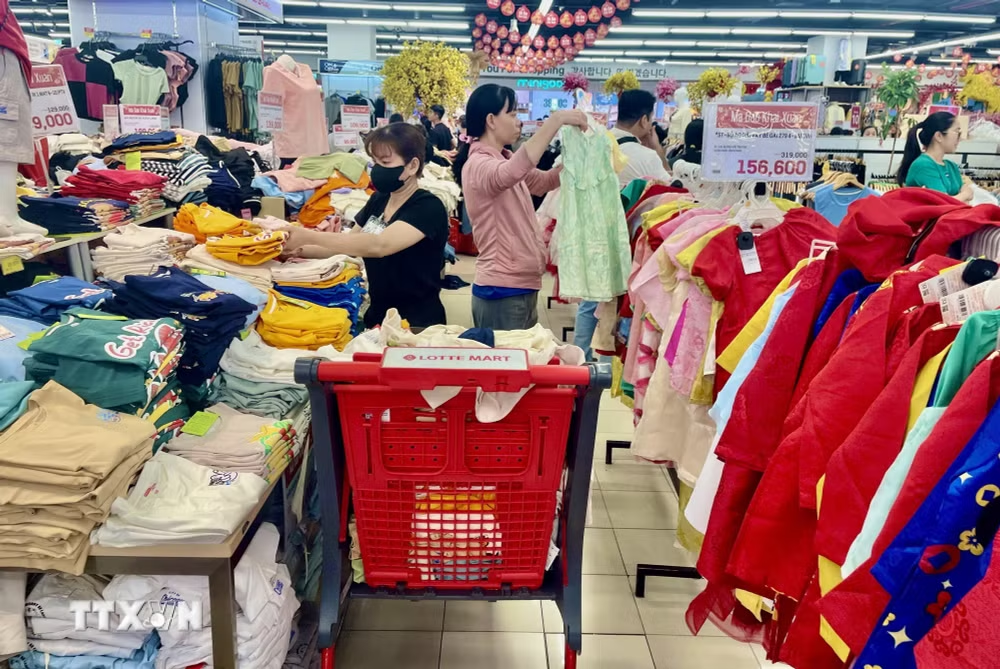
Sharing the same view, Ms. Ly Kim Chi argued that the event showed that if only administrative orders were used for management, the circulation of goods would be difficult to achieve effectively. For sustainable economic development, it is necessary to respect market laws and create conditions for economic entities to play their roles.
"The role of the State is not limited to management, but more importantly, it is to create a favorable environment for businesses, farmers, and other economic sectors to participate in the market effectively," Ms. Chi emphasized.
Looking back at half a century of development of Ho Chi Minh City's commercial market, Mr. Nguyen Nguyen Phuong believes that the city's trade sector has undergone many groundbreaking transformations. While the 1980s marked the transition from a centrally planned economy to a market economy, the 1990s saw the birth of the first modern supermarket model in the country, located in Ho Chi Minh City.
Entering the 2000s, sales models via television, telephone, and the Internet began to emerge, opening up new distribution channels. From 2010 onwards, e-commerce developed strongly, making Ho Chi Minh City one of the most dynamic digital commerce centers in the country.
Currently, the city's commerce is entering the digital economy era and applying artificial intelligence in the management and distribution of goods.
"Every 10 years or so, the city's trade undergoes a qualitative transformation. Models like the Market Stabilization Program, established over 30 years ago, remain effective and have become an important regulatory tool, being emulated by many localities," Mr. Phuong stated.
From a business perspective, Mr. Nguyen Ngoc Thang, Deputy General Director of Saigon Co.op, said that looking back on its nearly 40-year journey, Saigon Co.op is proud to have accompanied the development of Ho Chi Minh City's commerce, from the new cooperative model to the modern retail system. "The core value of 'breaking the mold' lies not only in innovative approaches but, more importantly, in the spirit of daring to innovate for the common good, daring to remove bottlenecks to meet the practical needs of society," Mr. Thang shared.
However, according to Ms. Ly Kim Chi, each stage of development presents new "bottlenecks" that need to be addressed. While previously it was the issue of rice distribution, now the bottlenecks lie in logistics infrastructure, transportation costs, digital transformation, quality standards, and the ability to connect to international markets.
Therefore, Ho Chi Minh City needs to continue to uphold the spirit of "dare to think, dare to act, dare to take responsibility," while simultaneously promoting institutional reforms, investing in modern logistics infrastructure, developing high-quality human resources, and strengthening regional linkages to enhance its competitiveness.
From the boats carrying rice across the river to the city nearly half a century ago to its modern commercial system, Ho Chi Minh City has proven that the impetus for all innovation always begins with real-life experiences.
The pioneering spirit from the historic "breaking the rules" rice exchange campaign has contributed to shaping its position as the largest commercial center in the country, while also laying the foundation for new developments in the future.
Readers are invited to read the next article:
Final article: Pillars of economic growth
Source: https://www.vietnamplus.vn/khoi-thong-dong-chay-hang-hoa-post1119824.vnp


![[Image] Ho Chi Minh City: Ma Lang area, Chicken-Rice Market about to change its appearance](https://vphoto.vietnam.vn/thumb/1200x675/vietnam/resource/IMAGE/2026/06/25/1782377698627_ndo_br_m1-jpg.webp)

![[Photo] General Secretary and President To Lam receives Palestinian Ambassador Saadi Salama](https://vphoto.vietnam.vn/thumb/1200x675/vietnam/resource/IMAGE/2026/06/25/1782365384740_a1-bnd-9423-8322-jpg.webp)
![[Image] Schools organize meetings and introduce teaching models to students admitted to grade 10.](https://vphoto.vietnam.vn/thumb/1200x675/vietnam/resource/IMAGE/2026/06/25/1782368077271_ndo_br_z7970052192242-1ec8daeb77a6eed1a4e9f58c564ddd3e-jpg.webp)