

Housing and Urban Development Investment Corporation - Limited Liability Company (HUD) has just announced its consolidated semi-annual financial report for 2024 with positive business results. Specifically, the company's net revenue reached nearly VND 1,792 billion, double that of the same period last year. After-tax profit reached VND 136.7 billion, an increase of 63% compared to the same period in 2023.
Nevertheless, the corporation's business results have been on a downward trend from 2017 to the present. Data shows that in 2017, the company recorded net revenue of over 6,182 billion VND and after-tax profit of 457.5 billion VND. However, by 2023, net revenue and profit had decreased to only 2,277 billion VND and 166.3 billion VND respectively.
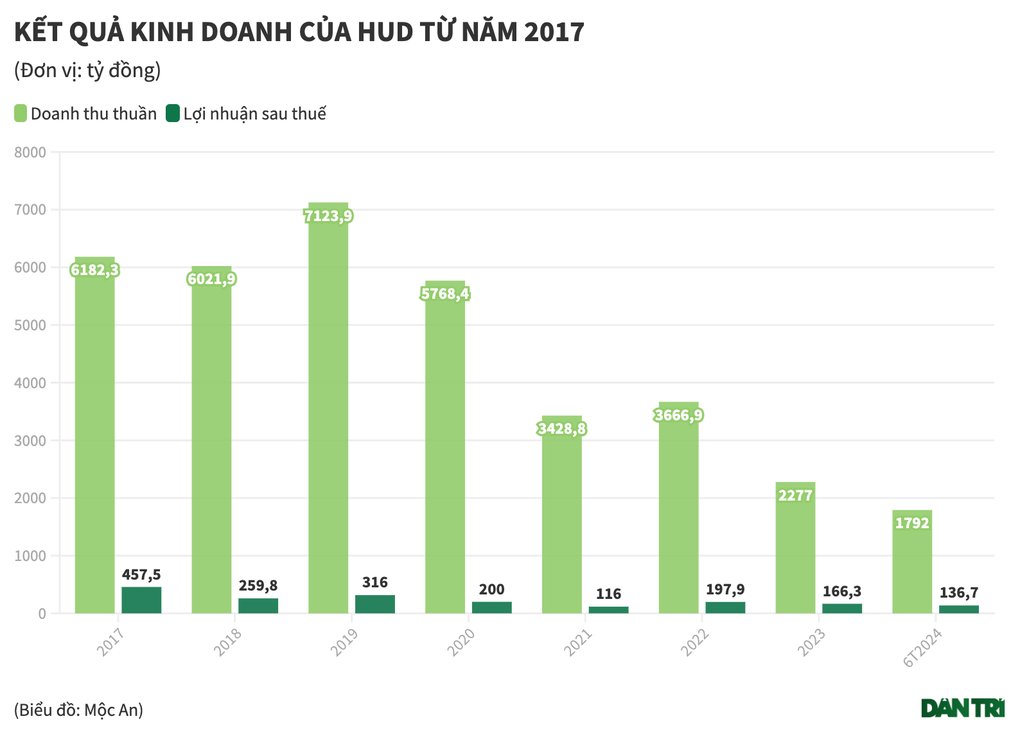
The after-tax profit margin decreased from 7% in 2017 to only 3-5% during the 2018-2022 period. This profitability ratio improved back to its previous level in 2023 and reached 8% in the first half of this year.
The financial report shows that the company's profits mainly come from its production and business activities. Profits from financial activities, as well as other activities, are insignificant.
In the first half of this year, HUD's real estate business thrived, reaching VND 1,475.2 billion (contributing over 82% of net revenue), 2.7 times higher than the same period in 2023. Net revenue from sales also reached VND 209 billion, five times higher than before. However, revenue from service provision decreased sharply from VND 220.5 billion to VND 51 billion.
As of June 30th this year, HUD's total assets were nearly VND 15,123 billion, an 11% increase compared to the beginning of the year. Of this, short-term assets amounted to VND 11,982 billion, accounting for 79.2% of total assets. Long-term assets accounted for only nearly 21%.
Inventory accounts for the largest proportion of short-term assets, valued at VND 9,495 billion, a 19% increase compared to the beginning of this year. The company stated that some assets under construction, such as the HUD Building office building in Long Bien district, are being used as collateral to secure long-term loans from BIDV's Hanoi branch.
On the other side of the balance sheet, liabilities accounted for 75.6% of the company's capital as of June 30th. The majority of this was short-term debt, at nearly VND 5,320 billion, a 40% increase compared to the beginning of the year. Notably, taxes and other payments to the State surged from nearly VND 77 billion to VND 1,595.4 billion by mid-year, mainly due to increased property taxes and land lease fees.
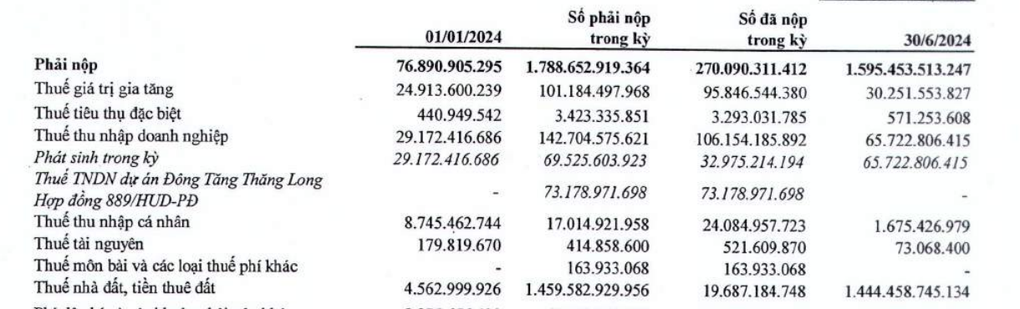
Property taxes and land lease payments by HUD surged in the first half of the year (Source: Financial statements).
The company has outstanding financial debt of over VND 3,973 billion, primarily long-term loans (VND 2,125 billion). The largest long-term loan is from BIDV's Hanoi branch, valued at VND 819 billion. These loans were used to finance investment costs for the An Sinh housing project (Binh Duong), the infrastructure construction project for the Thanh Lam - Dai Thinh 2 new urban area (Hanoi), and the Dong Tang Long new urban area (Ho Chi Minh City).
In terms of capital structure, HUD has a high debt-to-equity ratio, remaining at 2.5 times at the end of the 2017-2022 period. By the end of 2023, this ratio increased to 2.7 times, and by mid-2024 it reached 3.1 times.
The Housing and Urban Development Investment Corporation (HUD) is a state-owned enterprise under the Ministry of Construction , whose main business is investing in and developing new urban areas and housing, and real estate business. Some projects developed by HUD include the Dinh Cong new urban area, the Phap Van new urban area, and the Viet Hung new urban area.
Source: https://dantri.com.vn/bat-dong-san/hud-dang-kinh-doanh-ra-sao-20240916101727030.htm

![[Image] Bridges and roads connecting the eastern part of Ho Chi Minh City](https://vphoto.vietnam.vn/thumb/1200x675/vietnam/resource/IMAGE/2026/04/16/1776328595108_ndo_br_bh-vt5-jpg.webp)















































![[Photo] National Assembly Chairman Tran Thanh Man meets with the Speaker of the Georgian Parliament](https://vphoto.vietnam.vn/thumb/402x226/vietnam/resource/IMAGE/2026/04/16/1776338494029_anh-man-hinh-2026-04-16-luc-18-21-21.png)



















Comment (0)