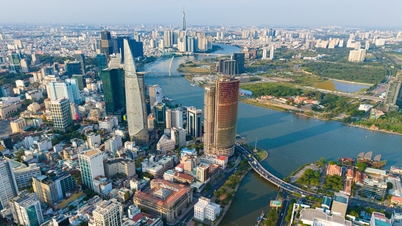
A new face of development is gradually taking shape in the ancient capital region.
In the context of the prolonged Covid-19 pandemic, volatile global economic conditions , and stalled investment projects, the National Assembly's issuance of special mechanisms for Hue has contributed to creating additional resources and policy space for the locality to overcome difficulties, maintain growth momentum, and especially achieve the goal of becoming a centrally-governed city from January 1, 2025. Therefore, it can be affirmed that Resolution No. 38/2021/QH15 dated November 13, 2021, of the National Assembly has fulfilled an important historical mission.
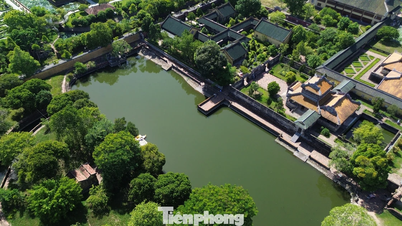
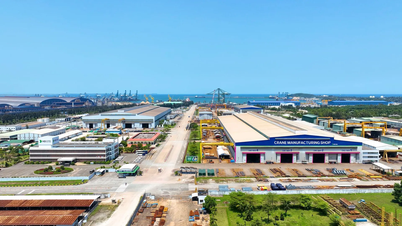
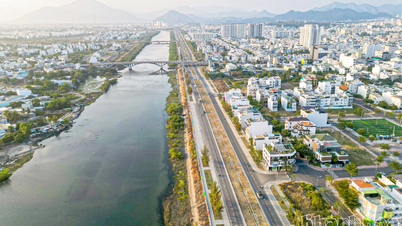
Looking back over the past five years, the figures speak for themselves. The average GRDP growth rate reached over 7.2% per year; budget revenue increased by more than 10% per year; and total social investment reached approximately 153 trillion VND. Hundreds of new investment projects were attracted; strategic transportation infrastructure systems such as the Cam Lo-La Son and La Son-Tuy Loan expressways, the coastal road, Phu Bai Airport Terminal 2, Chan May Port, the Perfume River bridge, and the Thuan An estuary bridge were successively completed and put into operation. A new face of development is gradually taking shape in the ancient capital region.
The effectiveness is still uneven.
However, a closer look at the specific mechanisms that the National Assembly has authorized for pilot implementation reveals that the effectiveness of these policies is uneven.
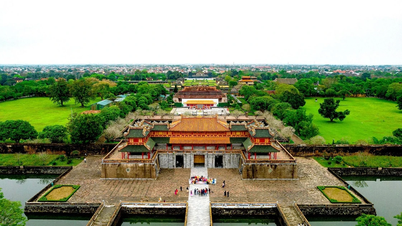
The most evident success of this mechanism is the policy on entrance fees to historical sites. In just over three years of implementation, revenue from entrance fees has contributed nearly 700 billion VND to the budget, enabling the allocation of over 634 billion VND to implement nearly 70 projects for the restoration and preservation of historical sites. This is a vivid example showing that when given the right mechanism, heritage sites can completely generate their own resources to protect themselves. This is also a model that deserves to be maintained and expanded in the future.
Meanwhile, the Hue Heritage Conservation Fund, despite its significant policy implications, has achieved rather modest results in fundraising. After more than three years of operation, the total capital received has only reached over 8 billion VND. This shows that we have yet to develop sufficiently attractive policies to encourage the participation of businesses, the community, and international organizations in heritage conservation efforts.
Other mechanisms, such as increasing loan limits, supplementing revenue from import and export activities, or increasing recurrent expenditure limits, have contributed to supporting localities, but their impact has not been truly significant. In particular, the mechanism expected to generate substantial resources from the restructuring and handling of public assets of central government agencies in the area has been largely ineffective because it depends entirely on the decisions of central ministries and agencies.

The most thought-provoking aspect of the five-year summary report on the implementation of Resolution No. 38/2021/QH15 of the National Assembly on piloting some specific mechanisms and policies for the development of Thua Thien Hue (now Hue City) is not the numbers achieved or not achieved, but the very frank assessment of the Hue City People's Committee: after five years of implementation, Resolution 38 has not created the breakthroughs initially expected; it has not clearly formed new growth drivers; and it has not created sufficiently strong "impetus" for investment, finance, and urban development. This reality is understandable.



Hue needs a stronger mechanism that doesn't overlap with other localities.
When Resolution 38 was issued in 2021, Hue was still a province. The biggest goal at that time was to create the conditions to fulfill the criteria for becoming a centrally-governed city. But today, the context is completely different.
Hue is no longer a province striving to become a centrally-governed city. Hue is already a centrally-governed city. This means that the institutional requirements must also change.
While in the past, Hue needed support mechanisms to achieve its administrative upgrade goals, currently, Hue needs strong mechanisms to assert its role as a centrally-governed city with its own unique identity, distinct from any other locality.
This is also the time to recognize Resolution 80-NQ/TW of the Politburo and Resolution 28 of the National Assembly as new strategic directions for the development of Hue.
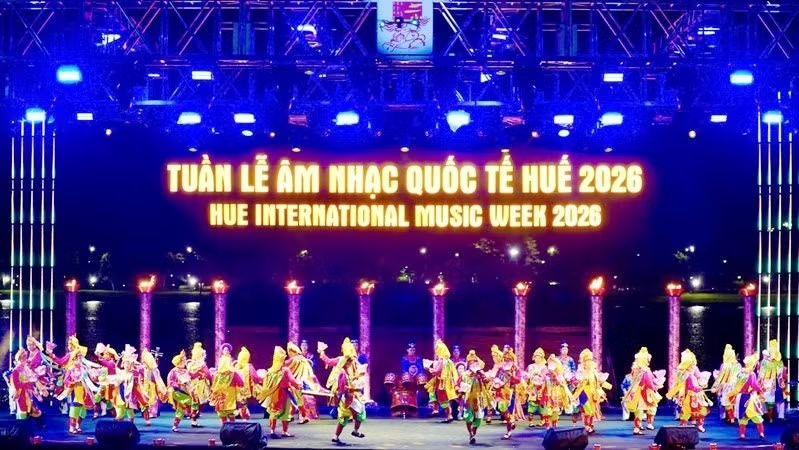
The overarching spirit of Resolution 80 is to make culture an endogenous resource and a driving force for national development. For Hue, this is not only a general direction but also a special opportunity. Among the centrally-governed cities today, nowhere else has the density of cultural heritage, cultural institutions, historical landscapes, and cultural depth that Hue possesses.
Meanwhile, Resolution 28 of the National Assembly has opened up new directions for cultural development linked to economic growth, the development of the cultural industry, and the mobilization of social resources for culture.
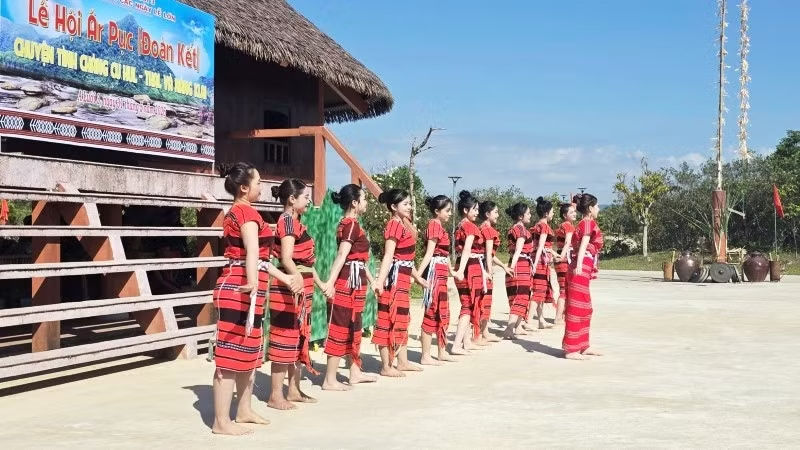
From that perspective, perhaps Hue shouldn't just stop at proposing an extension of Resolution 38. What Hue needs more is a specific resolution for the new generation.
A resolution should not only focus on finance and budget as before, but should also prioritize a model for developing heritage cities. A resolution should allow Hue to pilot special mechanisms for the preservation and economic exploitation of heritage; for the development of cultural industries; for public-private partnerships in the fields of culture and sports; for the management of the landscape of the Perfume River and the Tam Giang-Cau Hai lagoon area; for specific investment mechanisms for the Chan May-Lang Co Economic Zone; and for the digital transformation of heritage and the construction of a national cultural data center in Hue…
In particular, it is necessary to study mechanisms that allow a portion of revenue from heritage sites, cultural tourism, and cultural industries to be directly reinvested in conservation and community development. This is a model that many famous heritage cities around the world are applying very effectively.
More importantly, Hue needs to be given more autonomy in planning, land management, public investment, exploitation of public assets, and attracting strategic investors. A centrally-governed city cannot develop using the same management mechanisms as a former provincial-level locality.



Five years of implementing Resolution 38 have given Hue many valuable lessons. There have been successes and limitations, but the most important thing is that we now have sufficient practical basis to clearly identify what needs to change.
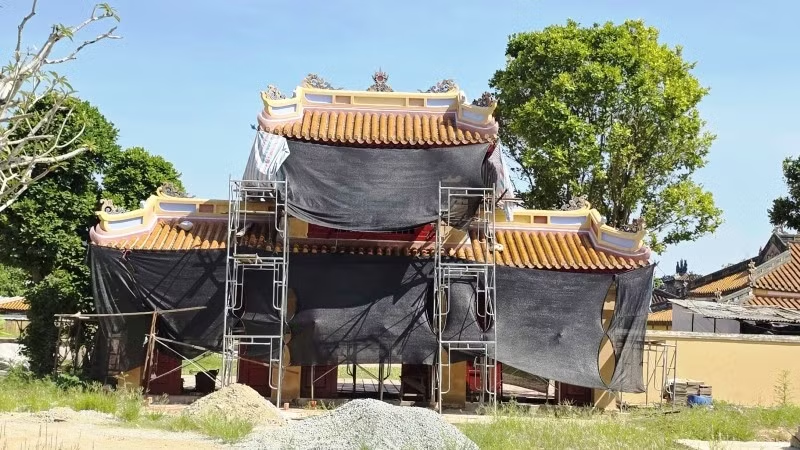
If Resolution 38 served as a stepping stone to help Hue become a centrally-governed city, then the next phase requires a new mechanism to help Hue become a model heritage city of Vietnam and the region.
This is not just a desire of Hue alone. It is also a requirement set forth by the Central Committee's resolutions, stemming from the city's new status and the expectation that culture will truly become a driving force for development in the country's new era.
Source: https://nhandan.vn/hue-can-mot-co-che-dac-thu-the-he-moi-post969164.html




![[Photo] Strengthening character and expertise: Intense training for artillery soldiers.](https://vphoto.vietnam.vn/thumb/1200x675/vietnam/resource/IMAGE/2026/06/30/1782815602541_lu-368-1875-4571-jpg.webp)





























![[Video] Today, Hanoi opens online enrollment for entry-level classes.](https://vphoto.vietnam.vn/thumb/402x226/vietnam/resource/IMAGE/2026/07/01/1782858817884_mam-non-jpg.webp)