

Every year, when the floodwaters overflow the banks, turning the familiar fields white, the Mekong Delta seems to don a new, gentle, vast, and vibrant cloak. In my hometown, we call it the flood season.
The murky, muddy waters of the flood season not only bring shrimp and fish but also awaken tiny green sprouts that have been dormant beneath the mud for countless seasons. Among them is water chives—a seemingly ordinary wild vegetable, yet it holds so much familiarity within it. For me, water chives are not just a vegetable, but a part of my memories, a piece of my mud-stained childhood, peaceful and sweet, just like the flood season in my hometown.
 |
Farmers in Ca Mau are harvesting water chives. |
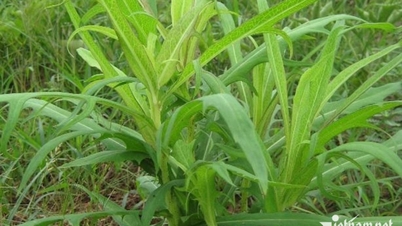
Water chives are not as vibrant as the Sesbania grandiflora, nor as common as the water lily. They grow quietly on the flooded rice paddies, their long, slender leaves a beautiful emerald green. No one plants them, nor do they need to cultivate them; as soon as the water arrives, clumps of chives emerge on their own, soft and smooth as silk. In that simplicity lies the heart of the earth and sky, as if nature is graciously bestowing upon the people a touch of gentleness and love.
In the past, my hometown was poor. Each flood season brought more worries. But it was precisely during those times of scarcity that we found fulfillment in our own unique way—fulfillment in the warmth of community spirit, in simple yet comforting meals. I still remember my father going out to cast his nets at dawn, and my mother carrying a bamboo basket along the edge of the rice fields behind the house, meticulously picking tender green chives. When she returned, she would often sit on the porch, carefully picking each chive, telling stories of the old days. Amidst the rustling wind in the garden, the gurgling water in the ditch, and my mother's slow storytelling, there was something so peaceful that I, later in life in the city, always longed to recapture.
Just like how water chives silently sprout from the earth each rainy season, needing no planting, this vegetable doesn't require elaborate preparation. Simply boiling it or eating it raw, dipping it in fermented fish sauce, braised fish, or fermented fish paste... is enough to create a fragrant, sweet, and wholesome flavor. The slightly earthy smell of the water combined with the refreshing taste on the tongue gives this rustic dish a simple yet unforgettable appeal. My father used to say that eating water chives is like tasting the essence of the fields, of the changing seasons. For me, eating water chives awakens a whole realm of memories—the barefoot childhood wading through rice paddies, covered in mud, and the afternoons spent by the stove waiting for my mother to boil the vegetables after a day of traveling along the waterways.
 |
| Farmers in Ca Mau are harvesting water chives. |
Today, this vegetable still quietly emerges whenever the floodwaters return, like a familiar gift from nature to the people of the riverside countryside. But perhaps only those who have experienced the hardships of making a living in the deep, flooded fields, who grew up in poverty imbued with the warmth of their homeland, can fully appreciate the flavor of water chives.
Amidst the myriad of modern, elaborate dishes today, water chives are rarely mentioned. They don't appear on luxurious banquet tables, nor are they listed on restaurant menus. Yet, for me, each delicate sprig of chives carries the breath of the river, the sweetness of the alluvial soil, and the silent affection in every simple yet warm and loving meal.
Source: https://www.qdnd.vn/van-hoa/van-hoc-nghe-thuat/huong-vi-dong-que-mien-tay-1018899


























































![[Photo] Hue: Admire the 2.4 trillion VND sea bridge, the longest in Central Vietnam.](https://vphoto.vietnam.vn/thumb/402x226/vietnam/resource/IMAGE/2026/05/24/1779614018347_anh-man-hinh-2026-05-24-luc-16-13-29.png)






































Comment (0)