


Illustration: THIEN BAO
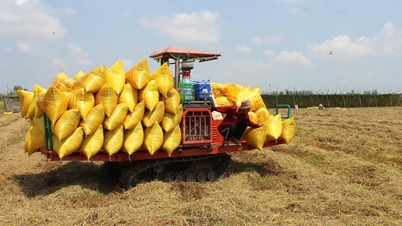
Although my hometown only grew one rice crop a year, known as seasonal rice, back then the fields were covered with alluvial soil, so there was no need for fertilizers or pesticides, and the rice still yielded abundant harvests.
When the rice harvest was bountiful, farmers would thresh the rice in the fields or bring it back in ox carts, filling their yards with it before letting the oxen trample it. The scene of oxen trampling the rice on moonlit nights during the harvest season in the peaceful and tranquil countryside, especially in December leading up to Tet (Lunar New Year), is truly poetic and has become an unforgettable memory for me.
And in the years following the rice harvest, back then, there were so many fish in the rice fields of my hometown that even children as young as 9 or 10 could catch them using any method and means appropriate for their age. Catching fish in the rice fields was both a fun game and... a real source of food.
One of the simplest yet most effective ways to catch fish in the rice fields after the harvest, just before Tet (Lunar New Year), is to build traps for the fish to jump into. This method is quite "amateurish," avoiding diving and getting covered in mud, and also preventing exposure to rain and sun, as most freshwater fish only jump into the traps at night. And checking the traps and catching fish on moonlit nights at the end of the year is a lot of fun.
When the rice fields were harvested and only the stubble remained, the water began to recede because it was the dry season, and it was the three months leading up to Tet (Lunar New Year). We children would go and observe the rice paddies where the water was still shallow, not reaching above our knees. These were the low-lying fields, attracting various kinds of fish from higher ground to gather there.
Once you've selected rice paddies with plenty of fish—a telltale sign being the sound of fish splashing or jumping up and down in the water in the afternoon—then go home, grab a jar or pot of water, and prepare to build a fish pond.
Usually, building a tunnel requires two people, or it can be done alone because it's very simple: just scoop up mud and build the tunnel walls in a circular, square, or rectangular shape as desired.
If the cellar is circular, like a well, the diameter should be around 2 meters; if it's square, it should be 2 meters x 2 meters; and if it's rectangular, the area should be around 6 square meters. I usually choose a rectangular cellar, about 30-40 centimeters deep.
The pond must be located in the middle of the deep water area of the rice field and definitely in the path of the fish. After the pond is built, all the holes are sealed, the water is drained out, and the banks are smoothed with a layer of soft mud.
Next, place a large earthenware pot or jar in the center of the pit so that when the fish jump in, they will slide down into the pot or jar and be unable to jump back out. That's all. Wait until nightfall, then use a torch made of coconut leaves, or an oil lamp, or, for a more advanced option, a flashlight, and bring a tin bucket to check the pit and catch the jumping fish. The fish that jump into the pit are usually snakehead or tilapia, rarely catfish or loach.
But generally, there are water snakes, king cobras, and toad snakes that, once they crawl into the pit and get to the bottom of the jars or pots, cannot escape. We check the pit every two hours or so to catch fish, and the important thing to remember after catching fish is to use a coconut shell ladle to scoop out the water that has seeped out of the pit. Absolutely do not leave any standing water at the bottom of the pit, because if you jump into the pit with water, the fish will jump back out.
Building a fish pond is something any child can do, but whether or not fish jump into it depends not only on the principles of choosing the right location and position for building the pond and embankment, but also on the secret of "luring the fish".
This secret isn't something every child knows, and even those who do know keep it a secret. I myself had to put in a lot of effort to find this secret from a close friend who's famous for building fish traps—every trap he built was a success, but he absolutely refused to reveal the secret of why fish kept jumping into his trap, even though it was next to mine.
The secret was that after building the embankment, he would go to the village riverbank, scoop up some soft mud, and spread a layer over the embankment before smoothing the surface as usual. He did this every few days until I discovered it.
It turns out this secret stems from a natural law. When the water level is low, the fish find their way back to the rivers and canals. As they move along, they encounter muddy banks with a fresh, muddy smell, and they recognize the scent of the riverbanks, so they "close their eyes" and jump in.
If you add a layer of soft mud with the scent of alluvial sediment deposited by rivers and canals to the pond banks, the fish will be even more certain that this is the place they must return to, so they will flock there even more, unaware that their entire family of fish has been trapped by human ingenuity? After learning this secret, I followed my friend's advice and added that layer of alluvial mud to the pond banks, and... I caught fish non-stop.
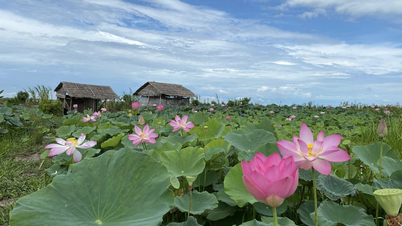
Nature has bestowed upon the people of my homeland in the Mekong Delta abundant fields and produce in every season. With just light labor and fishing, we can have food all year round, eliminating the need to buy from the market.

Illustrative image
In those days, rice was grown only once a year, the fields were not sprayed with pesticides or chemical fertilizers, yet the rice plants were still lush and green, bearing abundant grains at harvest time. Crops on the sandy, hillside fields were always verdant, allowing farmers to cultivate them with little effort but with tremendous yield.
When the rice fields dry up, coinciding with the Lunar New Year season, after the adults have harvested the rice, the children build ponds to catch fish. This is both a fun pastime and a way to earn a living, providing not only enough food for family meals but also enough to sell at the market to earn money for Tet shopping.
Now, the rice fields in my hometown are gradually shrinking due to the movement to create orchards, then destroying them to build industrial shrimp farms, so there isn't much land left for growing rice.
Furthermore, the rice fields are heavily fertilized with chemicals and sprayed with pesticides, which also destroys the fish and shrimp populations. As a result, rural children no longer have the fun of building ponds for fish to jump into when the fishing season arrives, as they did in the past.
No wonder rural children nowadays are no longer connected to nature, instead wasting their time in front of phone and computer screens or glued to internet cafes playing games. The rustic charm of the countryside has largely disappeared...
Source: https://tuoitre.vn/tet-nho-mua-bat-ca-dong-20260204105803488.htm


![[Photo] Prime Minister Pham Minh Chinh receives the Chinese Ambassador to Vietnam](https://vphoto.vietnam.vn/thumb/1200x675/vietnam/resource/IMAGE/2026/04/05/1775397481797_ndo_br_dsc-5512-jpg.webp)























































































Comment (0)