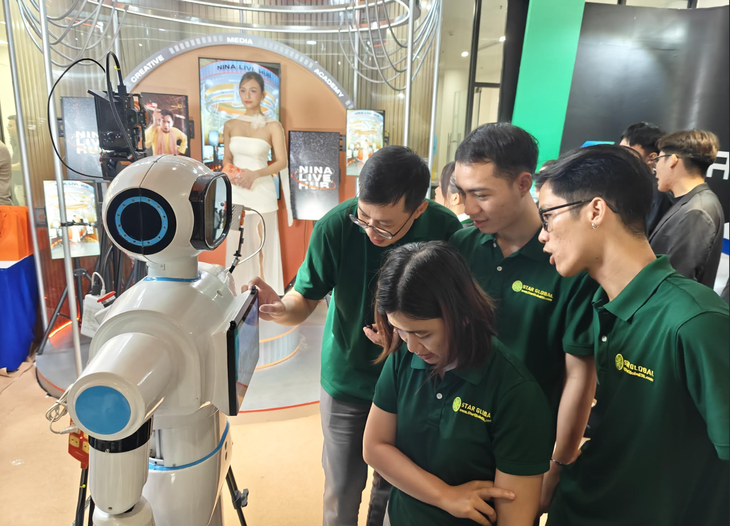
Users experience robots at a technology exhibition in Ho Chi Minh City - Photo: DUC THIEN
From policy impetus to the aggressive commitment of technology corporations, businesses, and startups, AI Make-in-Vietnam is shaping its identity.
Impressive AI Make-in-Vietnam
In October 2025, AI Hay – a question-and-answer social network developed by Vietnamese engineers – became the only representative from Southeast Asia to be included in the Top 5 AI applications in terms of real users and downloads, according to the “State of AI – Report 2025” published by Sensor Tower, a leading global mobile data analytics platform.
In Vietnam during the first half of 2025, AI Hay surpassed even big names like Google Gemini and DeepSeek in terms of real users, ranking only behind ChatGPT. AI Hay is the first and largest purely Vietnamese AI-powered question-and-answer social network in Vietnam, with over 15 million downloads and currently leading the " Education " category on the App Store and Google Play.
Despite achieving such impressive results, Nguyen Hoang Hiep, AI Hay's operations director, remains humble: "This achievement is not the ultimate goal, but proof that focusing on the real needs of Vietnamese people is the right direction. We know we are on the same path as many 'big players' with resources hundreds of thousands of times greater."
The young man also clearly stated the start-up's direction: instead of trying to catch up with leading businesses in every aspect, AI Hay chooses to deeply understand and serve Vietnamese users – from students needing the latest admissions information to civil servants working with the most up-to-date information on policies and laws…
"The game is long, there are many challenges ahead, but there are also many opportunities to do better," Hiep said confidently.
While startups are making a big splash, leading Vietnamese technology corporations and businesses are not only applying AI to optimize internal operations but also developing "Make in Vietnam" platforms and solutions that deliver tangible results.
For example,FPT developed the FPT.AI platform with many application modules such as natural language processing (NLP) for Vietnamese, artificial voice (Text-to-Speech), and virtual assistant tools (Chatbot). Typically, FPT has deployed the GenAI application suite (generated AI) for businesses, helping to automate content creation, support customer service, and improve work efficiency, bringing immediate results to thousands of businesses.
Viettel Group is building a comprehensive AI ecosystem, spanning from internal operations management and big data analytics to digital simulation and automation. Viettel's AI solutions serve many critical sectors such as cybersecurity, defense, and smart city management, helping to optimize resources and ensure system security.
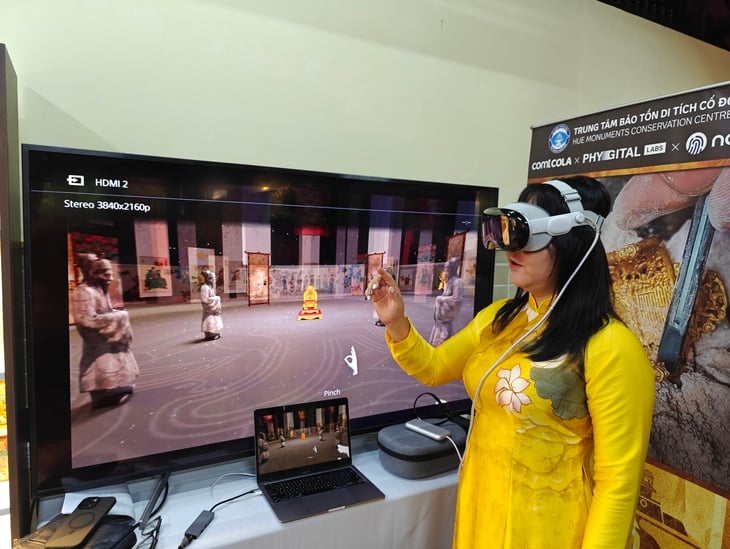
The application of AI and virtual reality technology makes it easier for users to visit museums in 3D - Photo: DUC THIEN
VinGroup, with its subsidiary VinAI, is one of the few Vietnamese companies capable of conducting fundamental AI research at an international level. VinAI focuses on high-end applications such as computer vision for autonomous vehicles and intelligent transportation.
VinAI's AI-powered facial recognition, behavior detection, and traffic monitoring technologies have been deployed in practice, contributing to solving complex traffic problems in Vietnam.
Spectacular growth
According to reputable international reports, the Vietnamese AI market is growing at one of the fastest rates in the region. Statista forecasts that the Vietnamese AI market will reach $932 million in 2025 and surge to $6.91 billion by 2031. Notably, the compound annual growth rate (CAGR) is projected to remain impressive, at 38.97% during the 2025-2031 period.
This growth is bolstered by the increasingly widespread application of AI in the business community. According to the "Unlocking Vietnam's AI Potential" study conducted by AWS in collaboration with Strand Partners, Vietnam currently has approximately 170,000 businesses (equivalent to 18%) that have implemented AI, a significant increase from 13% the previous year.
In 2024 alone, the application growth rate reached 39% year-on-year, with an average of 5 new Vietnamese businesses venturing into AI every hour.
In parallel, the Vietnamese government has also made efforts to improve its digital infrastructure capacity. The fact that Vietnam was ranked in the "Very High" group in the United Nations' e-Government Development Index for the first time (71st globally and 5th in Southeast Asia) reflects the increasing readiness of the system to embrace and deploy AI technology at the national level.
Vietnam's goal of becoming a leading AI hub in the region by 2030 has been concretized by the National Strategy on AI Research, Development, and Application to 2030. The newly passed Artificial Intelligence Law also includes provisions for the National Artificial Intelligence Development Fund (a non-profit, off-budget state financial fund).
At a seminar within the framework of VinFuture 2025 Science and Technology Week, Deputy Minister of Science and Technology Bui The Duy stated that Vietnam is building a national AI supercomputing center, an open data ecosystem, and a Vietnamese AI infrastructure aiming for self-reliance, while simultaneously implementing comprehensive AI at a rapid pace, making AI a universal "intelligent assistant" for all citizens to enhance social productivity and expand access to knowledge…
Drawing on the group's experience in collaborating with large international businesses, Mr. Nguyen Van Khoa, General Director of FPT Group, affirmed that Vietnamese businesses can compete on equal footing with global businesses through only one path: investing in science and technology with three breakthroughs.
Firstly, there's a breakthrough in human resources. This is the nation's greatest asset. Secondly, there's a breakthrough in science, technology, and data. The younger generation of entrepreneurs must have the skills to work with machines and collaborate with AI.
Thirdly, there's the breakthrough in business models and ecosystems: businesses need to be interconnected and have the potential to drive growth across sectors. To achieve this, they must know how to share, how to unite, and how to create a cohesive ecosystem.
"If we can grasp science and technology, and embrace digital transformation, Vietnam can absolutely rise to the leading group in the new era," Mr. Khoa said.
Great opportunities, but also significant challenges.
According to assessments by many experts and research findings from the aforementioned reports, despite rapid progress, Vietnam's AI development path still faces challenges.
Firstly, Vietnam still suffers from a severe shortage of high-quality AI experts, especially AI PhDs or highly specialized engineers capable of leading basic research and developing large-scale models.
Secondly, there's the computing and data infrastructure. Building large-scale data center and high-performance computing (HPC) infrastructure requires enormous costs and complex technology. Thirdly, there's the investment capital. Despite the increase in venture capital, total investment in Vietnamese AI startups in 2024 is expected to reach only about $80 million.
VIRTUE
Source: https://tuoitre.vn/but-pha-ai-make-in-vietnam-20260218082328879.htm



































































































Comment (0)