

In the Bài Chòi game, Mr. Hiệu leads the game with various humorous antics, including riddles where players know the name of the card being called out. These riddles are sometimes simple and straightforward, but many are also witty and humorous, making the audience burst into laughter.
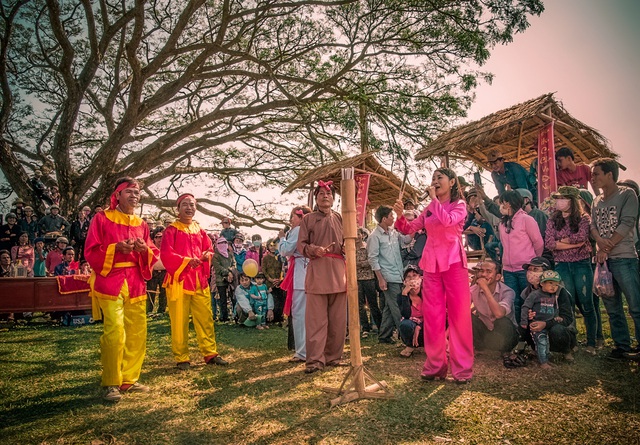
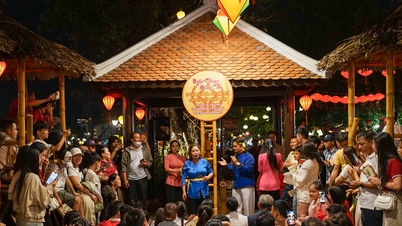
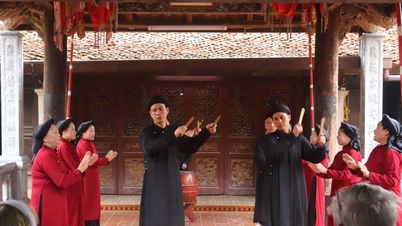
Bài Chòi festival during Tet in Phù Mỹ, former Bình Định province
Photo: Dao Tien Dat
The origins of the Hieu brothers.
In the South Central region, there's a haunting folk verse: "Let's go play Bài Chòi (a traditional Vietnamese card game) / Let the child cry until its umbilical cord comes out." In Binh Dinh (formerly), it goes like this: "When Tet comes and we have free time, we must play / Bài Chòi is a popular game everywhere / People shout and cheer excitedly / Hearing the drums urging us on, we cradle our babies / Regardless of bumping into the bushes / Let's see what the game master shouts for the new year."
Young mothers, some letting their babies cry until their umbilical cords protrude, others braving the elements, rushing as fast as they can to make it in time for the festival. These young mothers aren't gambling addicts; they want to immerse themselves in the atmosphere of the Bài Chòi festival, or to put it bluntly, they're captivated by... the singer and performer, Mr. Hiệu. "Let's see what Mr. Hiệu will chant for the New Year." That chant he uses at the Bài Chòi festival has such a powerful allure. Where did Mr. Hiệu come from, that he can charm even married women with babies in their arms?
In the old days, young men and women in rural areas would sing call-and-response songs on moonlit nights. They would sing while pounding rice or carrying soil to build foundations for houses in the village. If the work itself consisted only of carrying soil or pounding rice, it would quickly become boring, so they devised the art of singing and call-and-response. Many of the best folk songs and proverbs, passed down through generations, originated from these "labor-accompanied singing sessions."
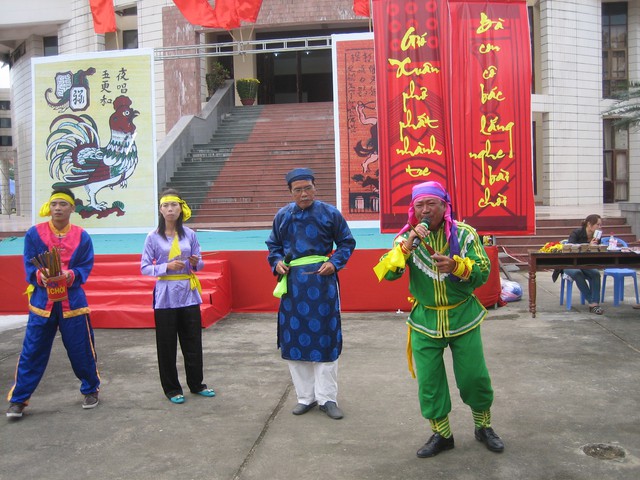
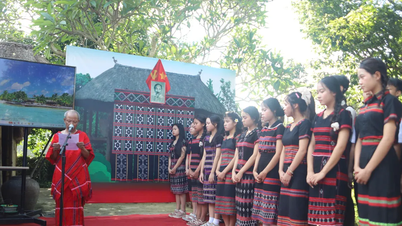
Mr. Hieu (right in the photo) at the Bài Chòi folk game festival.
Photo: Tran Dang
In the folk singing sessions held during those labor days, there was always someone with a special talent. These were people who could improvise quickly, respond intelligently, and adapt to the situation presented by the "challenger." "A phoenix flies past the market hut/I ask you, do you have a wife yet?/Holding a piece of paper to shield from the rain/How can I avoid getting wet? I answer, I'm not married yet." The girl posed the riddle, knowing full well that the boy in the singing group couldn't answer because how could a piece of paper shield him from the rain? But here, the man won. The woman sang: "My body is like a custard apple/Placed on the Buddha's altar, dragons and a canopy provide shade." The man replied: "My body is like a bat/Flying up and down, playfully snatching and playing with the custard apple." And so they continued their exchange all night, sometimes forgetting their main task of leveling the ground or pounding rice on moonlit nights.
These "Hieu" singers will gradually emerge in such call-and-response singing sessions, and then they will take over the space and time in the Bài Chòi folk singing gatherings.
Mr. Hieu is very talented.
Besides responding quickly and appropriately to the context of the opponent's song, Mr. Hieu must also be able to improvise verses in various standard poetic forms, rhyming correctly to captivate the audience. The appeal of the game lies in this. He can boast and brag incessantly for hours, but if those verses don't rhyme or have a rhythm, the game's impact will be greatly diminished. However, if all the verses he "performs" in the game rhyme, following the six-eight meter or its variations, or even witty five-word poems, the fun will be endless. The players will "reward" Mr. Hieu with continuous applause. This is something not everyone can do, even renowned poets struggle.
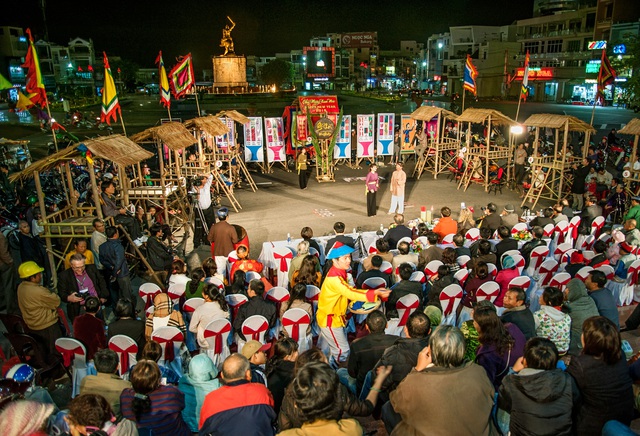
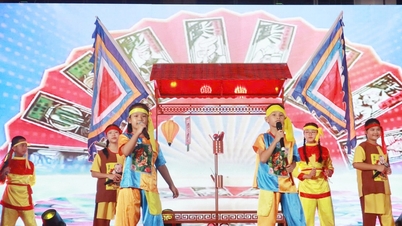
Central Vietnam Folk Bài Chòi Art Festival
Photo: Dao Tien Dat
Mr. Hieu is not only proficient in various forms of poetry and folk sayings, but also keeps up with current events to sing verses that accurately reflect the cards drawn, while also being relevant to the events happening in his hometown. He leads the story to the name of the drawn card with rhyming and simple verses, yet they contain profound life lessons and moral insights. Therefore, the verses Mr. Hieu performs in the game are not just ordinary sayings for momentary entertainment, but many of them prompt listeners to ponder. This is where Mr. Hieu's captivating and alluring nature in the Bài Chòi game lies.
The flexibility of the verses
Each card that Mr. Hieu calls out in the Bài Chòi game corresponds to one or more rhyming verses. This is different from the early Bài Chòi games. In those early days, when a card was drawn, players would simply call out the name of the card. For example, if it was a four-legged card, he would just say: "This is a four-legged card." Anyone in the booth who had a four-legged card would raise it. The game would be very boring if it only stopped at calling out the card's name like that. Mr. Hieu had to draw from folk songs and proverbs or compose verses or poems corresponding to the card's name to increase the suspense for the players. For example, this is the rhyming verse corresponding to the first card of the game:
"Even if it's not delicious, it's still a sticky rice cake wrapped in thorny leaves."
Even if he's foolish, he's still a schoolboy."
In the two sentences above, there is the word "tro," which corresponds to the card called "nhat tro" (first game).
Or the bowl-shaped fish:
"My dear! The crescent moon is here tonight."
"Let him go up and down so you can hold our child in your arms."
These two lines contain the word "bồng," corresponding to the "bát bồng" (a type of fish). But Mr. Hiệu's talent, which can make many people burst with joy, lies in his incredibly skillful way of "flirting." Without beating around the bush, he directly states the time of the "new moon," letting the other party know that he's not afraid of ghosts or tripping in the dark anymore. Even bolder, he might even "give" a child! The enthusiastic applause from the players at the bài chòi game is always thanks to such clever and witty remarks.
Not only did he sing verses that mentioned the names of playing cards, but Mr. Hieu went a step further, adding a symbolic element:
"Last night I went to the hill."
"Seeing him pitying the woman with her four legs crossed" (the "four-legged" child).
The riddle above contains the phrase "four legs crossed," completely omitting the words "legs" and "four," yet players still understand it as "four legs," because four legs implies four legs - "four legs." This flexibility is also a step forward for Mr. Hieu in leading the game; even romance novel writers cannot match it.
Like many other art forms, Bài Chòi has to reinvent itself to suit the circumstances. For example, at festivals organized by many provinces, Bài Chòi has a proper script, and sometimes it's just singing instead of playing cards. Mr. Hiệu no longer has the space to perform as he did in the village courtyards of the past; sometimes he has to stand on the sidelines of the performance.
Today, although there are many options for entertainment during the three days of Tet, Bài Chòi (a traditional Vietnamese folk game) has never lacked players. Among them, Mr. Hieu remains deeply etched in the hearts of many generations. For them, Mr. Hieu, the barefooted figure, always stayed up with them in the village courtyards during Tet.
Source: https://thanhnien.vn/nghe-anh-hieu-hat-bai-choi-185260130185454983.htm

![[Photo] General Secretary and President To Lam presides over a working session with the Central Policy and Strategy Committee on the development of the materials industry.](https://vphoto.vietnam.vn/thumb/1200x675/vietnam/resource/IMAGE/2026/05/21/1779359935432_a3-bnd-3129-1412-jpg.webp)
![[Photo] National Assembly Chairman Tran Thanh Man working with the Standing Committee of the Law and Justice Committee](https://vphoto.vietnam.vn/thumb/1200x675/vietnam/resource/IMAGE/2026/05/21/1779378929214_ndo_br_1-4610-jpg.webp)















































































Comment (0)