

Temple of Literature in the land of martial arts
Amidst the bustling atmosphere of the New Year, as crowds flock to famous spiritual tourist destinations, there is a place that quietly awaits visitors: the Binh Dinh Confucian Temple in An Nhon Bac ward, Gia Lai province (formerly An Nhon town, Binh Dinh province). Humbly situated on a corner of Do Nhuan street, Vinh Phu neighborhood, this historical site holds profound cultural and educational values, yet remains relatively unknown to many.
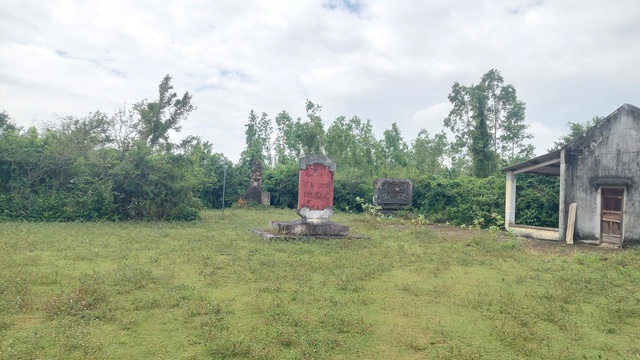
The Binh Dinh Confucian Temple is modestly situated at a corner of Do Nhuan Street, Vinh Phu neighborhood, An Nhon Bac ward, Gia Lai province.
PHOTO: DUC NHAT
Mr. Vu Thanh Long, head of the Vinh Phu residential group, said that over time and due to historical changes, the temple has suffered some damage. "Currently, mainly older people still remember the temple well, while younger generations have had few opportunities to learn about it, so they don't know much about this historical site," Mr. Long said.
According to Mr. Long, in the past, in front of the temple gate, on both the left and right sides, there were stone steles over 3 meters high inscribed with the words "khuynh cái hạ mã," meaning to tilt the palanquin and dismount from the horse, showing respect for the sages. Inside, there used to be two lime-cast lion statues guarding the sides, creating a solemn and ancient atmosphere. Next to them was a screen with a relief of a stone mythical creature carrying a letter, an architectural detail rich in symbolic meaning.
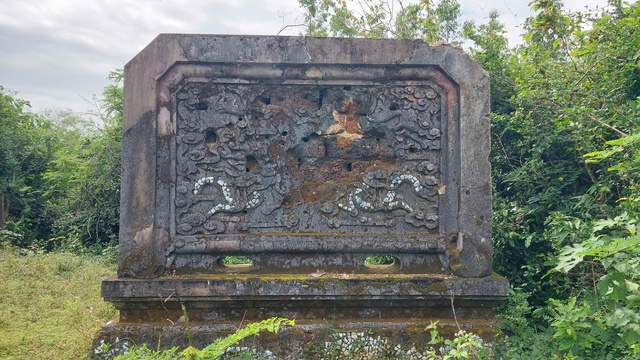
The screen with the relief carving of a mythical creature has been damaged by the passage of time and historical upheavals.
PHOTO: DUC NHAT
According to the book "The Landscape of Binh Dinh" by scholar Quach Tan, the Confucian temple once had a fairly large scale with three buildings, each with three bays and two wings. " Large columns, more than one could embrace, and rafters made entirely of precious wood. The main hall was dedicated to Confucius and other sages. The western hall was dedicated to Khai Thanh (Confucius' father). The eastern hall was dedicated to the ancient Confucian scholars. The temple faced south, with a screen, three memorials, and a triple-arched gate in front, surrounded by a stone wall… ".
Not only is the ancient temple complex remarkable for its architecture, but its grounds are also surrounded by rows of ancient mango trees with lush foliage, creating a solemn and tranquil atmosphere. Visitors often feel a sense of peace and serenity.
Built in 1802 during the reign of Emperor Gia Long, the Temple of Literature in Gia Lai is a provincial-level Confucian institution established by the imperial court to honor Confucian scholars. In the early Nguyen dynasty, the emperor "ordered all garrisons to establish Temples of Literature," including the Binh Dinh Temple of Literature. This was an important Confucian institution, contemporary with the Dien Khanh Temple of Literature (Khanh Hoa), the Tran Bien Temple of Literature ( Dong Nai ), and many other temples along Central Vietnam.
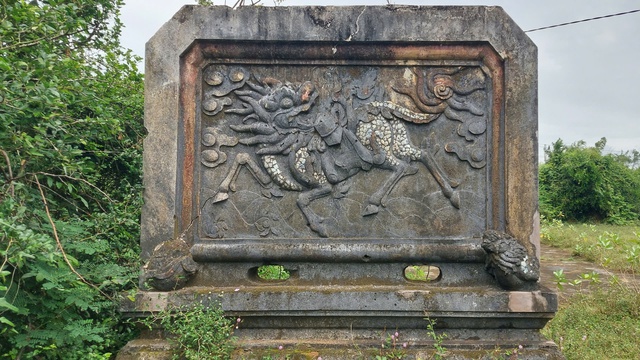
The inside of the screen is still relatively intact, featuring a mythical creature carrying a letter.
PHOTO: DUC NHAT
During the Nguyen Dynasty, this place was not only a sacred space for worshipping Confucius and other sages, but also a center of educational activities and rituals for the entire region. The Temple of Literature became a symbol of the tradition of studiousness in ancient Binh Dinh, contributing to affirming the position of a region renowned not only for martial arts but also for philosophy. The presence of the Temple of Literature contributed to creating a unique balance between literature and martial arts, a distinctive feature in the history of the land of martial arts and literary arts of ancient Binh Dinh.
We hope it will be restored and renovated.
Today, on a plot of land approximately 500 m², the remnants of a once magnificent structure are reduced to a small, simple house, a screen wall, and ancient pillars stained with cracks and damage from the ravages of time and war. The surrounding area is quite peaceful, offering a tranquil atmosphere to visitors. However, according to local residents, the site remains little-known among cultural tour itineraries.
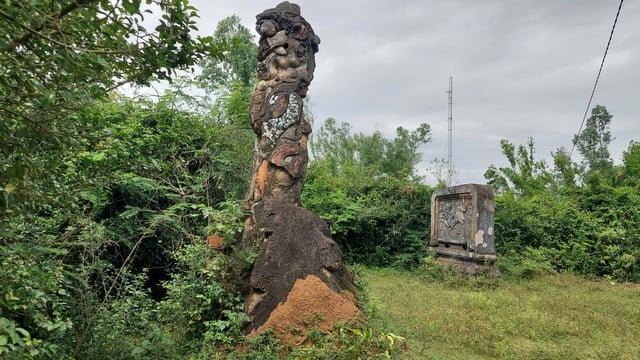
The remaining pillar and screen at the Binh Dinh Temple of Literature.
PHOTO: DUC NHAT
During his visit at the beginning of the year, Mr. Tran Duc Hoa, a tourist from Quy Nhon, said he has a special fondness for historical sites. This was his first time visiting the Temple of Literature in Gia Lai province to satisfy his passion for exploration and to express his admiration for the ancient sages.
"Upon arriving here and witnessing the damage to the temple caused by time and the ravages of war, I felt truly saddened. A place that was once a symbol of the region's tradition of valuing education is now quite deserted. I think that with better care, restoration, and promotion, this place could absolutely become a meaningful cultural destination for tourists and students," Mr. Hoa shared.
According to Mr. Vu Thanh Long, the Binh Dinh Temple of Literature is not only a collection of architectural relics, but also a symbol of the tradition of studiousness that our ancestors painstakingly cultivated since the Nguyen Dynasty. The fact that the site is not widely known is something to consider, as it could become a traditional educational site for local students.
"The elderly people in the neighborhood still hope that the monument will continue to be restored, renovated, and preserved so that younger generations can better understand a symbol of this land of learning," Mr. Long expressed.
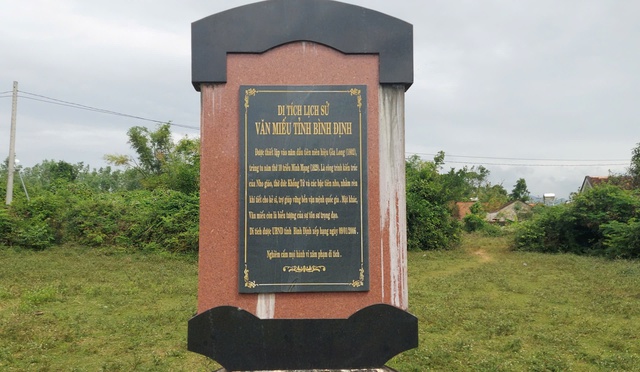
The Binh Dinh Temple of Literature was classified as a provincial-level historical and cultural relic in 2006.
PHOTO: DUC NHAT
Despite undergoing numerous historical changes and its reduced scale, the Binh Dinh Temple of Literature still holds special value and was classified as a provincial-level historical and cultural relic in 2006. This is an important foundation for the continued preservation and promotion of the relic's value in local cultural life.
Source: https://thanhnien.vn/dau-nam-den-gia-lai-tham-van-mieu-185260219100738831.htm
































































































Comment (0)