

Indonesia inaugurated its new capital, Nusantara, on August 17th, coinciding with the 79th anniversary of its National Day. However, the $32 billion "relocation" project of the archipelago nation is not scheduled to be fully completed until 2045.
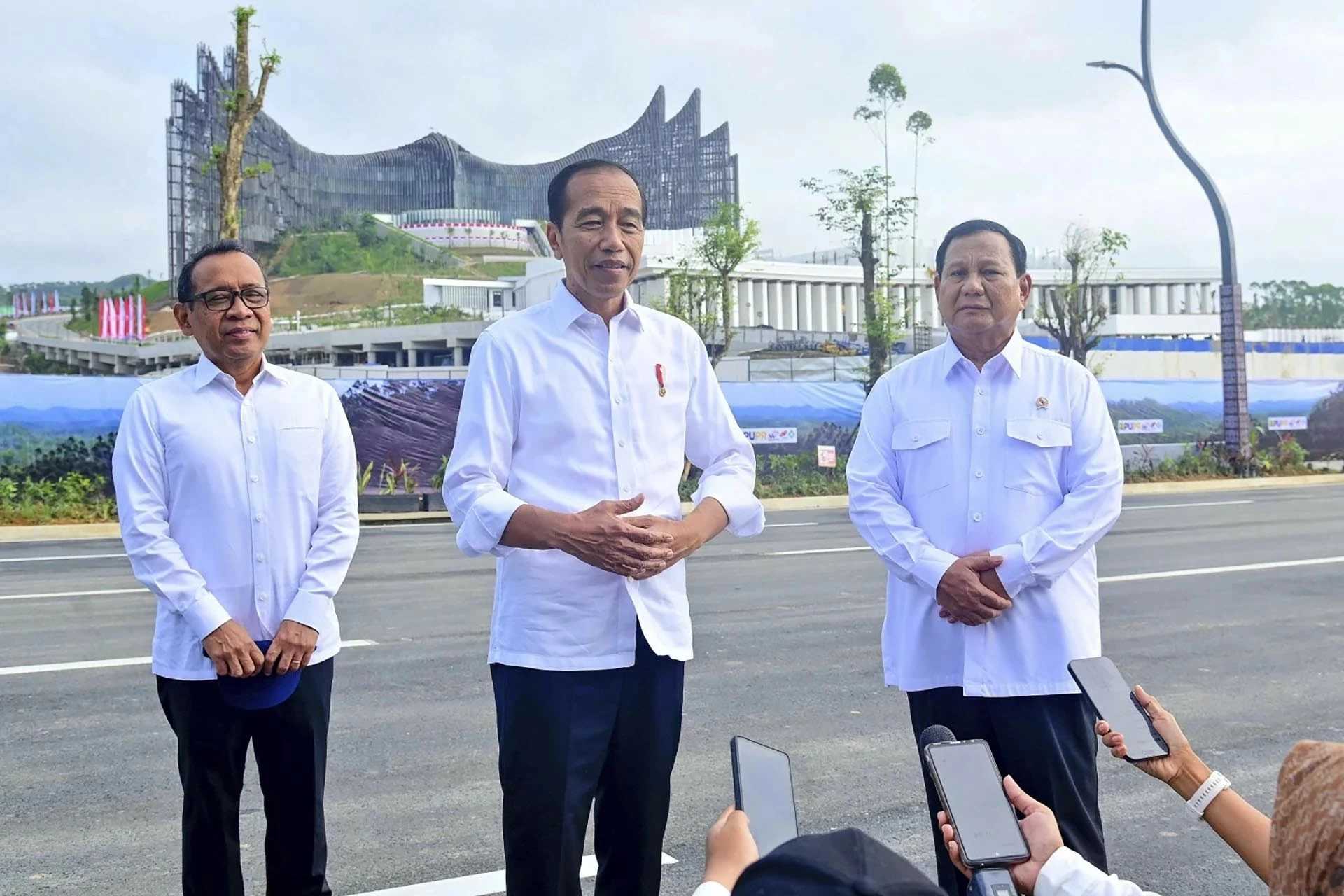 |
| President Joko Widodo (center) speaks to reporters in the new capital Nusantara on August 12. (Source: the Jakarta Post) |
On August 12, President Joko Widodo, who spearheaded this mega-project, held the first full cabinet meeting at the Garuda Palace in Nusantara. The meeting was attended by Vice President Ma'ruf Amin and cabinet ministers, including Defense Minister Prabowo Subianto, who was elected President and is scheduled to take office on October 20 in Nusantara.
Mr. Subianto chose Gibran Rakabuming Raka, son of President Widodo, as his running mate and pledged to continue his predecessor's policies, including the new capital project.
Speaking at the meeting, President Jokowi emphasized that the new capital, Nusantara, marks a new chapter in Indonesian history. Not every country has the opportunity or the ability to build a new capital "from scratch."
According to the President, Nusantara has a strategically important location and will promote balanced development for the Indonesian economy . Stating that completing this massive project is not a quick task but a long and difficult process, he pledged to continue working alongside his successor, Prabowo Subianto, in building the new capital and called for foreign investors to participate in the project.
Nusantara is being built in the forest east of Kalimantan province on Borneo island, about 1,200km from the current capital, Jakarta. However, the project is currently facing many problems, especially slow construction and a lack of investment capital. The plan to relocate Indonesia's capital was first put forward by the Indonesian Ministry of National Development Planning in early April 2019 and mentioned by President Joko Widodo in his State of the Union address on August 16, 2019, on the occasion of the 74th anniversary of Indonesia's Independence Day.
The idea of relocating the capital has actually been discussed for decades by various presidents, since the time of the country's first president, Sukarno. The idea was realized and became urgent under President Widodo.
The plan to relocate the capital comes as Jakarta faces numerous problems such as environmental pollution, flooding, and severe traffic congestion. Furthermore, due to its low-lying location, Jakarta is frequently affected by high tides and suffers from flooding during the rainy season.
Over-extraction of groundwater is causing the city to sink at an increasingly rapid rate. Researchers say North Jakarta has sunk 2.5 meters in the last 10 years and continues to sink at an average of 18 centimeters per year. It is estimated that a large part of Jakarta could be completely submerged by 2050.
Once the capital of the Sunda kingdom during the Middle Ages, then the port city of Batavia during the Dutch colonial period, and later the capital in the 1940s when Indonesia declared independence, Jakarta is now the largest city in Indonesia with a population of approximately 10 million people, three times larger than the population of its neighboring cities.
Therefore, when discussing the plan to relocate the capital, President Widodo emphasized that the capital is not only a symbol of national identity but also represents the nation's progress. The choice of a new capital also reflects the country's foresight, realizing its future economic goals.
According to President Widodo, Indonesia's new capital is designed as a sustainable smart city with an efficient public transportation system and green water and electricity systems. The Indonesian government aims to place the new capital among the top 10 most livable cities in the world and attract foreign talent, especially from Southeast Asian countries.
Source: https://baoquocte.vn/indonesia-doi-do-ve-dong-kalimantan-282677.html

![[Image] Shipbuilders exposed to steel and record-breaking heat.](https://vphoto.vietnam.vn/thumb/1200x675/vietnam/resource/IMAGE/2026/06/04/1780545781745_ndo_br_img-5402-4683-jpg.webp)






































![[Video] Sunset at Lap An Lagoon – Where the sun sets over the fishing nets](https://vphoto.vietnam.vn/thumb/1200x675/vietnam/resource/IMAGE/2026/05/31/1780192137701_beach-landscape-sea-water-nature-grass-745871-pxhere-com.jpeg)






























Comment (0)