

The 13th Maritime Dialogue aims to raise public awareness of existing frameworks and new regulations governing the management of international waters beyond national jurisdiction.
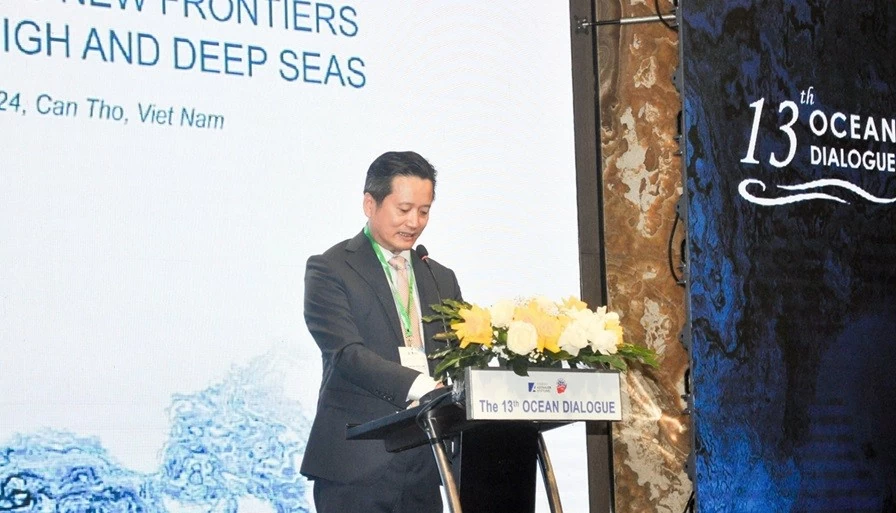 |
| Dr. Nguyen Hung Son, Deputy Director of the Diplomatic Academy, delivered the opening remarks at the 13th Maritime Dialogue. (Photo: Pham Hang) |
On November 14th, in Can Tho City, the Diplomatic Academy of Vietnam, in collaboration with the Konrad-Adenauer-Stiftung Institute in Vietnam (KAS), organized the 13th Maritime Dialogue with the theme " Exploring New Boundaries of International Waterways". The event was attended by numerous experts, scholars, and legal professionals from Vietnam and abroad, participating both in person and online.
In his opening remarks at the Dialogue, Dr. Nguyen Hung Son, Deputy Director of the Diplomatic Academy, reviewed the negotiation process leading to the Agreement within the framework of the 1982 United Nations Convention on the Law of the Sea (UNCLOS) on the conservation and sustainable use of marine biodiversity in areas outside national jurisdiction (BBNJ).
Dr. Nguyen Hung Son emphasized that the BBNJ (Border Security Agreement) is a new milestone in international law, a significant victory for multilateralism. In September 2023, the draft agreement was opened for signing with the goal of entering into force as soon as possible. Vietnam was one of the first countries to sign the BBNJ and highly values the importance of this agreement.
2024 marks the 30th anniversary of the official entry into force of UNCLOS; UNCLOS is recognized as the "Constitution of the seas and oceans". Besides establishing the legal regime for maritime zones under national jurisdiction, UNCLOS also sets out a legal framework for maritime zones outside national jurisdiction, such as the High Seas with the principle of "freedom of the seas" and the Ocean Zones with the principle of "the common heritage of mankind".
Dr. Nguyen Hung Son affirmed that UNCLOS, after 30 years, remains a "guiding light" for activities in the seas and oceans.
"I hope the 13th Maritime Dialogue will help stakeholders better understand the BBNJ and find common ground among scientists and legal experts so that Southeast Asian countries can prepare for the BBNJ implementation process, and make new recommendations to promote cooperation," said Dr. Nguyen Hung Son.
In this context, the 13th Maritime Dialogue aims to: (i) raise public awareness of existing frameworks and new regulations governing the management of international waters outside national jurisdiction; (ii) assess opportunities and challenges related to exploration and conservation cooperation in international waters; and (iii) propose legal and policy recommendations for countries to promote the potential for cooperation in international waters.
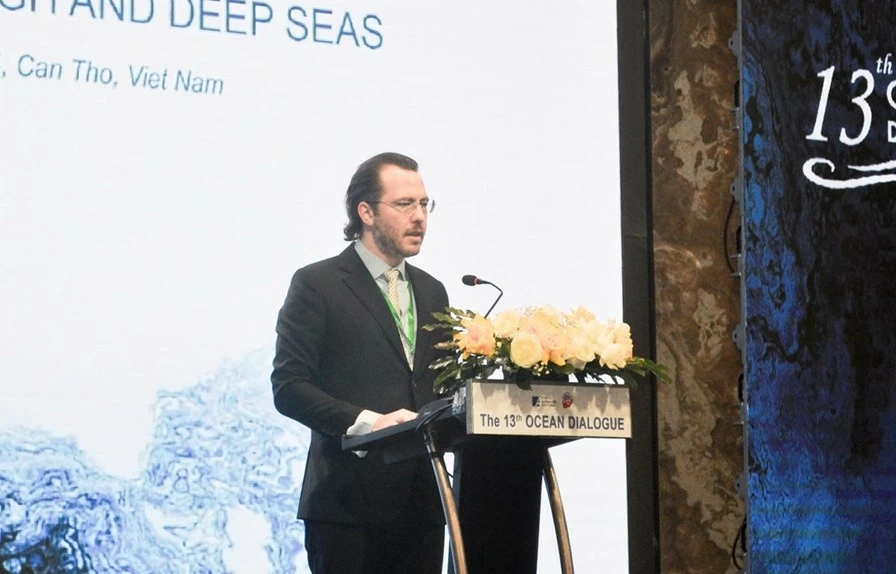 |
| Florian Feyerabend, Head of KAS Institute's representative office in Vietnam, delivered the opening remarks at the Dialogue. (Photo: Pham Hang) |
Speaking at the opening ceremony, Mr. Florian Feyerabend, Head of the KAS Institute, affirmed the important significance of the 13th Maritime Dialogue and expressed hope that it would be a forum for delegates to engage in in-depth discussions on deep-sea exploitation, governance of areas beyond national jurisdiction, and the development of platforms to promote cooperation and build future policies.
This Maritime Dialogue comprises four discussion sessions covering diverse topics. The BBNJ Agreement: Key Contents and Prospects (Session 1) will focus on exchanging and clarifying the fundamental contents of the BBNJ Agreement; and discussing how this Agreement can be applied in accordance with other existing legal instruments.
After nearly two decades of discussion and negotiation, the recently adopted BBNJ Agreement has become the third implementing agreement under the UNCLOS framework. The agreement regulates key issues related to the conservation and sustainable use of marine biodiversity in areas beyond national jurisdiction, such as: marine genetic resources; regional management instruments (ABMT), including marine protected areas (MPAs); environmental impact assessment; capacity building and technology transfer; and the operation of agencies and institutions.
“New Perspectives in Deep-Sea Sea Regulations” was the topic of discussion in the second session. Speakers discussed the importance of deep-sea seabed exploitation activities, existing legal frameworks, and the process of developing regulations to govern these activities. Delegates also exchanged views on issues such as: what challenges or obstacles will the new exploitation law present? What is the relationship between this law, UNCLOS, and the new BBNJ Agreement? How to balance different objectives of economic growth, environmental protection, and social welfare? How to harmonize differences among stakeholders (government, industries, environmental groups, etc.)?
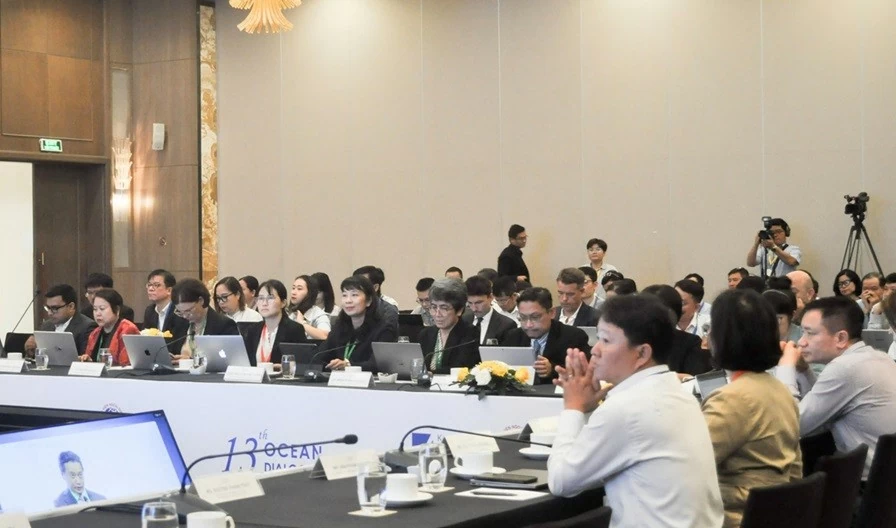 |
| The 13th Maritime Dialogue included four in-depth discussion sessions. (Photo: Pham Hang) |
In the discussion session on opportunities and challenges in cooperation in international waters (session 3), delegates discussed and assessed the opportunities and challenges in cooperation in international waters (the High Seas and the Regions), especially in the context of the BBNJ Agreement being open for signing and the "exploitation code" being under negotiation.
Centered around the theme of “exploitation and conservation in international waters, recommendations and policies,” the final session of this year’s Maritime Dialogue focused on discussing and formulating legal and policy recommendations to promote cooperation in exploration, exploitation, and conservation in international waters.
In addition, the speakers assessed the factors to ensure the BBNJ Agreement is effective and implemented efficiently, as well as the factors that will help reach consensus on a new exploitation law in the future.
In addition, the discussion focused on the following issues: (i) how to involve multiple stakeholders and third parties; (ii) how to promote the role of international organizations or specialized agencies at the global and regional levels; (iii) how to enhance opportunities for both developed and developing countries; (iv) how to peacefully resolve potential disputes; and (v) how to address other interdisciplinary issues in this field.
 | Vietnam actively upholds the values of UNCLOS and promotes cooperation on maritime and ocean issues. The 34th Conference of States Parties to the United Nations Convention on the Law of the Sea (SPLOS) was held from June 10-14. |
 | 5th Vietnam-Australia Maritime Dialogue On September 26, the Vietnamese Ministry of Foreign Affairs, in coordination with the Australian Department of Foreign Affairs and Trade, organized the Vietnam-Australia Maritime Dialogue. |
 | Strengthening and expanding international cooperation on maritime issues for peace, stability, and sustainable development in the South China Sea. Permanent Deputy Minister of Foreign Affairs and Chairman of the National Border Committee Nguyen Minh Vu answers an interview with TG&VN Newspaper on the occasion of... |
 | Opening Ceremony of the International Conference on Cooperation for Peaceful and Developed Borders, Seas, and Islands On the morning of October 8th, in Hanoi, the Ministry of Foreign Affairs, in coordination with the Wallonie-Bruxelles Delegation in Vietnam, organized the international seminar 'Cooperation...' |
 | The Agreement on the High Seas (BBNJ): A new milestone in international law, an extension of UNCLOS. Agreement within the framework of UNCLOS on the conservation and sustainable use of marine biodiversity in areas beyond territorial rights... |
Source: https://baoquocte.vn/doi-thoai-bien-lan-thu-13-kham-pha-ranh-gioi-moi-cua-vung-bien-quoc-te-293651.html


![[Image] National Assembly discusses the implementation of the socio-economic development plan.](https://vphoto.vietnam.vn/thumb/1200x675/vietnam/resource/IMAGE/2026/04/20/1776696707422_ndo_br_img-20260420-185419-jpg.webp)

![[Photo] General Secretary and President To Lam meets with National Assembly delegates from ethnic minorities.](https://vphoto.vietnam.vn/thumb/1200x675/vietnam/resource/IMAGE/2026/04/20/1776696701056_a1-bnd-8331-3342-jpg.webp)
































































Comment (0)