

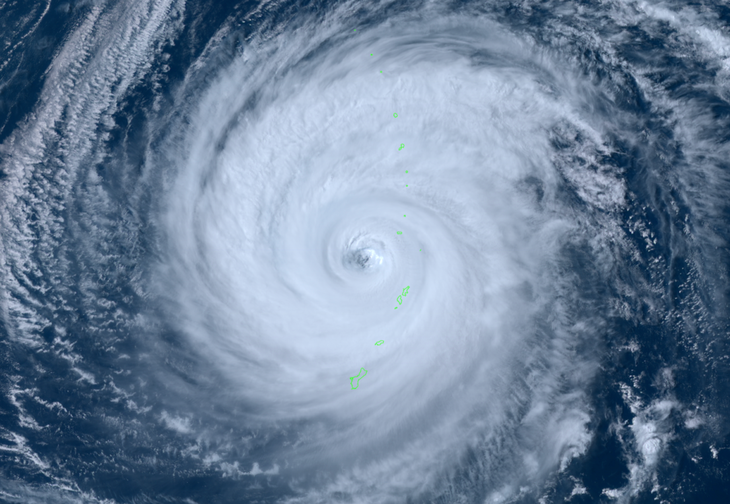
Talk with Tuoi Tre Online On the morning of April 15th, Mr. Nguyen Van Huong, Head of the Weather Forecasting Department of the National Center for Meteorological and Hydrological Forecasting, stated that at 7:00 AM this morning, the center of Typhoon Sinlaku was located in the sea northwest of the Northern Mariana Islands.
The current storm intensity is level 15 (167-183 km/h), a decrease of 2 levels compared to its peak intensity and no longer a super typhoon.
Mr. Huong said that the forecast for the next 24 hours is that Typhoon Sinlaku will move north, then move in a north-northeast direction.
From around April 19th, the storm changed direction, moving northeast towards the waters east of Japan, and had no impact on the weather in the East Sea of Vietnam.
According to the Japan Meteorological Agency (JMA), Typhoon Sinlaku swept across the Northern Mariana Islands last night, with its epicenter on the islands of Saipan and Tinian.
According to JMA, at 10:00 AM today, the strongest winds were maintaining at approximately 175 km/h (equivalent to Category 15), with gusts reaching 250 km/h (above Category 17). Currently, the central pressure of the storm has increased to 935 hPa - a sign that the storm is weakening.
Satellite imagery of Himawari 8 shows that the eye of the storm is narrower and fainter than yesterday, but the storm's circulation remains hundreds of kilometers wide, symmetrical, and dense.
The JMA issued a warning for wind speeds of level 7 or higher extending 500-600km from the storm's center, and for wind speeds of level 10 or higher extending approximately 165km.
Simultaneously, it is predicted that in the coming days the storm will move north, then northeast, towards the waters off the coast of Japan, and its intensity will gradually weaken.
According to the National Center for Hydro-Meteorological Forecasting, Sinlaku is the first typhoon to reach super typhoon status in 2026 (according to the JMA, the strongest winds at the time of the typhoon are approximately 212 km/h, equivalent to level 17, with gusts up to 305 km/h, exceeding level 17). Since the beginning of the year, Sinlaku has been the strongest storm in the world with a central pressure of 905 hPa, surpassing Hurricane Maila in Australia (924 hPa). This also marks the third time since 1977 that a super typhoon has appeared in April, the first being Super Typhoon Surigae in 2021. |
Source: https://baotayninh.vn/du-bao-moi-nhat-ve-sieu-bao-sinlaku-144255.html
![[Photo] The General Secretary, President and his wife begin their state visit to the Philippines.](https://vphoto.vietnam.vn/thumb/1200x675/vietnam/resource/IMAGE/2026/05/31/1780230559452_anh-man-hinh-2026-05-31-luc-19-28-11.png)

![[Photo] Admire the coral "masterpiece" amidst the million-year-old heritage of Dak Lak province.](https://vphoto.vietnam.vn/thumb/1200x675/vietnam/resource/IMAGE/2026/05/31/1780221235105_anh-man-hinh-2026-05-31-luc-16-53-27.png)
![[Photo] Solemn bathing ceremony and Buddha procession in Hue](https://vphoto.vietnam.vn/thumb/1200x675/vietnam/resource/IMAGE/2026/05/31/1780228263543_1-jpg.webp)




















![[Video] Sunset at Lap An Lagoon – Where the sun sets over the fishing nets](https://vphoto.vietnam.vn/thumb/340x192/vietnam/resource/IMAGE/2026/05/31/1780192137701_beach-landscape-sea-water-nature-grass-745871-pxhere-com.jpeg)










































![[Photo] Admire the coral "masterpiece" amidst the million-year-old heritage of Dak Lak province.](https://vphoto.vietnam.vn/thumb/402x226/vietnam/resource/IMAGE/2026/05/31/1780221235105_anh-man-hinh-2026-05-31-luc-16-53-27.png)




































Comment (0)