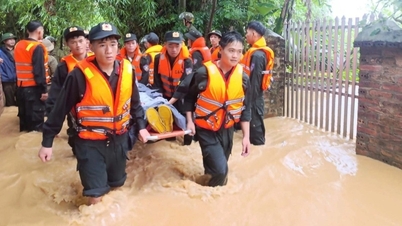
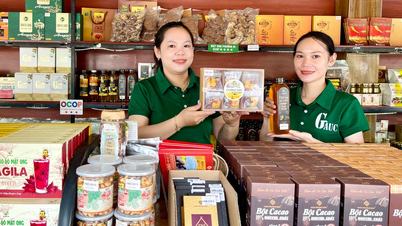
Publishing Tuoi Tre newspaper in Can Tho during the COVID-19 pandemic in 2021 - Photo: HOANG TRI DUNG
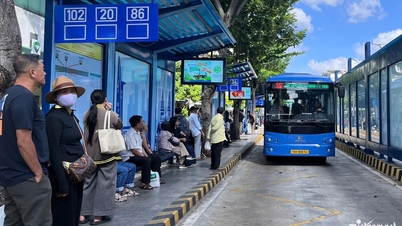
People read newspapers on buses, in cafes, on motorbike taxis parked on the sidewalk... Paper newspapers are a link between individuals and communities; between yesterday, today, and tomorrow.
What do we lose?
Newspapers force readers to pause, turn pages, and pay attention to every word. Reading a newspaper article requires a level of concentration far different from browsing the internet. This slow pace fosters critical thinking and depth.
When everything is just quick, concise information optimized by algorithms, we easily fall into the "confirmation trap" (automatically accepting something as true when it is repeated by many people).
A newspaper can be kept, read repeatedly, cut and pasted, or even used to wrap gifts... It bears the marks of time: yellowed pages, folded corners... and thus it becomes a keepsake, even an artifact of historical value. Electronic newspapers are just a stream of bits, which can disappear with a single click to "clear the cache" or a change in the algorithm.
When print newspapers disappeared, thousands of workers in the printing, publishing, and distribution industries lost their jobs. Street vendors and newspaper delivery drivers gradually vanished. Technological progress always comes with the sacrifice of a segment of traditional labor.
However, not everything is a loss. Online newspapers bring unprecedented democratization of information. A farmer in a remote area can instantly read an article about fertilizer prices, a student can look up specialized documents in just a few seconds...
News is constantly updated and presented in multiple formats: videos , infographics, podcasts, livestreams… It also offers higher levels of interaction: comments, sharing, and discussions. Print newspapers can hardly keep up with that speed and scale.



What is the future of journalism?
I believe print newspapers won't disappear completely, at least not for the next few decades, but they will change in nature.
It could become a premium product, much like vinyl records in the age of streaming. Some newspapers will print limited editions, beautifully designed, on high-quality paper, for collectors or those who want to experience the feeling of reading old newspapers.
Imagine a luxurious, 40-page Sunday newspaper, filled with lengthy feature articles, artistic photography, and minimal news... It would be more of a treat for the mind than a daily news source.
Another scenario is the "hybrid" model: a condensed version of the print newspaper, retaining only the in-depth, analytical, and investigative content, while breaking news is entirely available on digital platforms. Some major newspapers around the world are doing this quite well: maintaining a print version but focusing heavily on the digital segment and charging readers a subscription fee.
However, the biggest challenge is not technology, but trust. In the age of AI writing, deepfakes, and information spreading at lightning speed, the role of traditional journalism as a "gatekeeper" becomes even more crucial. But even journalism itself is losing trust for many reasons: bias, commercialization, access pressure, etc.
If journalism fails to save itself through accuracy, integrity, and depth, whether in print or digital, it will be replaced by more personalized, extremist, and less verified information channels.
I predict that in the next 10-15 years, most people under 40 will hardly touch newspapers anymore. Children born from 2020 onwards may view newspapers as museum artifacts, much like we view typewriters today. But this very rarity may make newspapers even more valuable, as a cultural ritual rather than just a tool for information.
Keep something.
I still make it a habit to keep physical newspapers whenever I can. Not to reread them, but to feel them. To remember that information once had weight, taste, and a price to pay in money and time.



I once saw an old man sitting on a park bench, slowly reading each page of the newspaper, underlining important lines with a pencil. He was conversing with the world in the way of a bygone generation. That moment was breathtakingly beautiful.
Perhaps when print newspapers are completely gone, we will realize how precious what we once considered normal actually is. Not because it's the most effective, but because it bears the mark of humanity: slow-paced and full of nostalgia.
Newspapers may gradually disappear, but the habit of reading slowly, thinking deeply, and appreciating information is not easily lost.
In a world where everything can slip away with a swipe of a finger, holding a newspaper, flipping through the pages, letting the ink lightly stain our fingertips, is perhaps a way for us to affirm that we are still beings of linear time, rather than merely gliding across a cold glass surface.
Source: https://tuoitre.vn/khi-bao-giay-vang-bong-10026063005570346.htm
![[Image] National conference summarizing one year of operation of the overall organizational model of the political system, the three-tiered government model.](https://vphoto.vietnam.vn/thumb/1200x675/vietnam/resource/IMAGE/2026/07/01/1782882811691_ndo_br_1-jpg.webp)