


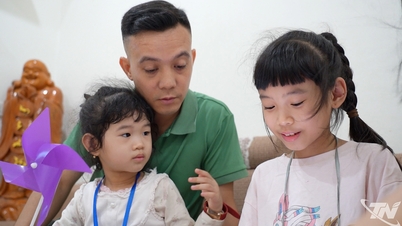
If children are treated in a balanced way, they will feel loved and safe, while also learning to protect themselves and respect the boundaries of others. - Illustration: CHAU SA
Some people see it as a normal, adorable moment of father-son affection. But many others have expressed concerns. What do psychology experts advise?
As children grow older, does love need its own space?
Videos showing intimate moments between a father and daughter have become a topic of public discussion. Some commenters argue that as children grow older, physical closeness needs appropriate boundaries. Others believe it's simply a normal display of father-daughter affection.
The debate goes beyond simply asking "right or wrong," raising broader questions.
Some accounts suggest that as children grow older, the intimacy between parents and children changes. What constitutes a healthy level of closeness that allows children to feel loved while also developing awareness of their bodies and personal space, and should private moments of children be shared online?
Dr. Le Thi Lam, a lecturer in the Psychology - Education - Social Work Department at the University of Pedagogy (Da Nang University), said that from around the age of 6-7 onwards, children begin to shift from the mindset that "the body is part of the family" to the understanding that "the body belongs to oneself." If adults handle this in a balanced way, children will still maintain a sense of safety and love while simultaneously developing the ability to protect themselves and respect the boundaries of others.
At this age, children also begin to develop a clearer understanding of their own bodies and personal space. They tend to be hesitant to change clothes in front of others, want to be respected when bathing or going to their room, and begin to care more about gender differences and control over their own bodies.
This is a completely normal stage of psychological development, showing that children are building a sense of self, personal boundaries, and safety. It's important for parents to view this change as a natural step in growing up, rather than assuming their child is becoming more "distant" or "difficult" than before.
According to Ms. Lam, during this period, the closeness between parents and children should not be lost, but should gradually shift to expressions that are age-appropriate and respectful of the child's feelings.
Parents can still hug their children, hold hands, read books together, or express affection through positive daily gestures. However, parents should start paying more attention to asking permission before touching a child's body, respecting when children refuse hugs or kisses, or wanting their own space.
Seemingly small things like knocking before entering a child's room or letting them dress themselves can help children understand that their bodies deserve respect.
This does not diminish emotional bonding; on the contrary, it helps children feel safe and respected in their relationship with their parents.
The most important distinguishing factor is whether a child's feelings and consent are respected. Healthy emotional interactions typically make children feel comfortable, safe, and not coerced.
Conversely, if adults ignore a child's discomfort, force them to be hugged or kissed to "behave," make embarrassing body-shaming jokes, or make them feel they have no right to refuse, these things can confuse the child about personal boundaries.
Many parents are sometimes too carefree, thinking, "It's nothing for my child." However, children need to learn that even with family members, they have the right to say "no" when they feel uncomfortable.
"Parents need to teach children about privacy, the right to refuse, and respect for their own bodies as well as those of others," Ms. Lam said.
Be cautious when sharing private photos of your child online.
Ms. Lam noted that many parents post pictures of their children bathing, sleeping together, wearing revealing clothes, or other private moments with the simple thought that they are cute and harmless. However, once these images are uploaded to the digital environment, it is very difficult for parents to control whether they are stored, shared, or misused.
In addition to image safety risks, regularly publicizing children's private moments can also affect their sense of personal boundaries and privacy as they grow up.
Children need to understand that their bodies and personal space deserve respect, including online.
Ms. Lam shared: "The most positive thing a family can build is a culture of mutual respect: adults respect children's feelings and boundaries, and children learn to respect others. This provides children with both a secure emotional foundation and the ability to protect themselves in a healthy way."
Lawyer Tran Thi Thu Phuong ( Hoa Phat Law Office - Hoa Khanh branch, under the Da Nang City Bar Association) stated that the law does not prohibit parents from posting photos and videos of their children on social media because parents are the legal representatives of their children. However, children still have the right to protection of their privacy and personal secrets in the online environment, as stipulated in the 2018 Cybersecurity Law. This right continues to be maintained in the 2025 Cybersecurity Law, which will take effect from July 1, 2026.
According to Ms. Phuong, the new aspect of the law is the expansion of protection to vulnerable groups in cyberspace, including children. Notably, for children aged 7 and above, the posting of images and videos related to their private lives requires their consent.
Source: https://tuoitre.vn/khi-con-lon-dan-ranh-gioi-yeu-thuong-thay-doi-20260522232427632.htm






























































































Comment (0)