


In the context of increasingly extreme heat, every forest preserved is not only a resource, but also an ecological shield for the entire community.
The heartfelt concerns shared by Mr. Nguyen The Linh, a forest ranger in charge of Ban Xeo commune ( Lao Cai province ), in an interview with the Government Online Newspaper, clearly reflect the current level of tension in forest fire prevention and control.
According to Mr. Linh, the commune currently has over 1,500 hectares of forest at medium risk of fire, and approximately 1,472 hectares at high risk of fire, with the potential for wildfires to break out at any time.
According to Report No. 3427/BNNMT-LNKL dated April 9, 2026, from the Ministry of Agriculture and Environment , intense heat is currently covering many areas across the country, with temperatures commonly ranging from 36–39 degrees Celsius, and exceeding 40 degrees Celsius in some places. Forest fires have occurred in several mountainous areas in the North, such as Lai Chau and Dien Bien.
Under the impact of climate change and the El Niño phenomenon, forecasts indicate that hot weather will continue in the coming period, concentrated in the Northern and Central regions. The risk of forest fires therefore remains ever-present, threatening not only forest resources but also directly affecting people's lives.
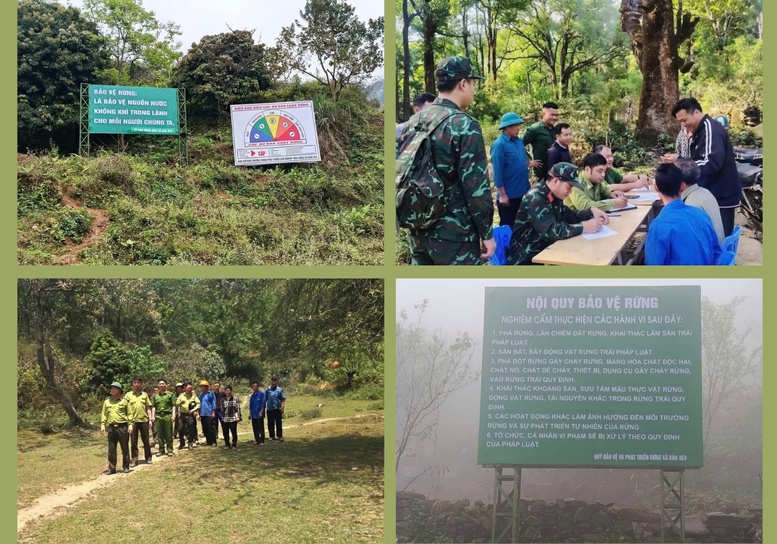
In Ban Xeo commune (Lao Cai province), mobile forest fire prevention and control checkpoints have been set up in the villages of Na An, Na Rin, Ban Giang, Ta Pa Cheo, Seo Pa Cheo, and Can Ty.
Prevent forest fires from spreading due to even the smallest oversights.
Recently, in Ban Xeo commune (Lao Cai province), task forces comprising forest rangers, police, and local military personnel fanned out to man checkpoints. Temporary shelters, hastily erected along forest trails, provided only enough shade, but were always manned by personnel.
Mobile checkpoints have been set up in the villages of Na An, Na Rin, Ban Giang, Ta Pa Cheo, Seo Pa Cheo, and Can Ty. People entering and leaving the forest are reminded and checked.
"The checkpoint is not only for control but also to educate the local people. Many still have the habit of burning fields, burning undergrowth, or bringing fire into the forest without fully understanding the risks," said Nguyen The Linh.
The areas of the commune identified as high-risk zones for forest fires include: Cán Tỷ, Tả Pa Cheo, Cửa Cải, San Lùng, Séo Pa Cheo, Pờ Sì Ngài, Bản Giàng, Làng Mới, Ná Rin, and Tả Lèng.
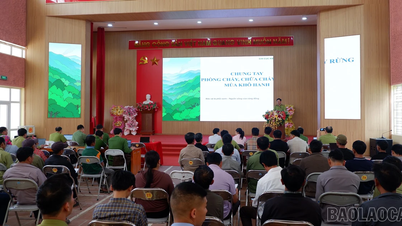
The entire commune organized a signing ceremony for forest fire prevention and control commitments with 110 households. The commitment forms weren't long, but for many, they served as a constant reminder during the dry season.

Lung Tam commune (Tuyen Quang province) is strengthening patrol and inspection teams in key areas with a high risk of fire.
On duty 24/7
In Lung Tam commune (Tuyen Quang province), the atmosphere regarding forest fire prevention is extremely tense. All 17 villages are located in high-risk areas.
The People's Committee of the commune has requested the commune's Forest Protection and Fire Prevention Steering Committee, relevant agencies and units, village management boards, and forest patrol teams to organize 24/7 forest fire prevention and control duty; strengthen patrols and inspections in key areas with high fire risk; prepare sufficient firefighting equipment and tools; and mobilize the people to clear undergrowth and create firebreaks – the "lifeline" when a fire occurs.
In addition, the village management boards are tasked with proactively reviewing and strengthening their forces, preparing sufficient equipment and supplies, and being ready for forest fire prevention and control according to the "four on-the-spot" principle - on-the-spot command, on-the-spot forces, on-the-spot equipment, and on-the-spot logistics.
In addition, local officials are stepping up propaganda and mobilization efforts to raise people's awareness of forest protection, discouraging the careless use of fire in and around forests, thereby contributing to minimizing the risk of forest fires in the area.
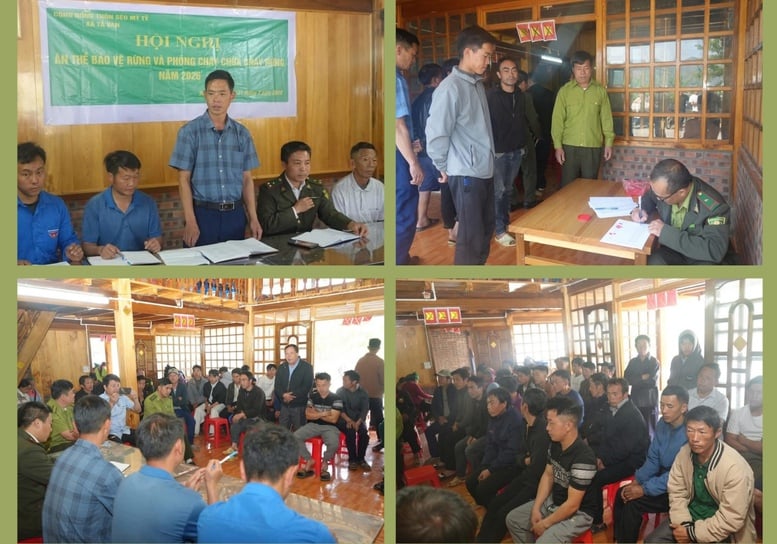
The solemn oath-taking ceremony to protect the forest was held in Seo My Ty village, Ta Van commune (Lao Cai).
The oath to protect the forest: When customary law becomes a "firebreak"
While administrative and technical measures act as a "hard shield," in the area deep within the buffer zone of Hoang Lien National Park, a unique "soft shield" is proving effective: community customary law.
In late March, at Seo My Ty village, Ta Van commune (Lao Cai province), a solemn oath-taking ceremony to protect the forest was held, attracting the participation of all the villagers. More than just a long-standing tradition of the Mong people, the oath-taking ceremony also carries the meaning of a community "commitment," where forest protection rules are "legalized" with honor and trust.
Seo My Ty currently has 122 households, of which the Mong ethnic group accounts for 98%. The lives of the people here are closely intertwined with the forest, especially in sub-areas 29A, 292B, and 286, where the forests are not only a source of livelihood but also the living space and cultural heritage of the entire community.
In 2025, the village's forest protection team, with 17 members, conducted 260 patrols, organized 7 awareness campaigns reaching 850 people, and achieved 100% forest protection commitment signing among households. Notably, the villagers also voluntarily contributed to erecting 52 additional "no fire" signs and maintained a 24/7 patrol during the dry season.
Mr. Tran Quoc Nam, Deputy Head of Hoang Lien Forest Ranger Station, assessed: "In the context of complex dry weather conditions, the fact that people voluntarily raise their awareness and consider the forest as a source of livelihood and the 'green lungs' of their villages is the decisive factor."
Meanwhile, Mr. Hang A Trang, head of Seo My Ty village, affirmed: "The villagers have sworn an oath, and they will do it. We are committed to preventing any violations of forestry laws in the area."
Not stopping at Seo My Ty, this model is also maintained in Den Thang village, the core area of Hoang Lien National Park, where 100% of households have been informed, signed commitments, and participated in forest patrols. As a result, throughout 2025 and the first few months of 2026, there were no forest fires in the area, and illegal logging decreased significantly.

The solemn oath-taking ceremony to protect the forest was held in Den Thang village, Ta Van commune (Lao Cai).
Preserving forests starts with the people's support.
One common thread can be observed: wherever people are truly involved, the forests are preserved.
The figures regarding area or the number of checkpoints are just the tip of the iceberg. More important is the shift in mindset, from simply following campaigns to voluntarily protecting the forests. When the law is combined with customary law, when commitments are not just on paper but are linked to the honor of the community, forest protection gains a solid "line of defense."
In the context of increasingly extreme heat, every forest preserved is not only a resource but also an ecological shield for the entire community. And in the highland villages, where people depend on the forest for their livelihood, preserving the forest is also about preserving their future.
Son Hao
Source: https://baochinhphu.vn/khi-moi-canh-rung-co-nguoi-canh-lua-102260412220651469.htm
![[Image] Current status of the land area of over 5.5 hectares that Ho Chi Minh City is considering reclaiming.](https://vphoto.vietnam.vn/thumb/1200x675/vietnam/resource/IMAGE/2026/04/15/1776245690095_1-3102-8409-jpg.webp)
![[Photo] Mrs. Ngo Phuong Ly meets and exchanges views with Mrs. Peng Li Yuan](https://vphoto.vietnam.vn/thumb/1200x675/vietnam/resource/IMAGE/2026/04/16/1776277858080_phu-nhan-1-jpg.webp)
![[Photo] General Secretary and President To Lam and General Secretary and President Xi Jinping meet with youth from both countries.](https://vphoto.vietnam.vn/thumb/1200x675/vietnam/resource/IMAGE/2026/04/15/1776245687540_vna-potal-tong-bi-thu-chu-tich-nuoc-to-lam-va-tong-bi-thu-chu-tich-nuoc-tap-can-binh-gap-go-thanh-nien-hai-nuoc-8702371-jpg.webp)
![[Photo] National Assembly Chairman Tran Thanh Man concludes official visit to Italy, departs for IPU-152](https://vphoto.vietnam.vn/thumb/1200x675/vietnam/resource/IMAGE/2026/04/15/1776253436109_vna-potal-chu-tich-quoc-hoi-ket-thuc-tham-chinh-thuc-italy-len-duong-du-ipu-152-tai-tho-nhi-ky-8702876-7969-jpg.webp)
![[Image] Overview of the Tam Trinh-Giai Phong connecting road section after land clearance is completed.](https://vphoto.vietnam.vn/thumb/1200x675/vietnam/resource/IMAGE/2026/04/15/1776245679644_ndo_br_dji-0195-jpg.webp)
![[Photo] General Secretary and President To Lam and his wife, along with General Secretary and President Xi Jinping and his wife, attending a tea party.](https://vphoto.vietnam.vn/thumb/1200x675/vietnam/resource/IMAGE/2026/04/15/1776245678527_vna-potal-tong-bi-thu-chu-tich-nuoc-to-lam-va-phu-nhan-cung-tong-bi-thu-chu-tich-nuoc-tap-can-binh-va-phu-nhan-du-tiec-tra-8702812-9829-jpg.webp)
























































































Comment (0)