

Poet Vo Van Luyen, a member of the Vietnam Writers Association and the Quang Tri Provincial Association of Literature and Arts, has just released another literary work, "Since Crossing the River,"* containing nearly 120 poems, mostly composed recently, imbued with anxieties, reflections, contemplations, and perhaps even insights, expanding the dimensions of artistic thought. The work is a continuation of his previous poetry collections such as "The Secret Language of the Sea" and "Ten Fingers of Autumn."
Poet Vo Van Luyen was a diligent and experimental writer, yet not extreme in his creative work. He perhaps formed a fairly consistent concept: both traditional and innovative in his poetry, creating new milestones on his poetic journey.
Similarly, in this poetry collection, readers can find many poems that are harmoniously blended with traditional poetic techniques, such as: Whispering to the Ancient Citadel, Love Flows Towards the Flooded Area, Remembering Father, A Self-Narrative Under the Shadow of Spring Evening, Dreaming of a Cold River at Night, Let the Day Pass Quickly...
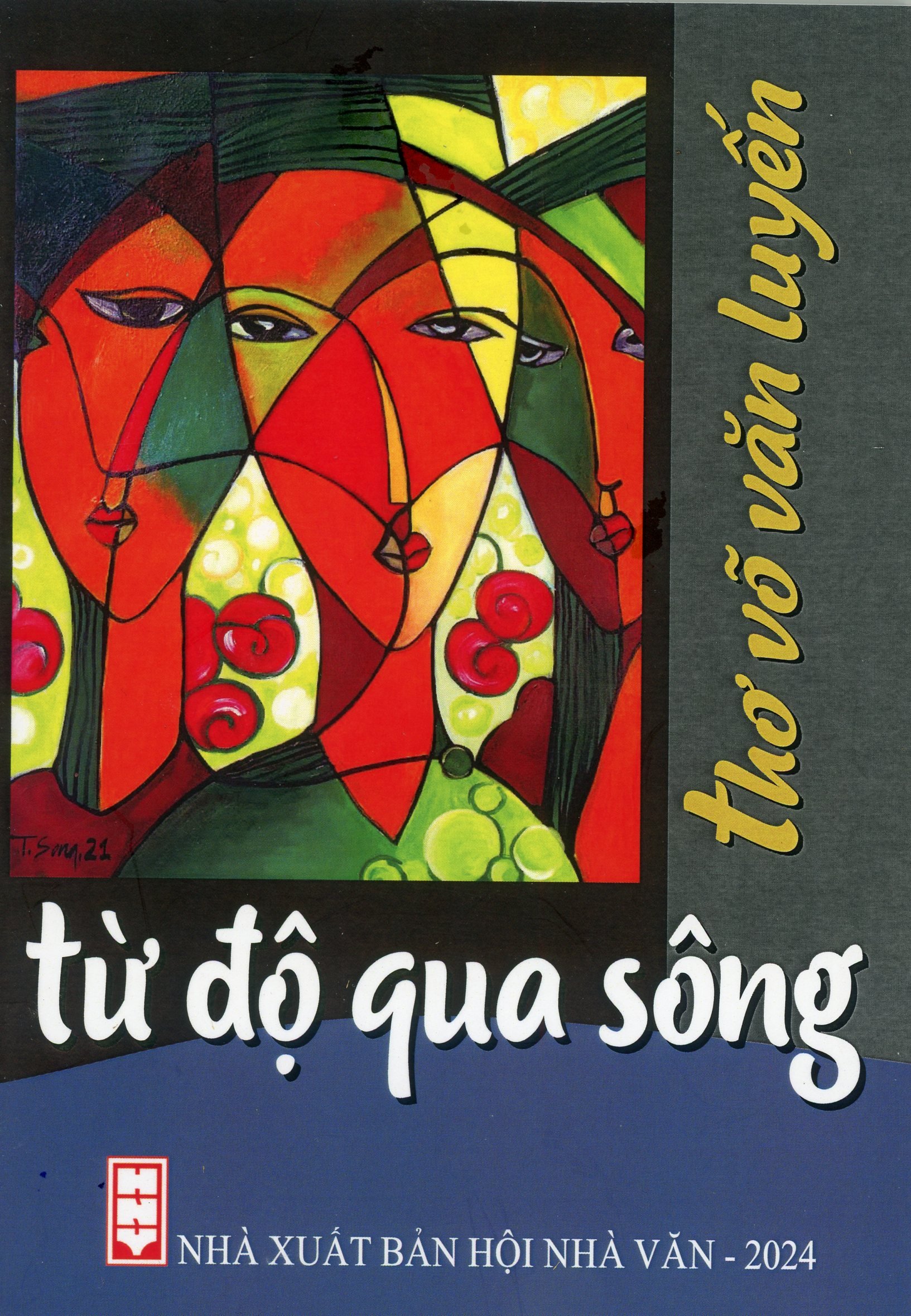
Poetry collection "Since Crossing the River" - Cover art: Thanh Song
For example, in the poem "Whispering to the Ancient City," the author begins: "The city rings with red bells / Carrying a blue plea / The ruins know how to enter the pages of history / Needing no one to be a witness for them." The verses are gentle, like a heartfelt confession about a spiritual place always shrouded in incense smoke in the community's heart, a memory of the entire nation even though more than half a century has passed.
Writing about war, loss, and sacrifice, yet overflowing with a yearning for peace, a message the poet entrusts: “A thousand reeds cut the horizon, bleeding/The day still clings to dreams of returning/That ancient citadel, a smile of the future/Even shattered, it cannot kill the vow.” “A thousand reeds cut the horizon, bleeding” is a line of poetry that explores and ponders, symbolic like a pang of pain, always reminding us, even when our hearts are calm and unwavering. “Then why be shy about loving each other anymore?/A burning kiss under the starlight/Imagining the ancient citadel again burning with a thousand degrees of fire/A hundred thanks to you, a thousand thanks to you.”
As the saying goes, when war is over, only love, compassion, and humanity remain as noble and eternal values.
The poem concludes with a whispered prayer that resonates from the left side of the heart. But the collection of poems shows innovations right from its seemingly simple form. First of all, none of the poems in the collection share the same title.
This is also the author's intention to break away from the familiar notion that there must be a "masterpiece" poem that names the entire collection. It is necessary to democratize all the works in the collection, so that readers are not influenced by the author's subjective perspective, and so that the movements of the individual elements of the poems are free.
Then there's the issue of not capitalizing the first letter of a line, not capitalizing after a period, each line of poetry not just being a single line but potentially multiple lines to create new meanings, breaking down the inherent limitations of poetry in both content and artistry; there are also instances where proper nouns are transformed into common nouns or adjectives...
All of them point towards an attempt at poetic innovation in the Neo-Formalist and Postmodernist styles. Examples of poems following this direction include: *The Choice*, *The Chairs on the Wall*, *Beside the Bridge of Life and Death*, *The Night Still Frows*...
The poem "The Choice," with the dedication "Dedicated to a postmodern poet," is such an experiment: "A cluster of herbs falls in the night / A pungent scent / The wind and horse release a dream of escaping / The mountain transforms, a hand of leaves waving / Metaphysical paradox."
The first two lines present a superficial association in the poem, but by the next two, the semantic "connection" has gradually blurred, becoming mere symbols, like fireflies flickering in the night. The final line of the poem is a concise summary carrying a challenge to language: "The parables no longer dwell beneath the grass / patient and solitary / where can they hide the demand for light of fire / the thick veil of darkness?"
The poem, like a solitary self in the dark night, is paradoxical: simultaneously wanting to reveal and conceal within a state of mind that is both obscure and mysterious, like a sphinx riddle. "wrestling with dizzying signals / arranging the world in a game of guessing words / as a choice about existence / waiting for tomorrow."
The ending is like an experience of contemporary human philosophy, reflecting the state of mind and emotions of today, at least that of the author himself. It is concise, concentrated, and naturally not easy to understand, given the writer's desire to explore and break the mold.
It demands a different way of feeling, a different way of understanding, and even co-creation, as contemporary critics often say. It's easy to draw a parallel to Nguyen Gia Thieu's poem: "The spinning top is already flicked up to the sky / Faint human figures like people walking in the night." Like poetry, like its readers.
The poem "Chairs on the Wall" is similar. Please note that the chairs are on the wall, not chairs in the room; they are not concrete reality but rather imaginary images, reflecting the poet's fresh perspective and imagination.
Therefore, after discussing the "virtual chairs" in human life, the poet concludes with a strange ending, as peculiar as the poem itself: "Oh, wonderful chairs! / They reveal the essence of wisdom / They liberate the bottomless realm / They thank boundless creation / They leave me standing still."
That's right, the virtual chairs are also very real, even though they change unpredictably, bringing countless surprises. Only humans, specifically the author here, remain still and are therefore left out of the game because they cannot keep up with the chairs, or because they want to fixate on a concept, a way of seeing things... There are many explanations; the poem ends but reveals many other things.
When poetry crosses the river, it's like a magpie crossing the river, or like a pawn transforming into something incredibly powerful and formidable. This brings to mind the most profound and esoteric classic, the I Ching. The second-to-last hexagram is Ji Ji, meaning the task is completed (like crossing the river), but the final hexagram is Wei Ji, meaning the task is not yet finished (not yet crossing the river).
It seems paradoxical, yet it is very logical, emotional, and full of wisdom. Perhaps the journey of poetry, including the poetry of poet Võ Văn Luyến, is similar. Congratulations to the poet on his new work, his new creativity, and for leaving such a significant impression on his journey with the Muse, and first and foremost on the poetry of Quảng Trị.
Pham Xuan Dung
* “From the moment we crossed the river” - a poetry collection by poet Vo Van Luyen, Vietnam Writers Association Publishing House, 2024.
Source: https://baoquangtri.vn/khi-tho-da-sang-song-189097.htm





































































Comment (0)