Official document 3175/BGDĐT-GDTrH of 2022 provides guidance: "In evaluating learning outcomes at the end of the semester, the end of the school year, and the end of the school level, avoid reusing texts already studied in textbooks as materials for constructing reading comprehension and writing tests to accurately assess students' abilities and overcome the situation where students only memorize lessons or copy content from available materials." However, model essays still exist due to various reasons.
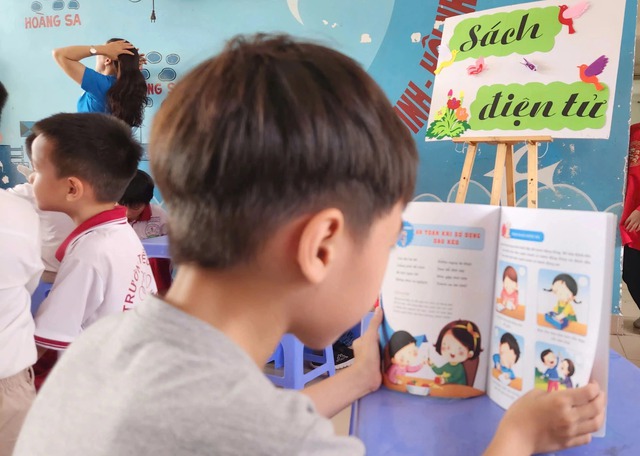
Cultivating a reading habit in students from a young age helps them expand their vocabulary, learn writing skills, express themselves creatively, and thus reduces their reliance on model essays when writing assignments.
Photo: Thuy Hang
There is still a gap between the guidelines and reality.
Circular 3715 encourages the development and use of open-ended questions in tests and assessments to maximize students' creativity. It also calls for the development of assessment tools to limit the subjectivity and emotional bias of graders. When commenting on and evaluating students' work, it is necessary to respect and encourage students' individual thoughts and feelings, while adhering to ethical, cultural, and legal norms.
However, current teaching methods and test-taking strategies do not truly aim to develop students' qualities and abilities. Much of the knowledge tested in literature tests and exams still focuses on reproducing knowledge from the old curriculum.
The grading guidelines for tests and exams are still heavily based on the answer key. This means that students who answer differently from the teacher's answer key will find it difficult to achieve high scores. Instructions like, "In your opinion," or "Please present your thoughts," are often followed by grading rubrics that strictly adhere to "the teacher's opinion."
Official document 3175 requires: "avoid reusing texts already studied in textbooks as source material for constructing reading comprehension and writing tests," but teachers in many schools currently follow the guidance while also being apprehensive. Although they comply with the rule of not using textbook material for test questions, they limit the number of works and specific questions to a few particular works before regular, periodic tests to allow students to prepare in advance.
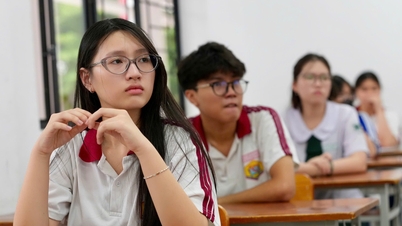
Before the exam, some teachers will thoroughly review literary works or pre-defined question types with their students. In addition, students also prepare by using tools like ChatGPT, Gemini, Roboki, or by having tutors do the exercises for them. Therefore, many students memorize sample answers and simply repeat what they have reviewed or prepared for during the exam.
Therefore, during periodic grading, even though the school arranged students in alphabetical order (A, B, C) and assigned unique codes to the test papers, most of the essays were very similar, closely following the teachers' answer key/grading guidelines.
Reasons why model essays still exist in secondary schools.

Although the new curriculum encourages creativity, current testing methods remain heavily formulaic. Many literature tests and exams still prioritize "correct answers" and "complete answers." This leads students to believe that the closer their answers are to the answer key, the easier it is to get a high score. In this case, model essays become the quickest way to earn points.
Furthermore, teachers are currently under pressure to meet the academic performance targets set by the school and subject departments at the beginning of the school year. In addition, entrance exam and graduation exam results are also among the criteria used to evaluate and rank teachers.
If teachers fail to meet targets, and the quality of teaching is not "equal to or higher than the previous year," they are essentially ineligible for awards and titles from the grassroots level upwards; they are also not eligible for consideration as outstanding civil servants. Meanwhile, these titles and annual civil servant rankings are closely linked to the rights and honor of teachers.
Therefore, many teachers are forced to have students practice according to "frameworks," "standard outlines," and even provide sample essays to help students achieve higher scores more easily.
Moreover, a significant number of students today read very few books and newspapers, resulting in a rather limited vocabulary. Some students lack vocabulary, life experience, and expressive abilities, so they often choose to memorize model essays for the sake of "safety." For students with average academic abilities, model essays become a "lifeline" to aim for an average (passing) grade.
Nowadays, a quick search on educational websites yields hundreds of sample essays, making copying incredibly easy. Furthermore, AI (artificial intelligence) is widely used; complete essays can be generated with just a command. With a large supply, the demand for its use also increases.
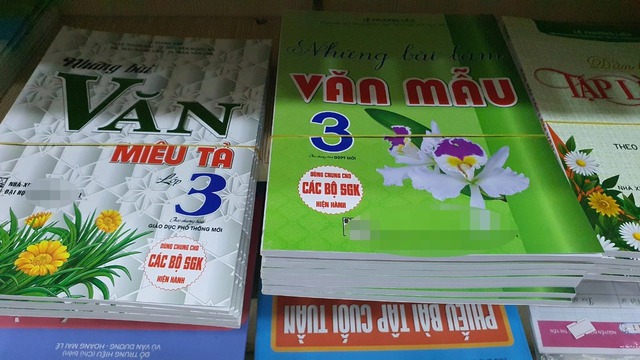
Sample essay writing guides are available in bookstores.
Photo: Thuy Hang
Solutions to reduce the use of template essays.
We all know that once model essays become "copied essays," it means students lose the ability to think independently, their writing lacks genuine emotion, and they become increasingly hesitant to be creative.
To reduce the prevalence of model essays, the first thing local literature councils and teachers need to do is innovate their essay writing and grading methods. Teachers should respect individual differences in writing, encourage personal experiences, and teach students to write from their own genuine thoughts instead of rote memorization.
In addition, literature teachers should guide students to improve their vocabulary, read regularly, and encourage those who write well and with emotion.



In particular, the criteria for evaluating and awarding commendations to civil servants at the end of the year need to be thoroughly studied, avoiding a situation where the quality of education at the end of the year must be "equal to or higher than the previous year" in order to be considered for individual or collective titles. The evaluation and ranking of civil servants should aim for transparency and the efforts of each teacher, rather than necessarily being bound by the quality of education.
The line between genuine quality and mere achievement is very thin. Some teachers who work diligently are not considered for awards, and instead receive reprimands and criticisms. As a result, teachers are forced to find ways to "improve" the quality of their teaching.
Source: https://thanhnien.vn/khi-van-mau-tro-thanh-phao-cuu-sinh-18526051310321044.htm


![[Image] National conference summarizing one year of operation of the overall organizational model of the political system, the three-tiered government model.](https://vphoto.vietnam.vn/thumb/1200x675/vietnam/resource/IMAGE/2026/07/01/1782882811691_ndo_br_1-jpg.webp)