

Along with its proven quality, demonstrated numerous times as the world's best-tasting rice, the brand is the "garment" that elevates the value of the rice grain.
The joys and sorrows of Vietnamese rice grains
For the past three consecutive years, rice exports have been a hot topic… Not only because it is a key export item, closely linked to the lives of millions of Vietnamese farmers, but also because of the extremely volatile export prices of this commodity.
Specifically, from September 2022, India imposed a ban on the export of 100% broken rice and subsequently restricted the export of all other types of rice in 2023 after low rainfall raised concerns about yields. Since then, the price of Vietnamese rice exports has continuously increased, peaking in 2024. The average export price of rice in 2024 reached US$627 per ton.
However, since India gradually eased its rice export ban from the end of 2024 until now, the price of Vietnamese exported rice has continuously decreased. Recently, at one point, the price of rice fell below $400/ton, nearly half of its peak in 2024. In early 2025, the supply to the world rice market is expected to increase to a record high of 532.7 million tons (according to the US Department of Agriculture , February 2025), continuing to put strong pressure on other exporters such as Vietnam and Thailand, especially in the lower-quality segment.
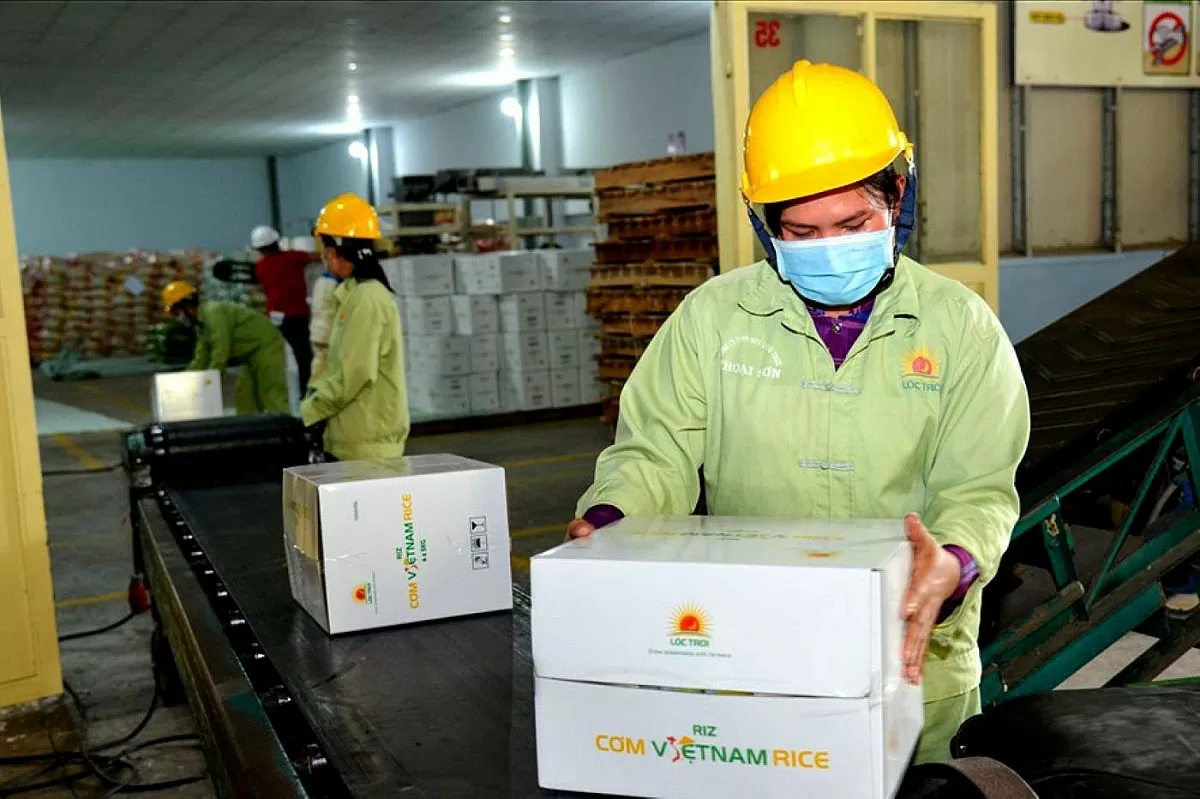 |
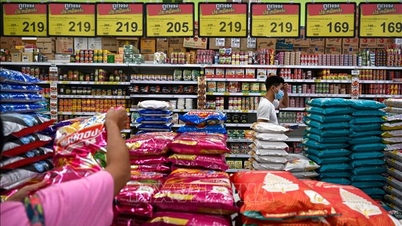
| Brand building has helped Loc Troi rice maintain very high prices (Photo: Loc Troi Group) |
While price fluctuations are a normal part of the market, the volatility of this particular commodity was predictable and continues to raise thought-provoking issues.
It is worth remembering that in 2023, when India and several other countries intensified their rice export bans, at the 2023 Rice Export Management Conference, Minister of Industry and Trade Nguyen Hong Dien expressed deep concern about the current weak linkage between farmers and rice export businesses. The Minister emphasized that, in the context of a volatile rice market with many markets imposing export restrictions, businesses must establish and strengthen close and effective cooperation mechanisms between production forces (growing regions, farmers) and rice export businesses, and among rice export businesses themselves, to avoid breaches of contracts, unfair competition in buying and selling, and market competition that could destabilize the rice market.
At the meeting on the establishment of the Vietnam Rice Export Council in August 2024, just as the price of Vietnamese rice exports was soaring, the head of the Ministry of Industry and Trade was once again grappling with another issue: the branding of exported rice. Due to the lack of branding, despite exporting large quantities at high prices, Vietnamese rice still faces many risks, especially the risk of not being able to maintain stable prices.
Positioning the value of Vietnamese rice through branding.
Regarding brand storytelling, this is nothing new. To successfully build a rice brand, quality is the essential condition. So, what is the current quality of Vietnamese rice?
According to the latest report from the Ministry of Agriculture and Environment, currently, 80% of Vietnam's rice exports are high-quality rice. Specifically, white rice (approximately 71%, average price 523-540 USD/ton) is mainly exported to the Philippines, Indonesia, and Africa; fragrant rice such as Jasmine, Dai Thom, ST24, and ST25 (19%, price 640-700 USD/ton) is mainly exported to the EU, the United States, China, and Japan. Glutinous rice (6%) is exported to China, the Philippines, and some other Southeast Asian countries. Japonica rice and other specialty rice (4%) are mainly consumed in Japan, South Korea, and other high-end markets…
Along with high-quality rice, Vietnamese rice has been recognized many times as the best rice in the world, especially ST 25. Vietnamese rice has entered Europe under the brand Vietnam Rice, selling for up to 4,000 Euros per ton. Vietnamese rice under the ST25 AAN and Japonica-AAN brands of Tan Long Group has also entered Japanese supermarket chains, selling at a considerable price.
Therefore, Vietnamese rice fully meets the necessary conditions…
So what about the sufficient conditions? What does Vietnam have? That is the trade promotion and facilitation solutions from the relevant authorities.
As can be seen, rice is one of the key commodities for which the Ministry of Industry and Trade is implementing trade promotion solutions. Deputy Minister of Industry and Trade Nguyen Sinh Nhat Tan affirmed that, in its role as a state management agency, the Ministry of Industry and Trade is always committed to promoting rice exports and considers rice a key commodity in the implementation of export promotion activities.
For example, at the annual Vietnamese Goods Fair organized by Vietnamese trade missions abroad, rice is always a central product. The image of Vietnamese rice is not only showcased in the form of small, pristine white bags bearing Vietnamese brands, but also cleverly presented through authentic Vietnamese dishes such as sticky rice, banh chung (Vietnamese rice cake), vermicelli, and pho... In this way, the image of Vietnamese rice grains naturally enters the minds of consumers in host countries.
The quality is already there, national-level trade promotion activities have been implemented, so what is Vietnamese rice still lacking? Perhaps what is missing is motivation from businesses. Motivation to build their own brands through quality, value, and the beautiful stories behind them…
Moreover, the sad reality remains that some businesses are still competing fiercely in buying and selling, driving already low rice prices even lower. The victims are not only the businesses, but also the farmers who work tirelessly to produce this rice…
Looking at the lessons from Loc Troi, Tan Long, etc., it's clear that building a rice brand is a long and costly process. However, a brand is an intangible value that makes consumers willing to pay a higher price for the product. A brand also affirms the product's position and the nation's image in the market. Furthermore, a brand ensures that rice maintains its value in the market, helping to mitigate some of the "price storms."
At the Conference on Rice Production, Market, and Salinity Control in the Mekong Delta held on March 7th, Deputy Prime Minister Tran Hong Ha once again instructed the Ministry of Agriculture and Environment to coordinate with the Ministry of Science and Technology to urgently develop a strong national rice brand strategy, including copyright registration and geographical indications, to promote trade and open new markets. It is clear that the issue of branding for rice is more urgent than ever. This is the "new look" for Vietnamese rice, allowing it to regain its true value on the world rice map.
| Rice exports in the first two months of 2025 are estimated at 1.1 million tons (up 5.9%), with a value of 613 million USD (down 13%). The average export price of rice is estimated at 553 USD/ton (down 18% compared to the same period). |
Source: https://congthuong.vn/khoac-ao-moi-cho-hat-gao-viet-377661.html

















































































Comment (0)