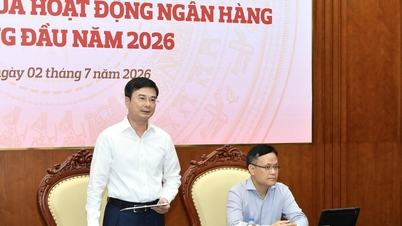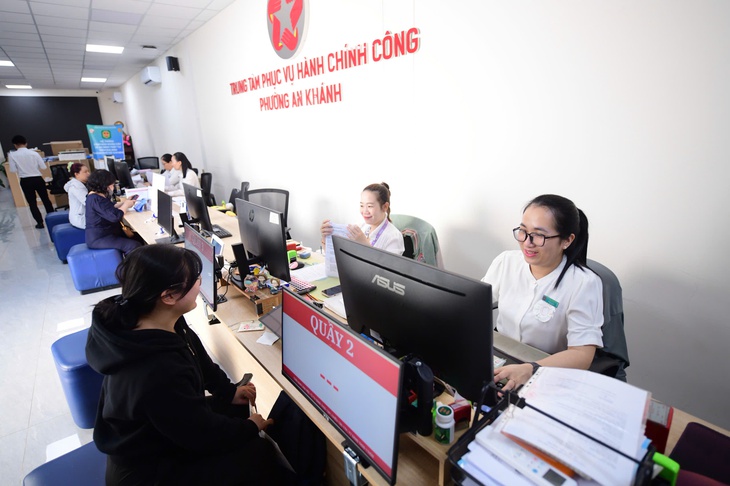
Citizens carry out administrative procedures at the An Khánh Ward Public Administrative Service Center, Ho Chi Minh City, on the morning of June 15 - Photo: QUANG ĐỊNH
Initial assessments indicate that much work remains to be done. However, from the perspective of the people, the most noticeable change is the positive shift in the service spirit of civil servants and public officials in government offices, especially at the ward and commune levels – the closest to the people.
We once witnessed an administrative system that society still complains about with the phrase "administration is paramount." It may seem a bit exaggerated, but there are reasons why that saying persisted for so many years.
Many people still remember the relatively common image of indifferent "officials" when meeting the people, speaking curtly and coldly in a language that made no distinction between old and young, big and small.
Their rigid, principled way of working, ignoring the people's pleas and explanations, sometimes even making unreasonable demands like "you need a house to get a household registration, but you need a household registration to have a house," not to mention all the tricks they come up with to demand the "first" procedure (where's the money?).
Many years ago, the State implemented numerous measures to address the problem of bureaucracy, ranging from ideological education and creating citizen feedback registers to deploying hotlines and implementing the "one-stop shop" model...
But change was very slow, until recently when significant progress was made with the reduction of one level of government and several bureaucratic layers.


There are many reasons that have strongly impacted the way officials interact with the public in government offices over the past year, but perhaps the screening process through mergers has yielded practical results. Of course, not all problems remain, but we must now recognize that the working methods in government offices are now far more different than before.
The ward/commune offices are more spacious and cleaner; some even provide drinking water for people going through administrative procedures. Most impressive of all is the question: "What would you like to do, sir/madam/madam/gentleman?"
People are no longer left feeling lost and bewildered, having to go from place to place to find out where their requests will be processed. It can be said that smiles, cheerful gestures, and a patient, attentive attitude have returned to the faces of most grassroots officials who interact with the people.
Although administrative procedures are still cumbersome and bottlenecks remain, people feel less tired and frustrated when dealing with officials who have a friendly attitude and understand the difficulties of everyday life.
Belief in the regime and new policies doesn't just stem from grand gestures; sometimes, it's deeply ingrained in people's minds by small, friendly acts and simple, thoughtful gestures.
However, the remnants of an administration criticized for being overly bureaucratic cannot be eliminated in a year.
Bureaucracy, abuse of power, and indifference still persist in some places. The authority, functions, and geographical scope of the grassroots level are currently very large, but up to 80% of the personnel are old employees who are having to handle a significantly increased workload due to the vast area. Many localities lack qualified and competent officials suitable for the new tasks.
Meanwhile, the information technology infrastructure is not yet fully developed and lacks complete data; the decentralization and delegation of authority are still unclear in some areas; and although some administrative procedures have been reduced and eliminated, they remain cumbersome...



All of these factors easily lead to a decline in the quality of public service, easily give rise to attitudes of contempt for the people, and even fanaticism about personal power.
As the saying goes, every reform is complicated and arduous, especially when hampered by outdated practices. Many problems remain to be overcome, but at least some bright spots have emerged. The crucial point is to prevent the resurgence of old habits, particularly the "action-oriented" mentality.
Source: https://tuoitre.vn/khong-de-hanh-la-chinh-tai-sinh-100260627092307911.htm