

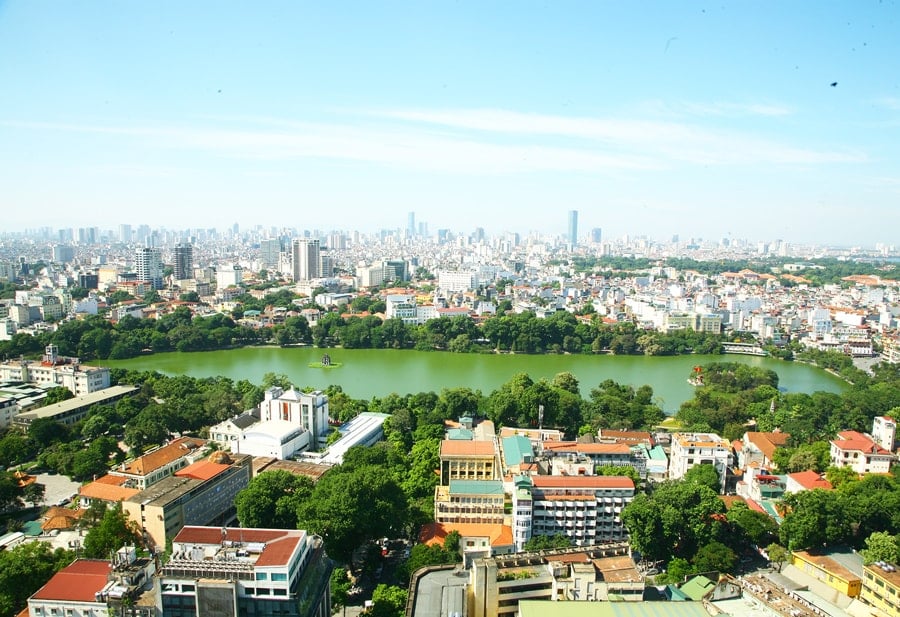
Hoan Kiem Lake viewed from above. Photo: Linh Tam
During the Ly and Tran dynasties, Hoan Kiem Lake was located north of Luc Thuy Lake. The lake lay outside the dike, stretching all the way to the beginning of Lo Duc Street. The dike and ramparts surrounded Thang Long citadel, starting from Hang Than Street and passing through Hang Duong, Hang Ngang, Hang Dao, Hang Trong, and what is now Le Thai To Street... Traces of the dike still remain. Bao Khanh Street is the slope from the dike down to the lake. To the east was a floodplain, but during the Tran dynasty there was the Pho Giac Pagoda. Around the latter half of the 18th century, a small temple appeared dedicated to the three founding masters of war elephant training.
During the Le Trung Hung period, a new dike was formed, running from Hang Dau Street through Nguyen Huu Huan and Ly Thai To streets to the beginning of Tran Hung Dao Street, so Luc Thuy Lake was located within the dike. Lord Trinh Giang ordered the construction of a palace southwest of Luc Thuy Lake (corresponding to the area at the beginning of Quang Trung Street) and built a road from the palace to the east side of the lake, thus dividing Luc Thuy into two parts. The upper part was called Ta Vong (later known as Hoan Kiem Lake). The lower part was called Huu Vong (also known as Thuy Quan Lake). Lord Trinh Giang also ordered the construction of Khanh Thuy Palace on Ngoc Island (now Ngoc Son Temple) and the construction of a small Ta Vong pavilion on Turtle Hill (now the location of Turtle Tower) as a place for recreation, fishing, and parties.
At that time, small villages formed around Hoan Kiem Lake. During the Nguyen Dynasty, the king ordered the construction of new dikes in the location where they stand today. Hoan Kiem Lake was surrounded by villages. In 1846, Bao An Pagoda was built to the east (the location of the Hanoi Post Office today).
In 1865, the renowned scholar Nguyen Van Sieu undertook the renovation of the old, dilapidated temple, constructing the Inkstone Platform and the Pen Tower – symbols of Thang Long, the land of learning. The tower is 28 Vietnamese cubits high according to the measurement standards issued during the reign of Emperor Minh Mang. If converted to Western units of measurement, the Pen Tower is over 10 meters high, making it the tallest point in the area.
In his book "A Campaign in Tonkin," Dr. Hocquard, who accompanied the expeditionary army, described how, in 1883, the villages were densely populated along the lake's edge. They "bathed, washed vegetables, and rinsed rice in the lake." The villages were connected by narrow dirt roads.
In 1888, Hanoi became a French concession. The government planned to renovate the old quarter, building new streets east and south of Hoan Kiem Lake in the style of Western urban planning. To build the Governor's Office (now the People's Committee of Hanoi City), they relocated Pho Giac Pagoda to Ngo Si Lien Street, demolished Bao An Pagoda, and built the Post Office. Simultaneously with the construction of administrative buildings, the government relocated residents' houses around the lake to make way for roads; demolished Phuc To village communal house to build the police headquarters (later the Hoan Kiem District Police headquarters, now the Hanoi City Police headquarters - Hoan Kiem headquarters).
The road was inaugurated during Tet (Vietnamese New Year) in 1893. On the inauguration day, the authorities organized many folk games. On the shore, there were wrestling matches, blindfolded pot-breaking games, and climbing greasy poles. On the lake, there were coracle boat races and duck catching. Between the Post Office and the Governor's building, the authorities built a flower garden, initially called the "Four Buildings Flower Garden" (now the Ly Thai To Flower Garden). In the flower garden, in 1893, they built an octagonal house for visitors to rest. On Saturday evenings, the French military band often played music there, so it was also called the "Bandstand".
The inauguration of the road around Hoan Kiem Lake in 1893 can be considered the year that marked the formation of Hanoi's first recreational area. In 1895, when the Hoan Kiem Lake Power Plant (now the Hanoi City Electricity Corporation, 69 Dinh Tien Hoang Street) was inaugurated, the government replaced the oil-fired lampposts with electric lights.
From then on, Hoan Kiem Lake and the surrounding area became a public recreational space. To harmonize the landscape and prevent the lake from becoming a pond, the authorities at the time issued a decree on the height of buildings facing the lake. Both residential and public buildings were only permitted to be two stories high; in exceptional cases requiring higher construction, approval from the Governor's Court was required. Therefore, in the first half of the 20th century, only a few three-story buildings existed around the lake, including: the building at 93 Dinh Tien Hoang Street and the Tuong Lai Bac Ky newspaper office (now the Hanoi Moi newspaper office).
After 1954, the regulations of the French government were rendered ineffective. However, from that year onwards, no new buildings were constructed around Hoan Kiem Lake. In 1971, the Chinese government provided aid to build a new post office building for Hanoi. This building, inaugurated in 1976, is 51 meters long and three stories high. In the 1980s, the headquarters of the Hanoi People's Committee was rebuilt, taller than the old office building.
After the Doi Moi (Renovation) period, in the 1990s, the "Shark's Jaw" building was constructed on the site of the tram operator's office and the 12 Hoan Kiem Department Store. Subsequently, several joint venture projects also sprang up, such as the Golden Hotel (opposite Thuy Ta store, now the headquarters of Bao Viet Group) and the General Department Store (the current Trang Tien Plaza shopping center).
From the late 19th century to the present day, the landscape around Ho Guom Lake has changed, but it has retained its role as the city center, a familiar place for recreation and entertainment for Hanoians and tourists alike.
Source: https://hanoimoi.vn/khong-gian-ho-guom-xua-va-nay-697244.html
![[Photo] Prime Minister Pham Minh Chinh receives the Director of RMIT University Melbourne (Australia)](https://vphoto.vietnam.vn/thumb/1200x675/vietnam/resource/IMAGE/2026/04/02/1775142120087_thiet-ke-chua-co-ten-2026-04-02t214220784-png.webp)






























































Comment (0)