For many years, university was considered the almost default choice for most Vietnamese students, as well as in other Asian countries. However, in many developed countries, especially in Europe, university is not the only path to success. Many countries have built high-quality vocational education systems that are respected by society and closely linked to the needs of businesses.

Experience from Germany, Switzerland, and many European countries shows that in the age of artificial intelligence (AI) and digital transformation, what determines career opportunities increasingly lies not in the title of a degree but in the practical skills that learners possess.
Nearly half of European students choose vocational training.
While many families in Asia still view university as the top goal after high school, vocational education is playing a much larger role in Europe.
According to the latest figures from the European Centre for Vocational Training Development, approximately 49% of high school students in the European Union (EU) are enrolled in vocational education programs. Notably, 72.6% of students in these programs are still able to continue their education at university if they wish.
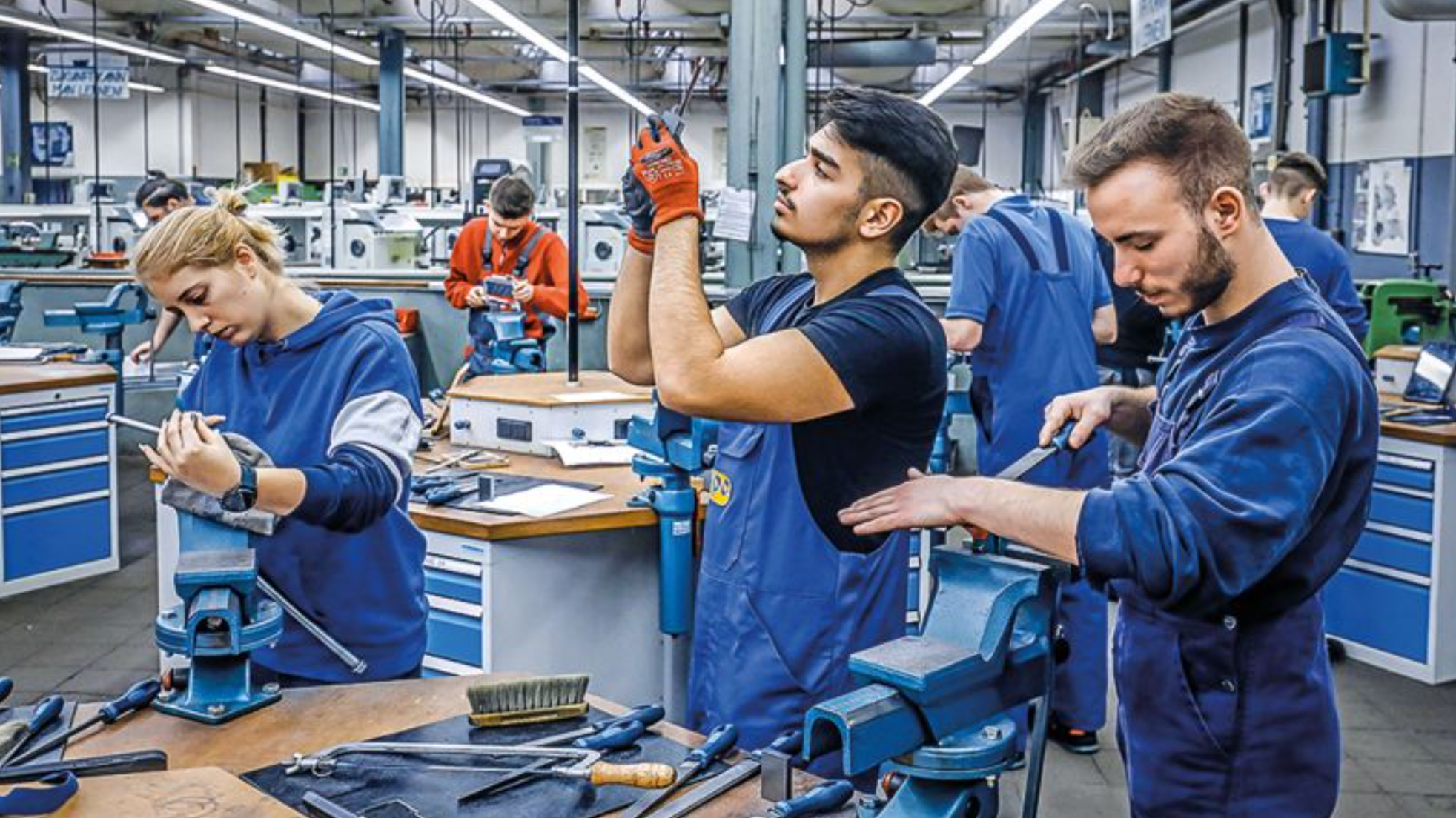
This shows that vocational training in Europe is not an option for students who cannot afford university. On the contrary, it is a formal, highly interconnected branch of education designed to directly meet the needs of the labor market.
The European Centre for Vocational Training Development also reported that 64.5% of graduates from vocational programs in the EU have participated in work-related learning. This rate even exceeds the target set by the European Union for 2025.
Germany: Over 1.2 million young people are pursuing vocational training.
Germany has long been regarded as a model of a modern vocational training system.
A key feature of the German model is its "dual vocational training" mechanism, where trainees both study at vocational schools and work directly in businesses. Trainees not only acquire knowledge but also earn income during their training period.




According to preliminary figures released by the German Federal Statistical Office in April 2026, by the end of 2025, Germany will have approximately 1.207 million trainees participating in the dual vocational training system. In 2025 alone, around 461,800 new apprenticeship contracts were signed.
These figures reflect the crucial role of vocational training in Europe's largest economy . Sectors such as precision engineering, industrial manufacturing, logistics, information technology, electronics, and healthcare all rely heavily on a workforce trained within this system.
Notably, many German companies are directly involved in the training process, as they consider this the most effective way to secure a workforce amidst an aging population and a growing shortage of skilled labor. This helps bridge the gap between education and the labor market.
Switzerland: The gap between vocational training and university education is narrowing.
While Germany is renowned for its dual education system, Switzerland is considered a leading country in elevating the status of vocational education.
According to the Education at a Glance 2025 report by the Organization for Economic Cooperation and Development (OECD), the Swiss labor market shows a relatively small difference in unemployment rates between those with vocational secondary education and those with university degrees compared to many other countries. In the 25-34 age group, the unemployment rate for those with secondary or post-secondary education (excluding university level) is 4.9%, while for those with university degrees it is 4%.

The income gap between the two groups is also lower than the OECD average. This makes vocational training an attractive option rather than a substitute for university education.
In many sectors such as precision engineering, high-tech manufacturing, hospitality, and financial services, apprentices in Switzerland can still achieve very competitive incomes and career opportunities.
The world is re-evaluating the value of academic degrees.
It is noteworthy that while higher education remains crucial, many developed countries are gradually changing their perspective on academic qualifications.



The OECD's Education at a Glance 2025 report shows that the proportion of young people with university degrees in OECD countries continues to rise, but governments are increasingly focusing on the quality of skills and their ability to meet job market demands, rather than simply expanding the number of university students.
The emergence of AI, automation, and green transformation is leading many businesses to prioritize practical capabilities, adaptability, and technological skills over academic qualifications alone.
In Europe, a shortage of skilled labor is occurring in many sectors, from industrial manufacturing and construction to renewable energy and healthcare. Meanwhile, many countries are facing the problem of graduates working in fields unrelated to their training or being unable to find jobs commensurate with their qualifications.
For many Vietnamese students, a university education remains a suitable and necessary option. However, international experience also shows that career success is not solely determined by whether or not one possesses a university degree.
In a rapidly changing technological landscape, the skills the job market needs today may be vastly different from what it will be in 5 or 10 years. The key is not just where you learn, but what you learn and how adaptable you are. In a world changing faster than ever before, skills can, in many cases, become a more important passport than academic qualifications.
Source: https://daibieunhandan.vn/khong-phai-ai-cung-vao-dai-hoc-10420452.html