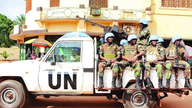
Multinational Joint Task Force (MNJTF) in the Lake Chad basin. Photo: AFP
The Sahel is a semi-arid transitional zone stretching 5,900 km from the Atlantic coast to the Red Sea, along the southern edge of the Sahara Desert. Amidst significant political instability, the conflict monitoring organization ACLED reports that since 2020, the area of the Sahel region affected by jihadist attacks has doubled.
This data coincides with a recent assessment by General Dagvin Anderson of the U.S. Africa Command, that the epicenter of global terrorism is now in Africa. Instead of being primarily concentrated in northern Mali as before, the scope of militant activity is shifting from rural to urban areas, including Mali's capital region, Niger, and even extending southwest to near Senegal and Mauritania.
The most powerful of these is arguably the extremist Islamic militant group Boko Haram, based in Nigeria. Known for its mass kidnappings, Boko Haram remains a formidable force nearly 20 years later.

Next is the self-proclaimed Islamic State (IS). After losing control of territory in the Middle East due to the turmoil in Afghanistan and Syria, 86% of IS's global operations in the first half of 2026 took place in Africa. While the terrorist organization al-Qaeda relied on extortion, kidnapping, and other illegal activities in the Sahel region to fund its operations, IS factions relied on indiscriminate terrorism (targeting civilians and civilian targets) as a core part of their extremist ideology.
Besides the two groups mentioned above, the Sahel region has also witnessed the rise of Jama'at Nusrat al-Islam wal Muslimeen (JNIM), which is linked to al-Qaeda. In recent years, JNIM has shifted its tactics of infiltrating the region through violence and politics, targeting the state more directly while filling the vacuum left by the government in rural areas.
The exact number of jihadists operating across West Africa is unclear, but the United Nations estimates it to be around 20,000. Between western Mali and eastern Nigeria lies an area spanning over 1 million square kilometers, yet finding a safe place is extremely difficult.
As jihadist elements challenged state control, extremist ideology also spread within controlled communities, especially in remote rural areas. For example, in the town of Nioro du Sahel, under the JNIM lockdown, women are now not allowed to appear with unfamiliar men and must cover their faces if they go outside, even to the fields.
In addition to tightened laws, the fear of robbery or murder stifles economic activity. In Mali and surrounding areas, armed groups have reached agreements with local leaders to collect taxes, often around 10% of harvests or income, in exchange for "protection." Farmers must pay these taxes if they want to farm. When they go to work in the fields, they also face the risk of kidnapping or even murder.
Despite the crisis extending beyond the Sahel region and spreading to northern Benin and Togo, coordinated efforts on the ground in West Africa remain limited and fragmented. Looking ahead, with the involvement of Algeria and Morocco in the Sahel, researcher Andrew Lebovich warns that jihadists could soon move into North African countries.



MAI QUYEN (According to AFP)
Source: https://baocantho.com.vn/khung-bo-thanh-chien-lan-rong-o-chau-phi-a208103.html